In the startup world, the term “MVP” (Minimum Viable Product) gets tossed around like confetti at a tech festival. Everyone says you need one, but only a few truly understand its purpose or how to execute it effectively.
Let’s cut through the jargon and take a straightforward look at MVPs - what they are, why they’re important, and how to build one that sets your product up for success.
What Is an MVP, Really?
An MVP (Minimum Viable Product) is the simplest, functional version of your product designed to validate a core idea by solving a specific problem for users. The primary goal of an MVP is to test critical assumptions about the product and its market fit. It’s not about delivering a stripped-down version of your vision but rather focusing on what is absolutely essential to verify the feasibility of your solution and its relevance to the target audience.
For example, the first version of Airbnb was a basic website where the founders rented out their apartment to test whether people would pay to stay in someone else’s home. As seen across numerous minimum viable product examples, this validated the idea and proved there was demand for such a service before investing in full-scale architecture.
See how successful startups turned simple ideas into real products.
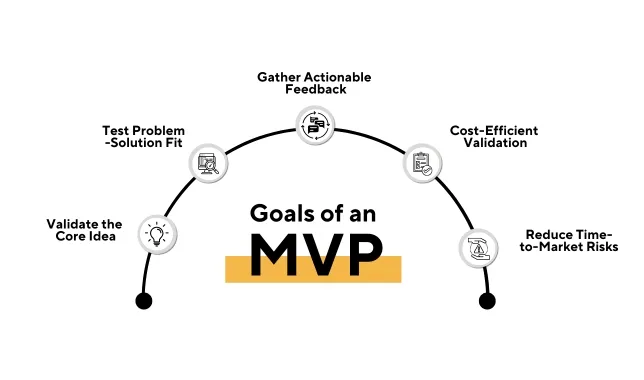
The Goals of an MVP
1. Validate the Core Idea
The primary purpose of an MVP is to validate the most critical assumption: does the problem exist in the market, and is your solution addressing it effectively? An MVP serves as a tool to test whether your idea resonates with your target audience and holds potential for success. By launching a simplified version, you gather real-world data that ensures you’re building a product that meets actual needs, not hypothetical ones.
2. Test Problem-Solution Fit
An MVP helps confirm whether your solution aligns with the problem it intends to solve. This involves determining if users can relate to the issue, understand your approach, and find value in your solution.
3. Gather Actionable Feedback
User feedback during the MVP phase is invaluable in shaping the product’s development. It identifies pain points, highlights missing functionalities, and validates existing features. Engaging directly with users through interviews, surveys, or usability testing allows you to refine your solution based on real-world needs rather than assumptions.
4. Cost-Efficient Validation
An MVP emphasizes lean methodologies to validate demand without incurring excessive costs. Keeping MVP development costs lean during early builds allows founders to test concepts with low-cost wireframes and interactive prototypes while minimizing financial risk.
5. Reduce Time-to-Market Risks
Launching a focused, essential version of your product ensures that you engage users quickly, gather insights, and pivot if necessary, all before investing heavily in full-scale development. Industry MVP statistics show that early user validation dramatically cuts the risk of building unwanted features and accelerates the path to product-market fit.
Learn how to measure market potential before you build.
The Anatomy of a Great MVP
1. **Focus on the Essentials
**An MVP is about doing less, but doing it right. Identify the one or two features that solve the user’s main problem and skip the extras for now. Think of it as putting the spotlight on what matters most. By focusing on essentials, you can launch faster and learn what really works.
2. Target AudienceYour MVP isn’t for everyone; it’s for those early adopters who need your solution the most. These are the people who will give you honest, actionable feedback. Narrowing your audience helps you create a product that feels tailor-made, which is key for building trust and engagement.
3. **Problem-Solution Fit
**If your MVP doesn’t solve a real problem, it’s just a nice idea. Dig deep to understand what keeps your audience up at night, and build a solution that addresses it directly. The goal isn’t perfection, it’s making sure your product resonates and delivers value from the start.
The Steps to Develop MVP
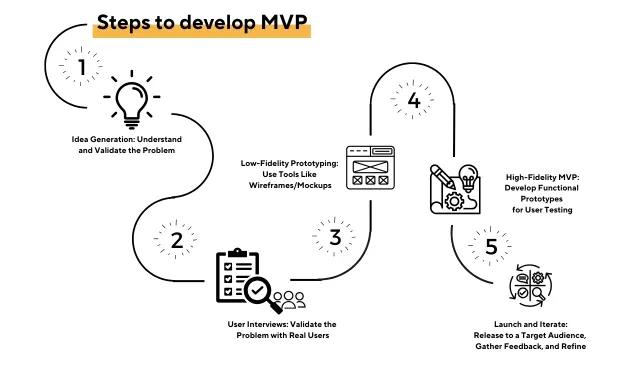
1. Idea Generation: Understand and Validate the Problem Every MVP begins with an idea, but the idea needs to solve a real problem. Start by researching the market, calculating market potential and TAM, identifying pain points, and exploring how to protect your app idea early. Validation at this stage ensures that your efforts are focused on creating something meaningful rather than chasing a hunch.
Tools: Google Trends, Statista, AnswerThePublic
2. User Interviews: Validate the Problem with Real Users To ensure your problem is worth solving, talk to potential users. Conduct interviews, surveys, or focus groups to understand their challenges, behaviors, and expectations. This helps you validate that the problem is real and your solution aligns with their needs, ensuring a user-centric approach.
Tools: Zoom, Google Meet, Calendly, Typeform, SurveyMonkey
3. Low-Fidelity Prototyping: Use Tools Like Wireframes/Mockups Before investing in development, create a basic visual representation of your concept to help turn your idea into an app. Use tools like Figma or Adobe XD to make wireframes or mockups that show the structure and flow of your product. These low-cost prototypes let you test the concept and gather feedback quickly.
Tools: Figma, Adobe XD, InVision, Balsamiq
4. High-Fidelity MVP: Develop Functional Prototypes for User Testing Once your low-fidelity prototype resonates with users, move to a more detailed, functional version. Transitioning into dedicated MVP software development allows you to observe how real users interact with your core functionality, bridging the gap between concept and reality.
Tools: Bubble, Adalo, Webflow, Thunkable, Firebase, GitHub
5. Launch and Iterate: Release to a Target Audience, Gather Feedback, and Refine Deploy your MVP to a small, focused audience of early adopters using targeted tester acquisition strategies. Collect feedback through surveys, analytics, or direct conversations to identify strengths and weaknesses. Use this feedback to improve your product iteratively, ensuring it evolves to meet user needs effectively.
Tools: UserTesting, Hotjar, Qualaroo, Google Analytics, Mixpanel, Amplitude
Understand the complete MVP process from planning to launch.
Common Pitfalls and How to Avoid Them
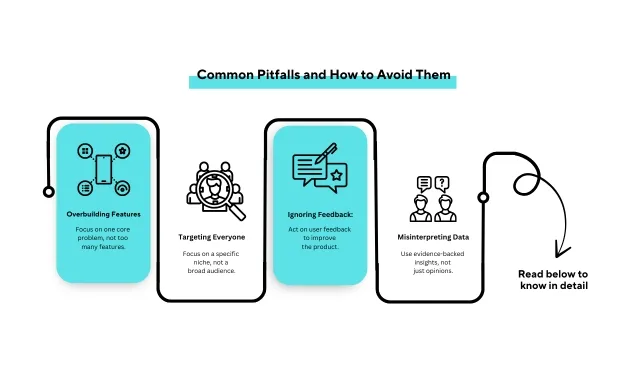
Navigating early-stage development is fraught with landmines. Understanding the top 10 mistakes to avoid before developing your MVP helps founders sidestep common resource traps:
1. Overbuilding Features
One of the biggest mistakes is trying to pack too many features into your MVP. Focus on solving a single, core problem rather than diluting your resources across unnecessary extras. This keeps development simple and ensures your product delivers clear value from the start.
2. Targeting Everyone
Trying to appeal to a broad audience often leads to a generic product that resonates with no one. Instead, focus on a niche audience that feels the problem acutely. This targeted approach helps you create a solution that truly meets their needs and stands out.
3. Ignoring Feedback
Your users are your greatest resource, and their feedback is invaluable. Ignoring their input risks building a product that misses the mark. Actively listen, analyze patterns in their responses, and use their insights to refine and improve your MVP.
4. Misinterpreting Data
Not all feedback is actionable, and misreading data can lead to bad decisions. Distinguish between opinions and trends backed by evidence. Focus on measurable behaviors and validated insights to guide your product development effectively.
Real-World MVP Success Stories
1. Dropbox
Dropbox didn’t start with a fully developed file-sharing platform. Instead, they created a simple explainer video that demonstrated how their product would work. This video generated significant interest and validated demand before they built the actual platform, saving time and resources while confirming their idea had potential.
2. Airbnb
Airbnb’s MVP, as already mentioned, was as simple as it gets: a basic website that offered their own apartment as a short-term rental with air mattresses for guests. This humble start allowed them to test whether people were willing to pay to stay in someone else’s home. The idea resonated, and the rest is history. Exploring detailed breakdowns in our guide to top SaaS MVP examples shows how today’s leading platforms began with similarly lean, hyper-focused prototypes.
3. Zappos
Zappos began by testing whether people would buy shoes online. Instead of building a full e-commerce platform, the founder listed shoes from local stores and manually purchased and shipped them when orders came in. This low-cost MVP validated demand and paved the way for a scalable business model.
Discover the key strategies for launching your MVP successfully in 2026.
Measuring Success: Metrics That Matter
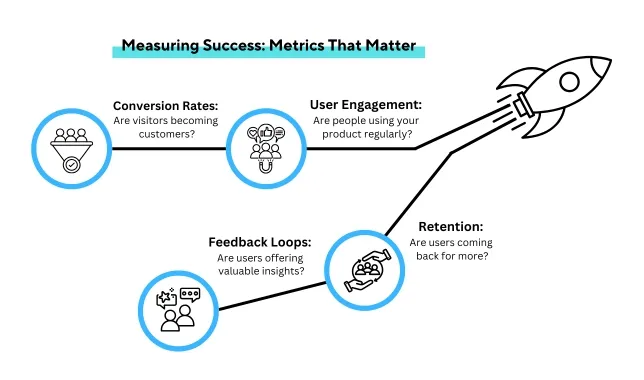
Tracking the right qualitative and quantitative benchmarks prevents founders from mistaking vanity numbers for true product validation:
- Activation Rate & Onboarding Completion: The percentage of signups who experience your product’s core “aha!” moment during their first session.
- Retention & Churn: Cohort retention curves indicate whether users return repeatedly or abandon the product after trial.
- Customer Acquisition Cost (CAC) vs. Lifetime Value (LTV): Measuring acquisition spend relative to monetization—vital when evaluating app marketing costs and determining sustainable business models like how free apps make money.
- Qualitative Feedback Loops: In-depth user interviews and direct surveys uncover user friction points that cold analytics cannot explain.
Final Thoughts
When you try to launch everything at once, you risk building something no one truly needs. An MVP keeps things simple, just enough to test the waters, gather feedback, and find your direction. It’s not about shortcuts; it’s about focus.
By tackling the essentials first, you save time, reduce risk, and give yourself space to adapt. Whether you choose to collaborate with vetted product development companies or build internally, the best products aren’t born fully formed—they evolve with insight, effort, and continuous iteration.
Start with what matters, learn as you go, and let your users guide the journey.
Turn your startup idea into a working MVP with expert development support.