Building before validating is how most startups die quietly. They spend six months and $80,000 building a product for a market that does not exist, or is too small to sustain a business, or is already locked up by a competitor with a ten-year head start.
Understanding how to calculate market potential is not optional if you are serious about your startup. It is the first real test of whether your idea is worth building — and the data is stark: 42% of startups fail simply because there was no market need for what they built.
This guide will walk you through the complete framework, including how to run a TAM SAM SOM calculation for your startup, what the numbers actually tell you, and how to use this analysis to make smarter decisions about your MVP scope.
What Is Market Potential and Why Does It Matter Before Your MVP
Market potential is the total revenue opportunity available if your product captured 100% of its target market. No product ever captures 100%, but that ceiling number matters because it tells you whether the market is large enough to justify the investment.
A market that supports a $2 million business is not the same as one that supports a $200 million business. Your investors, your team, and your development decisions all depend on which one you are building for.
Market potential analysis before building your MVP does three critical things:
-
It validates that demand exists at a scale worth pursuing.
-
It shapes your MVP scope by clarifying which user segment to prioritize first.
-
It anchors your investor conversations in real numbers rather than optimism.
The TAM, SAM, and SOM Framework Explained
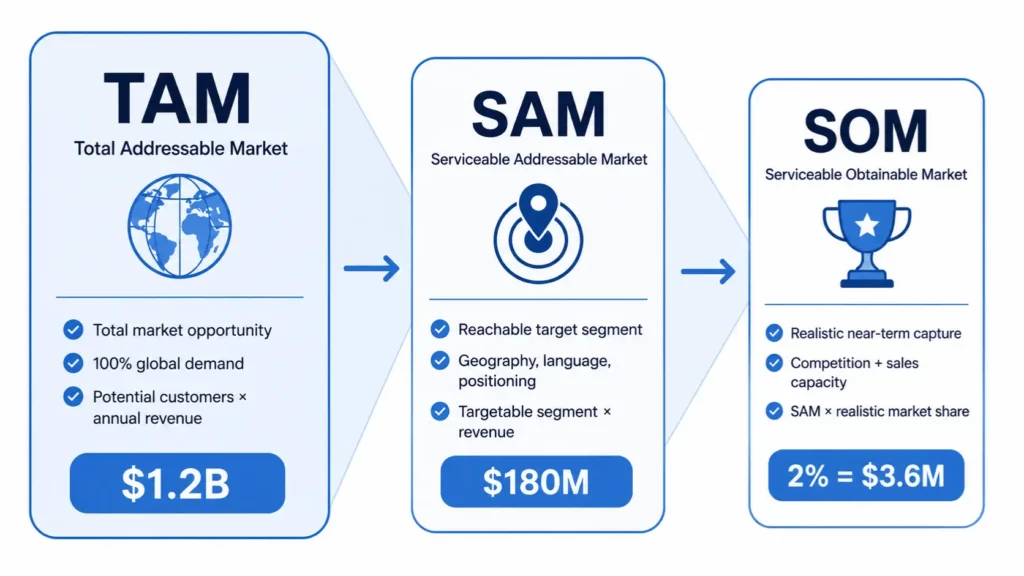
The most widely used framework for how to calculate market potential is TAM, SAM, and SOM. Here is what each term means and why the distinction between them matters.
TAM: Total Addressable Market
TAM is the total revenue opportunity if your product achieved 100% market penetration globally, with no competition and no constraints. It is the theoretical ceiling.
Total addressable market formula:
- TAM = Total number of potential customers x Average annual revenue per customer
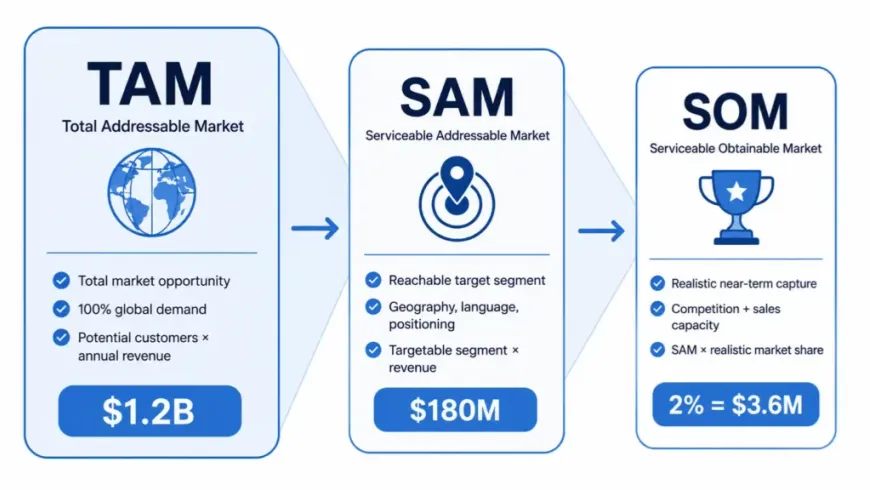
Example: If you are building a restaurant management platform and there are 1 million restaurants globally, each paying $1,200 per year for your tool, your TAM is $1.2 billion.
SAM: Serviceable Addressable Market
SAM narrows TAM to the portion of the market you can realistically reach given your geography, language, go-to-market model, and product positioning.
Serviceable addressable market formula:
- SAM = TAM segment you can realistically target x Revenue per customer in that segment
Using the same example: if you are targeting independent restaurants in English-speaking markets with under 10 locations, that narrows your universe to perhaps 150,000 restaurants and a market of $180 million.
SOM: Serviceable Obtainable Market
SOM is the realistic slice of SAM you can actually capture in the near term, accounting for competition, sales capacity, and market timing.
SOM formula:
- SOM = SAM x Realistic market share capture percentage
If you can realistically capture 2% of your SAM in the first three years, your SOM is $3.6 million. That is your near-term revenue ceiling and the number that determines whether your business model is viable at the early stage.
Also read: MVP launch strategies
How to Calculate Market Potential: Step-by-Step
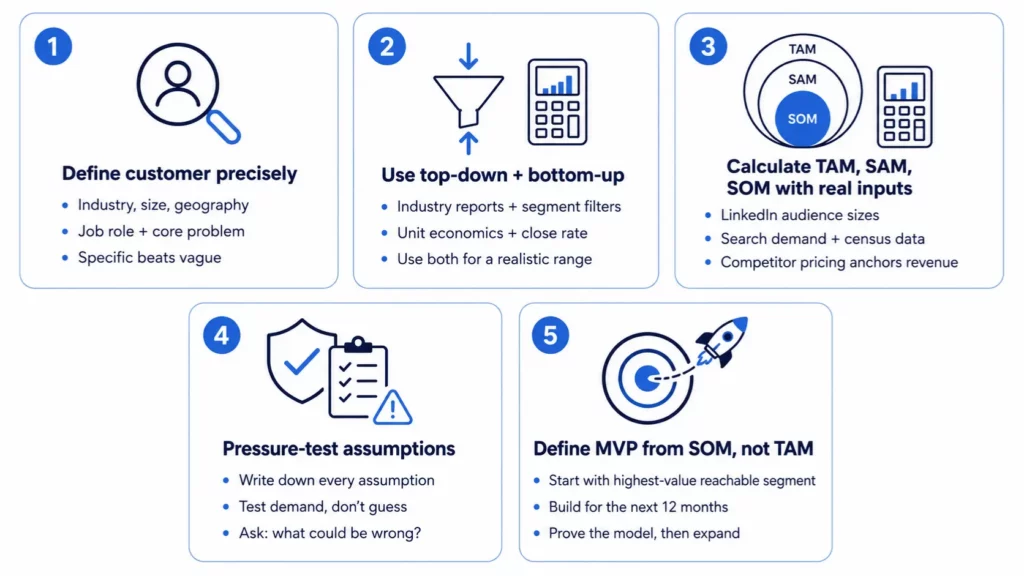
Step 1: Define Your Customer Precisely
Vague market definitions produce useless numbers. Before you calculate anything, write a one-paragraph description of your exact target customer: industry, company size, geography, job role, and the specific problem they have that your product solves.
The more specific this is, the more credible your market calculation becomes.
Step 2: Use Top-Down and Bottom-Up Approaches Together
Top-down starts with industry reports and narrows to your segment. Bottom-up starts with your actual unit economics and scales up. Using both gives you a range to work within rather than a single number you invented.
-
Top-down: Find industry market size data from reports like Statista, Grand View Research, or IBISWorld. Then apply your segment filters to arrive at your specific opportunity.
-
Bottom-up: Estimate how many customers you could realistically close per month, multiply by annual contract value, and project forward three years.
Also read: Cost to develop an MVP
Step 3: Calculate TAM, SAM, and SOM Using Real Inputs
Do not guess. Use LinkedIn to estimate audience sizes. Use keyword search volume to measure demand signals. Check government or industry census data for total business counts. Look at competitor pricing pages to anchor your revenue per customer estimate.
Step 4: Pressure-Test Your Assumptions
Every TAM SAM SOM calculation for a startup is built on assumptions. The discipline is in challenging each one. CB Insights research shows that 35% of startups fail because there is no market need. That means the assumption of demand was never properly tested. Write down every assumption in your model and ask: what would have to be true for this to be wrong?
Step 5: Define Your MVP Based on the SOM, Not the TAM
This is where market potential analysis directly informs product decisions. Your MVP should solve the core problem for your highest-value SOM segment first. Not the full TAM. Not your broadest vision. The smallest, most valuable, most winnable customer segment.
Build for the people you can actually reach and close in the next 12 months. Expand after you have proven the model.
Does your startup idea have a viable market behind it?
EnactOn’s discovery process helps you pressure-test your market assumptions before committing to development. Walk away knowing whether your idea is worth building and what to build first.
Talk to a Solution Expert
Common Mistakes in Market Potential Analysis
Using the full TAM as if it were your target
Saying your market is a $50 billion industry does not tell anyone whether your business is viable. Investors and serious founders care about the SOM. That is the number that tells you whether you can build a real business in a real timeframe.
Relying only on third-party reports
Industry reports give you context. They do not give you accuracy. Always validate with primary research: customer interviews, competitor pricing research, and direct signals from the market like search demand and waitlist signups.
Ignoring competition when sizing SAM
SAM calculations that ignore existing competitors are fiction. If three well-funded competitors already serve your target segment, your realistically achievable share is not 20%. It is much smaller unless you have a genuine and defensible differentiation.
Confusing revenue potential with profit potential
A large market does not guarantee profitability. Account for customer acquisition cost, churn rate, and the cost of delivery when deciding whether a market size number translates into a viable business.
How Market Potential Analysis Shapes Your MVP Scope
Once you understand your market potential, the MVP question becomes much simpler. You are not building for the $1 billion TAM on day one. You are building the minimum product that convinces your SOM segment to pay, stay, and refer. According to Failory, 90% of startups fail. Most of them had great ideas. Many of them had capable developers. What they lacked was the discipline to validate market size and align their product scope to a winnable early-stage market.
Market potential analysis before building your MVP is not a box to check. It is the foundation that determines whether you build the right product for the right market at the right scope.
When you bring those validated numbers to a development partner, you make their job easier and your outcome more predictable. From there, a structured MVP development process ensures those insights directly shape what gets built in version one — and what gets cut.
They can design a system at the right scale, for the right users, without overbuilding for a market that does not exist yet.
Conclusion
Market potential is not a slide deck exercise. It is the analytical foundation of every good product decision you will make. Before you scope your MVP, before you hire a development team, and before you raise a round, you need to know exactly what market you are entering, how large the realistic opportunity is, and how you will win the first 2% of it.
Run the TAM SAM SOM framework with real inputs. Pressure-test every assumption. Define your SOM segment before you define your product. Then build the MVP that proves you can win that segment.
EnactOn starts every engagement founder-first, with your market, users, and intent before a single feature. Our AI-first process accelerates the build while keeping experienced engineers in the loop on every architectural call. When your numbers are validated and you are ready to build for the right segment, we can help.
Check our MVP development services now.
FAQs
What is the difference between TAM, SAM, and SOM?
TAM (Total Addressable Market) is the entire theoretical market if you had 100% share. SAM (Serviceable Addressable Market) is the portion you can realistically reach given your geography, language, and go-to-market model. SOM (Serviceable Obtainable Market) is the realistic share you can capture in the near term given competition and your current resources. For early-stage startups, SOM is the only number that drives real product and business decisions.
How accurate does my market size calculation need to be?
It does not need to be exact. It needs to be credible and defensible. Use multiple data sources, triangulate top-down and bottom-up approaches, and document every assumption. Investors and advisors are not looking for perfect numbers. They are looking for evidence that you understand your market and have tested your assumptions.
Can I calculate market potential without buying expensive industry reports?
Yes. Use LinkedIn audience estimates for B2B markets. Use Google Keyword Planner for demand signals. Use government census or SBA data for business counts. Use competitor pricing pages to estimate revenue per customer. Free or low-cost primary research often produces more relevant data than a $5,000 Gartner report.
How does market potential analysis connect to MVP development?
Market potential defines which user segment your MVP should target first, what features are necessary to win that segment, and what scale the system needs to be built for. A well-executed market potential analysis before building your MVP means your development partner is building the right product at the right scope for the right audience from day one.
What if my market is too small?
A small market is not automatically a bad business. Niche markets with high willingness to pay and low competition can be more profitable than massive markets with thin margins. The question is whether the SOM is large enough to sustain your cost structure and growth goals. If not, you need to either reframe the problem, expand the segment, or choose a different idea.