You’ve probably heard about AI changing the world, but when it comes to AI agent use cases in healthcare, the impact is truly incredible, and it’s already happening. AI agents are actively helping doctors, hospitals, and patients in ways that felt like pure sci-fi not too long ago. Before we dive in, here are some eye-opening stats that show just how massive this shift is:
● The global AI in healthcare market is expected to reach $505 billion by 2033.
● AI can reduce diagnostic errors by up to 45% in clinical settings, speeding up treatment and saving lives.
● About 30% of administrative tasks in healthcare could be automated using AI, freeing up valuable time for clinicians (source: Accenture).
Alright, now let’s get into the top 10 ways AI agents are making healthcare smarter and easier for everyone.
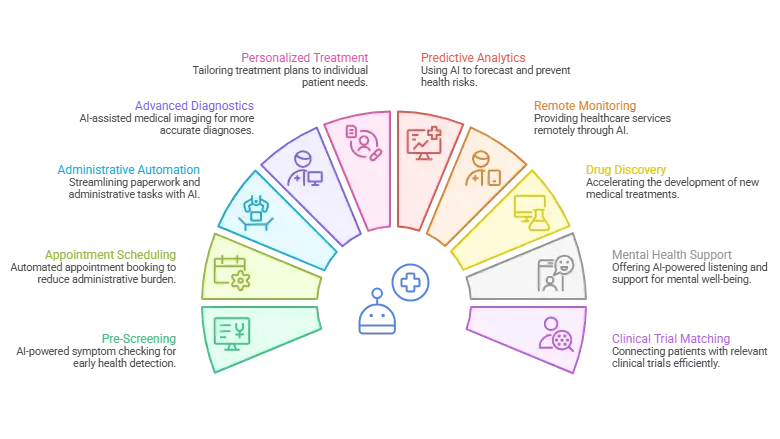
Top 10 AI Agents to Automate the Healthcare Industry
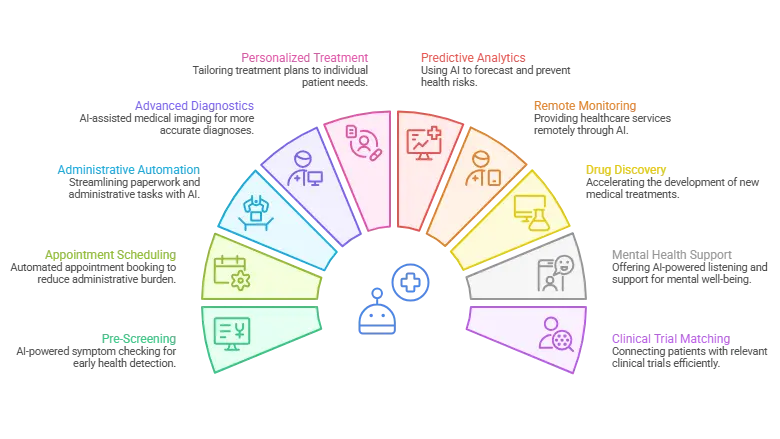
1. Pre-Screening and Symptom Checking — Your Health’s First Line of Defense
Before you even walk into a clinic or hospital, AI-powered pre-screening tools can save you precious time and effort. These virtual assistants ask detailed questions about your symptoms, medical history, and lifestyle, and use that info to assess how urgent your condition is.
This kind of triage helps prioritize patients so those who need immediate attention get it faster, while others might be guided toward self-care or telehealth options. The benefit? Less crowded emergency rooms, fewer unnecessary visits, and a more efficient healthcare system overall.
Plus, it’s available 24/7, which is a big deal when you wake up worried at 2 AM.
For example, AI chatbots can flag red-flag symptoms like chest pain or high fever, ensuring these cases jump to the front of the line. This helps reduce wait times and improves outcomes by speeding up care for those who need it most.
2. Automated Appointment Scheduling — No More Phone Tag
Booking a doctor’s appointment can be frustrating — long hold times, confusing availability, and constant back-and-forth. AI agents revolutionize this by automating the entire scheduling process (similar to the modern workflows analyzed in our guide to doctor appointment booking app development). They can check calendars in real time, suggest the soonest available slots, send reminders to patients, and even reschedule automatically if needed.
This convenience reduces no-shows, which cost the healthcare system billions each year, and makes it easier for patients to get timely care. Beyond just booking, some AI systems can also triage appointment types — for example, differentiating between a quick flu shot visit and a more detailed chronic condition checkup, ensuring the right resources are allocated.
This smart scheduling leads to better clinic efficiency and happier patients.
3. Administrative Workflow Automation — Paperwork, Meet Your Match
A lot of the time in healthcare is spent on administrative tasks like billing, coding, and managing insurance claims. These tasks are often repetitive and prone to human error, which can delay payments and slow down care.
AI agents can take over many of these functions by extracting data from documents, verifying insurance coverage instantly, and submitting claims automatically. This not only speeds up the whole process but also cuts administrative costs significantly.
Automating these workflows also reduces burnout among healthcare staff, who can then dedicate more time to patient care instead of paperwork. AI-driven automation has been shown to reduce claim denials by catching errors early, ensuring smoother reimbursements for providers. Building these systems requires strict data governance, which is why clinical providers partner with specialized teams for AI agent development to ensure full HIPAA compliance from day one.
4. Advanced Diagnostics with Medical Imaging — A Second Set of Super Eyes
Medical imaging like X-rays, MRIs, and CT scans, generates huge amounts of data, and interpreting them accurately takes skill and time. AI agents use deep learning to analyze images quickly and spot abnormalities that might be missed by even the most experienced radiologists.
For example, AI can detect tiny tumors, fractures, or signs of diseases like pneumonia with incredible precision. This helps doctors confirm or rule out diagnoses faster, leading to quicker treatment decisions.
One of the biggest wins is in cancer detection, where early identification drastically improves survival rates. AI tools not only assist radiologists but also reduce their workload, preventing fatigue-related mistakes.
5. Personalized Treatment Plans — Medicine That Fits You Like a Glove
Everyone’s health is unique, and AI helps make sure your treatment is too. By analyzing your genetics, medical history, lifestyle, and even environmental factors, AI agents can assist doctors in designing treatment plans tailored specifically to you. This personalized approach improves effectiveness and minimizes side effects compared to standard “one size fits all” treatments.
For chronic conditions like cancer or autoimmune diseases, personalized plans can adapt dynamically based on how you respond, thanks to continuous data monitoring. This flexibility means treatments can be tweaked in real-time, improving long-term outcomes.
6. Predictive Analytics — Catching Health Risks Before They Become Problems
AI doesn’t just react — it predicts. By analyzing huge datasets from electronic health records, wearables, and population health studies, AI agents can identify patterns that indicate a patient might be at risk for diseases like diabetes, heart failure, or kidney disease before symptoms even show up. This predictive intervention forms the cornerstone of modern AI patient care management.
This predictive power means doctors can intervene early, offering lifestyle advice, monitoring, or preventive treatment to keep patients healthier longer.
This approach shifts healthcare from reactive to proactive, potentially reducing hospital admissions and improving quality of life.
7. Remote Monitoring and Telehealth — Healthcare Anytime, Anywhere
AI combined with wearable devices and telehealth platforms allows continuous monitoring of patients outside the hospital. Vital signs like heart rate, blood pressure, and oxygen levels are tracked in real-time, and AI alerts doctors immediately if something looks off (see our dedicated guide on health monitoring app development and our complete telemedicine app development guide).
This is a game-changer for managing chronic conditions, post-surgery recovery, or elderly care, where early detection of complications can prevent emergencies.
Patients also get more freedom and comfort staying at home, while healthcare providers can prioritize attention where it’s needed most. AI-driven telehealth has proven especially useful during the COVID-19 pandemic, keeping people safe while maintaining access to care.
8. Drug Discovery and Development — Speeding Up Medical Breakthroughs
Discovering new drugs traditionally takes years and costs billions. AI is revolutionizing this by analyzing biological data and simulating how new compounds might behave in the body.
This accelerates identifying promising candidates, reducing the need for expensive lab testing early on. AI also helps design clinical trials more efficiently by selecting ideal patient groups and predicting outcomes.
This means we get new medicines faster and at lower costs — a huge benefit for tackling diseases like cancer, Alzheimer’s, or rare conditions that need urgent solutions.
9. Mental Health Support — AI as a Listening Ear
Mental health care is often hard to access due to stigma, cost, or the availability of professionals. AI-powered apps offer 24/7 support through chatbots that can listen, provide coping strategies, or guide users through therapeutic exercises like cognitive behavioral therapy.
These tools are not a replacement for human therapists but provide valuable support, especially in between sessions or for those reluctant to seek traditional care.
AI can also monitor speech and text patterns to detect signs of depression or anxiety early, prompting timely intervention.
10. Clinical Trial Matching — Finding the Right Trials Faster
Clinical trials are essential for medical progress but matching patients to the right trial can be slow and complex. AI agents analyze patient data alongside trial eligibility criteria to identify suitable candidates quickly.
This speeds up recruitment, helps researchers meet enrollment targets faster, and gives patients access to cutting-edge therapies they might not find otherwise.
Better trial matching also ensures diverse participation, improving the quality and applicability of research outcomes.
Real-Life Examples of AI Agent Use Cases in Healthcare
1. Breast Cancer Detection — Google DeepMind’s AI reduced false positives by 5.7% and false negatives by 9.4% in mammogram screenings, meaning fewer missed cancers and less unnecessary worry.
2. COVID-19 Diagnosis — AI models analyzed CT scans to quickly identify COVID-19 pneumonia with high accuracy, helping hospitals triage patients faster.
3. Diabetic Retinopathy Screening — Google’s AI tool detects diabetic eye disease from retinal images with sensitivity and specificity matching ophthalmologists, enabling earlier treatment.
4. Sepsis Prediction — AI algorithms predict sepsis onset hours before symptoms appear, allowing earlier intervention and reducing mortality.
5. Stroke Diagnosis — AI helps radiologists identify stroke types quickly from CT scans, crucial for timely treatment.
AI agents are already transforming healthcare, making it faster, more precise, and more patient-friendly. Whether it’s easing admin headaches, helping doctors catch diseases early, or supporting mental health, AI is here to stay. For clinical providers looking to operationalize these technologies, deploying compliant features through a unified patient portal or engineering bespoke workflows via custom medtech software development ensures long-term clinical safety and scalability.


![How Much Does It Cost to Build an AI Agent in 2026? [Realistic Pricing & Token Economics]](/images/blog-placeholder.svg)