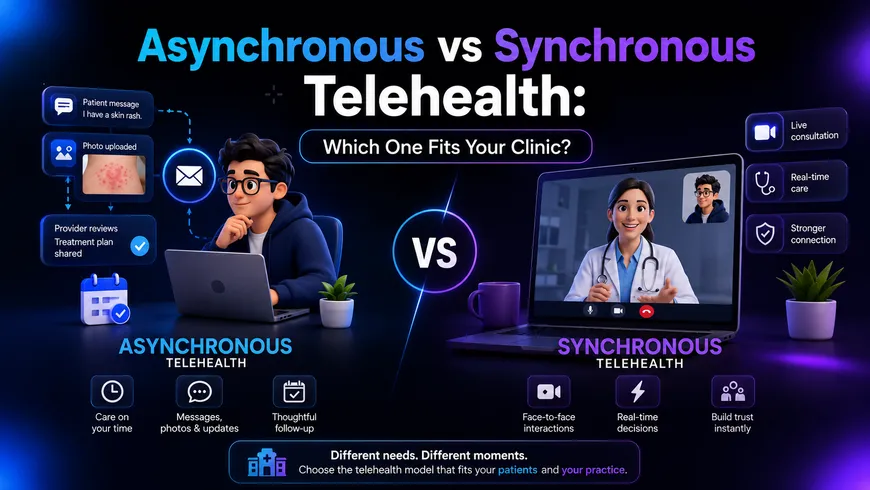
Quick answer: Asynchronous telehealth, also called store and forward, lets a patient send history, photos or questionnaire answers for a clinician to review later. Synchronous telehealth is a live video or audio visit. Async fits routine, visual or questionnaire-driven care such as acne, rashes, follow-ups and refills, and it saves clinician time. Live visits fit new, complex, urgent, therapy and controlled-substance care. Most clinics should run a hybrid, with clear triggers that escalate async cases to live video, and check state rules because some require a live evaluation before prescribing.
Your medical director wants live video for everything because it feels safe. Your growth lead wants a few-minutes-per-case async flow because it scales. Both are partly right, and both are partly wrong, which is why the asynchronous telemedicine vs synchronous question keeps coming up in clinic planning meetings and rarely gets a clean answer.
This guide is for clinic founders, telehealth startups in areas like men’s health, dermatology and mental health, and the medical directors who have to sign off on the care model. We will explain what each approach really is, compare them side by side, show where asynchronous telehealth wins and where it does not, cover the rules that limit it, and give you an execution roadmap. If you are ready to plan the product behind the model, our mobile app development team can help you design the patient flows.
You will leave with a comparison table, a clinic-type decision guide, a set of escalation triggers for a safe hybrid model and a six-step plan to roll it out.
What is asynchronous telehealth, and how does it differ from synchronous?
Asynchronous telehealth is care delivered without the patient and clinician being online at the same time: the patient sends information, and the clinician reviews it and responds later. Synchronous telehealth is real time, such as a video call or phone visit, where both sides talk live.
Definition: store and forward telemedicine. The most common form of asynchronous telehealth. A patient or referring clinician captures data such as photos, history and test results, sends it securely, and a clinician reviews it later to diagnose, advise or prescribe. It is the workhorse behind asynchronous dermatology, eConsults and questionnaire-based visits.
| Model | How it works | Typical example |
|---|---|---|
| Synchronous (live video) | Real-time visit with video and audio | A therapy session or a new-patient consult |
| Synchronous (audio-only) | Real-time phone visit | A follow-up where video is not possible |
| Asynchronous (store and forward) | Patient sends data; clinician replies later | Skin photos and an intake form reviewed within a day |
| Hybrid | Async first, escalate to a live visit when needed | Acne care with photo check-ins and a video visit for complications |
Asynchronous is not the same as unmonitored. The best asynchronous telehealth programs still apply clinical standards, structured intake, response-time targets and escalation rules. The difference is when the clinician engages, not whether they do.
Key takeaway: Async is about timing, not quality. Define the standard of care first, then choose the timing that can meet it.
Synchronous vs asynchronous telehealth: how do they compare side by side?
In short, synchronous vs asynchronous telehealth is a trade between rich conversation and efficiency. Live visits give you real-time dialogue and observation; async gives you scale, flexibility and clinician time.
| Factor | Synchronous | Asynchronous |
|---|---|---|
| Timing | Scheduled, both online at once | Patient sends anytime; clinician replies within an agreed window |
| Clinician time per case | Longer, tied to a slot | Often much shorter; one health system reported about 2 minutes per async encounter versus 15 to 18 for video |
| Patient convenience | Needs a time slot | Fits any schedule; no waiting room |
| Information quality | Real-time questions and observation | Depends on photo and form quality |
| Best for | New, complex, urgent, therapy, controlled substances | Routine, visual or questionnaire-driven care and follow-ups |
| Prescribing | Broadly accepted | Restricted in some states; limited for controlled substances |
| Payment | Widely covered | Narrower coverage; often cash-pay |
| Main risk | No-shows and capacity limits | Missed red flags and poor-quality inputs |
The time savings are the headline. Specode’s review of async platforms cites a health system averaging about 2 minutes per asynchronous encounter against 15 to 18 minutes for a video visit. Treat it as one data point, not a promise: your savings depend on condition mix, forms and how often cases escalate.
Key takeaway: Async saves clinician minutes but shifts the work into intake design and escalation rules. If those are weak, the savings disappear.
When does asynchronous telehealth fit best?
Asynchronous telehealth fits best when the condition is visual or questionnaire-driven, the decision is routine and the risk of missing something serious is low. Dermatology is the classic example, which is why store and forward telemedicine grew there first.
- Common skin conditions: acne, rashes and eczema flare-ups, where photos and history are the core data.
- Triage and referrals: primary care sending images to a specialist, which can shorten waits. In one US study, store-and-forward referrals cut median dermatology wait times from 77 days to 28.
- Follow-ups and refills: stable patients checking in on an established plan.
- Questionnaire-driven decisions: some men’s health and wellness services where a structured history and review support a decision, subject to state rules.
- Measurement between visits: mental health check-ins and symptom questionnaires that supplement, not replace, live care.
- Result reviews: lab and test follow-ups with clear instructions.
There is also a quality caveat. A 2026 meta-analysis found pooled diagnostic concordance of about 76% for store-and-forward across skin conditions, which is useful for triage and common conditions but explains why you need image quality checks and a path to a live visit. Our teledermatology software guide covers capture and review workflows in more depth.
Key takeaway: Choose async where a photo or form carries most of the information and the cost of a miss is low.
When do you need synchronous telehealth?
You need synchronous telehealth when the clinician must ask follow-up questions in real time, observe the patient, build a relationship or meet a rule that requires a live evaluation. Several categories of care almost always belong here.
- New or complex presentations: unclear symptoms, multiple conditions or anything that needs back-and-forth questioning.
- Urgent or high-risk situations: red-flag symptoms, rapidly changing lesions or safety concerns.
- Therapy and psychiatric evaluation: the conversation is the treatment, and risk assessment needs live interaction. Our mental health app guide covers safety design in detail.
- Controlled substances: federal rules treat these differently, and store-and-forward review generally does not qualify. Testosterone therapy, for example, is a controlled substance.
- First visits in states that require a live evaluation before prescribing.
A good rule: if you would feel uncomfortable explaining to a patient’s family why you decided from a form, move to live video.
Key takeaway: When in doubt, escalate. A five-minute video visit is cheaper than a missed diagnosis.
What do the rules and payers say about asynchronous telehealth?
The rules vary by state and payer, and they limit asynchronous telehealth more than most founders expect. Three layers matter: state prescribing rules, payer coverage and federal controlled-substance rules.
| Layer | What to know | What it means for your model |
|---|---|---|
| State prescribing rules | Some states require a live audio-visual evaluation before prescribing, then allow asynchronous follow-ups; others allow async to establish care if the standard of care is met. CCHP tracks these rules | Map your launch states before you design the first visit |
| Medicaid | Per CCHP’s Fall 2026 summary, 40 state Medicaid programs and DC reimburse store-and-forward, compared with all 50 states for live video | Coverage exists but is patchy; check each state’s conditions |
| Medicare | Medicare has historically limited store-and-forward payment to federal demonstration programs in Alaska and Hawaii, as summarized by Fuse Health | Do not build a Medicare-funded async model without confirming current rules |
| Federal controlled substances | DEA’s temporary telemedicine flexibilities run through December 31, 2026, and a final rule is pending; store-and-forward review does not qualify | Plan live video for any controlled-substance care |
| Cash-pay models | Payer coverage matters less, but licensure, consent and privacy rules still apply | Compliance does not disappear when insurance does |
Even where state law permits async, a questionnaire alone is often not enough to meet the standard of care. The prescribing standard sits in medical board rules, not only the telehealth statute, so check both. Our telemedicine regulations guide covers licensure, consent, HIPAA and prescribing in more detail.
Key takeaway: Async is legal in many places, but often only with the right inputs, the right clinician review and the right follow-up. Verify state by state.
Which model fits your clinic or startup?
Pick the model by condition and risk, not by habit. The table below gives a starting point for common clinic types, and your medical director should adjust it to your services and states.
| Clinic type | Recommended model | Guardrails |
|---|---|---|
| Dermatology and skin clinics | Async first, video for escalation | Guided photo capture, quality checks, urgent-lesion triggers |
| Men’s health | Hybrid; live video where controlled substances are involved | State prescribing rules, structured history, lab review, clear escalation |
| Mental health | Mostly synchronous; async for check-ins and measurement | Risk screening, crisis path, clinician review of every flag |
| Primary care and urgent care | Hybrid with strict triage | Red-flag rules that route urgent cases to live visits |
| Specialty referrals and eConsults | Async between clinicians | Structured referral forms and response-time targets |
If you want a quick test, ask five questions:
- Is the information visual or questionnaire-based? If yes, async is plausible.
- Could a miss cause serious harm? If yes, add live review or escalate.
- Does state law allow async for this service and visit type? If unsure, assume you need a live first visit.
- Does the service involve controlled substances? If yes, plan for live video.
- Who pays? Insurance-funded models need careful coverage checks; cash-pay models need strong consumer safeguards.
Key takeaway: Decide by condition, risk, state rules and payer. Not by what your platform happens to support.
Choosing a Care Model for Your Clinic or Startup?
EnactOn helps clinics and telehealth startups turn a care model into a product, with async intake, live visits and escalation rules, built with senior-led architecture and human-reviewed AI acceleration alongside your medical director.
How do you design a hybrid model that escalates safely?
Design a hybrid model with a simple flow: structured intake, automatic triage, clinician review and clear triggers that move a case to live video. The triggers matter more than the technology, so write them down with your medical director.
| Escalation trigger | Example | Action |
|---|---|---|
| Red-flag symptoms in intake | Rapid change, severe pain, fever, safety concerns | Immediate live visit or referral to urgent care |
| Poor-quality or missing inputs | Blurry photos, incomplete history | Request a retake, then offer video |
| Clinical uncertainty | Findings do not fit a clear pattern | Schedule a live visit |
| Medication risk | Contraindications, interactions, controlled substances | Live visit and pharmacist review |
| Patient preference | Patient asks to talk to someone | Offer video without friction |
| No response or worsening | Patient reports no improvement or new symptoms | Follow-up visit or in-person referral |
Add service-level targets to the flow, such as a response window for async cases and a maximum time to schedule an escalation, and measure them from day one.
What is the execution roadmap for choosing and launching a model?
Run a six-step plan, starting with decisions on paper and ending with a measured pilot.
Step 1: Map your services and risk
List each service line, the conditions it covers and the clinical risk of a miss. Rank them from lowest to highest risk.
Step 2: Check state and payer rules
For each launch state, confirm whether async is allowed, what a first visit requires and how payers cover it. Involve healthcare counsel.
Step 3: Choose a model per service
Assign async, live or hybrid to each service line, and document why. Keep controlled-substance and therapy services live by default.
Step 4: Design intake and escalation
Build structured forms, image or data quality checks and the escalation triggers above. Define who reviews, how fast and what happens when they miss a window.
Step 5: Pilot with a small group
Launch one service in one or two states with close clinical oversight. Review every escalation and every adverse event.
Step 6: Measure and expand
Track a short list: turnaround time, escalation rate, retake rate, clinician minutes per case, patient satisfaction and safety events. Expand only when the numbers hold.
Key takeaway: Start with the lowest-risk service line. Prove the model on a small scale before you expand it.
Conclusion
In the asynchronous telemedicine vs synchronous debate, neither side wins outright. Asynchronous telehealth is not better or worse than live video. It is better for some conditions, in some states, with some safeguards. The strongest clinics run a hybrid: async for routine, visual and questionnaire-driven care, and live visits for new, complex, urgent, therapy and controlled-substance cases.
Your next step is small: list your top five services, mark each as low, medium or high risk, and write one escalation trigger for each. Then check the rules in your first launch states with healthcare counsel. If you want to see how we plan the product around a care model, our enterprise software development page shows how we scope integration-heavy platforms.
EnactOn is a Clutch Certified engineering partner with 500+ products delivered for 350+ clients across 65+ countries, and medical is one of the largest industries in our Clutch client mix. We pair senior-led architecture with human-reviewed AI acceleration and a four-gate QA pipeline, and we work alongside your medical director and compliance advisers. For asynchronous telehealth programs, we are happy to review your plan.
FAQs
What is asynchronous telehealth?
Asynchronous telehealth is care delivered without the patient and clinician online at the same time. The patient sends history, photos, forms or test results, and the clinician reviews them later and responds. It is also called store and forward, and it is common in dermatology, eConsults and questionnaire-based visits.
What is the difference between synchronous and asynchronous telehealth?
Synchronous telehealth is real time, such as a video or phone visit. Asynchronous telehealth is delayed: the patient sends information and the clinician replies within an agreed window. Synchronous gives you live conversation and observation, while asynchronous gives you flexibility and clinician time savings.
Is store and forward telemedicine the same as asynchronous telehealth?
Store and forward is the most common form of asynchronous telehealth. It usually means sending photos, data and history for later review. Some asynchronous services are message-based or questionnaire-based without images, but regulators and payers often group them under the same label.
Can you prescribe medication through asynchronous telehealth?
Sometimes. Some states allow it if the clinician can meet the standard of care, while others require a live audio-visual evaluation first and then permit asynchronous follow-ups. Controlled substances generally require live interaction under federal rules. Check state medical board rules, not only the telehealth statute.
Does insurance pay for asynchronous telehealth?
Coverage is narrower than for live video. CCHP reports that 40 state Medicaid programs and DC reimburse store-and-forward in some capacity, compared with all 50 states for live video, and Medicare has historically limited it to demonstration programs in Alaska and Hawaii. Many asynchronous programs are cash-pay, but licensure, consent and privacy rules still apply.
Which is better for dermatology: asynchronous or synchronous?
Asynchronous works well for common conditions such as acne and rashes because photos and history carry most of the information. A 2026 meta-analysis found about 76% diagnostic concordance for store-and-forward, so you need image quality checks and a route to live video for uncertain or urgent cases. Most dermatology programs use a hybrid.
Which model works for men’s health and mental health startups?
Men’s health often works as a hybrid, with live video where controlled substances such as testosterone are involved and state rules requiring it. Mental health is mostly synchronous because the conversation is the treatment and risk assessment needs live interaction, with async used for check-ins and symptom tracking. Both need strong escalation rules.
Is asynchronous telehealth safe?
It can be, with structured intake, clear red-flag triggers, response-time targets and easy escalation to live care. The main risks are missed red flags and poor-quality inputs. Your medical director should approve the triggers and review escalations and adverse events regularly.
What are good escalation triggers for asynchronous cases?
Common triggers include red-flag symptoms, poor-quality or missing information, clinical uncertainty, medication risks or controlled-substance needs, patient preference for a live conversation, and worsening or no improvement. Write them into your workflow and measure how often they fire.
How do I measure whether asynchronous telehealth is working?
Track turnaround time, escalation rate, retake rate for photos or forms, clinician minutes per case, patient satisfaction, clinical outcomes and safety events. Review them monthly in a pilot before you scale. If escalations or retakes are high, fix your intake before adding volume.
How does EnactOn help with asynchronous telehealth products?
We start with discovery of your services, states and risk, then use our Target-Market Alignment work to cut 30 to 40 percent of non-essential scope before building. Senior architects write the specification, AI speeds up delivery under strict human review, and every release passes a four-gate pipeline for functional, security, performance and deployment checks. We work alongside your medical director and compliance advisers and do not provide clinical or legal advice.