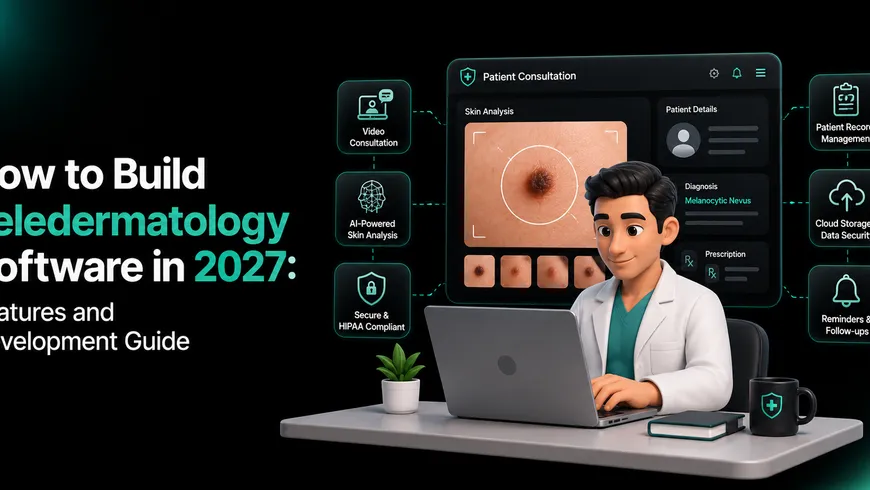
Quick answer: To build teledermatology software, choose your care model (store-and-forward, live video or hybrid), then build guided photo capture, a dermatologist review queue, secure messaging, e-prescribing and EMR sync, wrapped in HIPAA-grade security. Treat AI as decision support, not diagnosis, unless you plan an FDA pathway. A 2026 meta-analysis pooled store-and-forward diagnostic concordance at about 76%, so photo quality and clear escalation to a live visit matter more than any flashy feature.
A patient has a rash, a worrying mole or acne that will just not quit, and the first dermatology appointment is weeks away. That gap is the business case for teledermatology software: in one US single-center study, store-and-forward referrals cut median wait times from 77 days to 28. It is also why so many founders are asking how to build something that gets a good photo, a fast review and a real treatment plan into the same flow.
If you run a dermatology or skin clinic, or you are a telehealth founder adding a skin vertical, this guide is for you. We cover the care models, the features a teledermatology platform needs, image quality, architecture, EMR integration, AI and FDA rules, and where acne and other common conditions fit. If you are ready to plan the build, our mobile app development team can show you how guided capture and offline-friendly uploads come together.
By the end, you will have a 10-feature table with priorities, an architecture you can hand to engineers, a clear line between safe AI assistance and regulated AI diagnosis, and a phased roadmap from MVP to scale.
What is teledermatology software, and how does telemedicine for dermatology work?
Teledermatology software lets patients or referring clinicians share skin images and history with a dermatologist, who diagnoses, advises and prescribes without an in-person visit. Telemedicine for dermatology works so well because skin conditions are visual, which makes them a natural fit for photos and video.
Definition: store-and-forward. An asynchronous model where the patient or clinician uploads photos and a structured history, and the dermatologist reviews them later and responds, usually within a day or two. It is also called asynchronous teledermatology and is the workhorse of most dermatology telehealth software.
| Model | How it works | Best for |
|---|---|---|
| Store-and-forward (async) | Photos and intake sent, dermatologist replies later | Acne, rashes, eczema, mole triage, high volume at low cost |
| Live video (sync) | Real-time visit with video and screen sharing | Complex cases, counseling, follow-ups, isotretinoin check-ins |
| Hybrid | Async first, escalate to live video when needed | Most clinics and platforms |
| Provider-to-provider eConsult | Primary care sends images to a dermatologist | Referral triage, rural clinics |
The evidence is encouraging but not magic. A 2026 systematic review and meta-analysis found pooled diagnostic concordance of about 76% for store-and-forward across all skin conditions, and about 74% for skin cancer. That is useful for triage and many common conditions, and it is exactly why you need strong image quality controls and a clean path to an in-person visit.
Key takeaway: Pick the care model first. It decides your features, staffing and regulatory footprint.
What features does a teledermatology platform need?
A teledermatology platform needs ten core features: guided photo capture, structured intake, a review queue, live video, secure messaging, e-prescribing, EMR integration, lesion tracking, consent and identity controls, and billing. Here they are, with priorities.
| Feature | What it does | Build note | Priority |
|---|---|---|---|
| Guided photo capture | Walks users through angles, lighting, distance and scale; checks blur in real time | Native camera control | MVP |
| Structured intake | Skin history, symptoms, allergies, medications, body map | Condition-specific forms | MVP |
| Dermatologist review queue | Triage by urgency, assign cases, templates for responses | SLA timers | MVP |
| Secure messaging | Follow-up questions and updated photos | Encrypted, audited | MVP |
| E-prescribing | Send prescriptions to pharmacies | Integrated service | MVP |
| EMR and records sync | Notes, images and orders written back to the chart | FHIR or vendor API | MVP or Phase 2 |
| Live video visits | Real-time consults and counseling | WebRTC with fallback | Phase 2 |
| Lesion tracking | Side-by-side photo comparison over time | Consistent capture | Phase 2 |
| Consent, ID and location | Collects consent, verifies identity and patient state | State-aware flows | MVP |
| Billing and analytics | Payments, coding support, turnaround and outcome dashboards | Payer rules table | Phase 2 |
Key takeaway: A teledermatology app is only as good as its first photo. Spend your design budget on capture and triage.
How should you design image capture and quality control?
Design image capture as a guided, checked flow, not a camera button. Poor photos are the main reason teledermatology cases go back for a retake, and a good capture screen prevents most of them.
- Show examples and overlays: a body map plus an on-screen guide for distance and framing.
- Check quality on the device: detect blur, glare and low light before upload, and prompt a retake instantly.
- Require context shots: one wide shot for location, one close-up for detail, and a scale reference where useful.
- Support dermoscopy attachments: allow clinic-grade add-ons for lesion work.
- Preserve originals: upload full-resolution images with metadata, and generate thumbnails for the queue.
- Keep images out of the camera roll: capture inside the app so photos stay encrypted and under your control.
- Plan for weak connectivity: use resumable uploads so a patient on a slow connection does not lose the case.
Treat every photo as protected health information. That affects storage, access logs, deletion rules and how images appear in notifications.
Key takeaway: Reject bad images early and politely. It saves dermatologist time and avoids wrong or delayed answers.
What does the architecture of a teledermatology app look like?
A teledermatology app has five layers: patient and clinician apps, an API layer, case and image services, an integration layer for EMR and pharmacy, and a secure data layer. The image pipeline and the review queue are the parts that differ from a generic telehealth build.
| Layer | What it does | Typical choices |
|---|---|---|
| Apps | Patient app, clinician web console, admin panel | Native or cross-platform mobile, React web |
| API layer | Auth, rate limits, role checks, versioned APIs | Gateway with OIDC and role-based access |
| Case and image services | Intake, case queue, image upload, thumbnails, messaging | Object storage, queues, resumable uploads |
| Integration | EMR, e-prescribing, pharmacy, labs, billing | FHIR, HL7, vendor APIs, webhooks |
| Data and security | Encrypted storage, audit logs, key management | Managed database, KMS, SIEM-friendly logging |
A few design choices pay off later. Use an asynchronous job pipeline for image processing so uploads never block the UI. Store images in encrypted object storage with signed, short-lived access. Keep an audit log of every view, because dermatology images are sensitive and access reviews will happen.
How do you integrate with a dermatology EMR?
Integrate with a dermatology EMR through FHIR or the vendor’s API so that the visit note, images, diagnoses and orders land in the patient chart, and demographic and scheduling data flow back to your platform. Without that, your dermatologists copy and paste, and adoption stalls.
| Integration point | What flows | Common pitfall |
|---|---|---|
| Patient matching | Demographics, MRN, insurance | Duplicate patient records |
| Scheduling | Appointments and availability | Time zone and location mismatches |
| Clinical notes | Assessment and plan back to the chart | Unstructured text that is hard to code |
| Images | Photos attached to the encounter | Large files and size limits |
| Orders and prescriptions | Rx, labs, biopsy referrals | Missing pharmacy details |
| Billing | Codes, modifiers, payer data | Rules that differ by payer and state |
If you are a clinic with an existing EMR, start with the integration that removes the most double entry, usually notes and images. If you are building a standalone dermatology telehealth software product, decide early whether you will be the system of record or a layer on top of someone else’s.
Key takeaway: EMR integration is a workflow feature. If it saves a dermatologist two minutes per case, it earns its place.
Adding a Skin Vertical to Your Telehealth Product?
EnactOn builds teledermatology platforms with guided capture, review workflows and EMR integration, using senior-led architecture and human-reviewed AI acceleration, and works alongside your clinical and regulatory advisers.
Where does AI skin analysis fit, and what does the FDA say?
AI can help with image quality checks, triage and drafting notes at low regulatory risk, but anything that diagnoses a lesion or recommends management is likely regulated as a medical device. Decide early which side of that line your product is on.
The regulatory bar for skin cancer AI is high. The first AI-enabled skin cancer device authorized for primary care use, DermaSensor, was cleared through the FDA’s De Novo pathway after a pivotal study of more than 1,000 patients reported 96% sensitivity across 224 skin cancers. Note that it is a handheld spectroscopy device, not a photo app, which tells you how much evidence reviewers expect.
| AI use | Typical regulatory risk | Notes |
|---|---|---|
| Photo quality and blur detection | Low | Improves captures without making clinical claims |
| Case triage and queue ordering | Low to moderate | Keep a clinician in control; document how priorities are set |
| Draft notes and summaries | Low to moderate | Clinician reviews and signs; avoid unsupported claims |
| Lesion risk scoring | High | Likely device software; plan evidence and a submission |
| Autonomous diagnosis or treatment advice | High | Needs a clear FDA pathway and strong clinical validation |
If you are near that line, read the FDA’s SaMD guidance and talk to a regulatory specialist before you write marketing copy, because claims drive classification.
Key takeaway: Use AI to help dermatologists work faster. Make diagnostic claims only if you are ready for an FDA pathway.
What rules apply to telemedicine for dermatology?
The same rules as other telehealth: HIPAA for privacy and security, state licensure based on where the patient is located, informed consent, e-prescribing rules and payer coverage rules. Dermatology adds a few twists around images and store-and-forward payment.
- Licensure: your dermatologist needs a license in the patient’s state at the time of the visit.
- Consent: collect telehealth and image consent, and store the version of the text patients agreed to.
- HIPAA: images are protected health information, so you need BAAs, encryption, audit logs and access controls.
- Payment: coverage for asynchronous store-and-forward varies by payer and state, and Medicare has historically limited it, so verify current rules before you build a billing model around it.
- Advertising and structure: corporate-practice-of-medicine and advertising rules apply, so involve healthcare counsel before launch.
Key takeaway: Build state-aware consent, licensure checks and audit logs from the start. Retrofitting them is painful.
How do acne and other common conditions fit into teledermatology software?
Acne is one of the best fits for asynchronous care because diagnosis is visual and treatment is often topical or oral medication with follow-ups. Isotretinoin is the exception, because it is regulated through the iPLEDGE program and needs extra workflow support.
| Condition | Best model | Product notes |
|---|---|---|
| Acne | Async with follow-up photos | Structured history, treatment plans, refill and check-in reminders |
| Eczema and rashes | Async or hybrid | Body map, trigger tracking, flare photos |
| Psoriasis and rosacea | Hybrid | Longitudinal photo comparison and symptom scores |
| Hair loss | Async | Standardized scalp photos and lab ordering |
| Suspicious lesions | Triage then in-person | Dermoscopy support, urgent escalation, biopsy referral workflow |
For isotretinoin, the FDA approved iPLEDGE changes on February 9, 2026, including allowing prescriber-approved at-home pregnancy tests during and after treatment, though the pre-treatment test must still be done in a medical setting. The FDA says implementation is now scheduled for November 15, 2026. If you want to support isotretinoin, plan workflows for enrollment status, pregnancy test documentation, monthly check-ins and escalation, and confirm current requirements with your clinical lead.
Key takeaway: Start with acne and common rashes. They deliver volume, and the workflows are simpler than isotretinoin or lesion work.
What is a realistic roadmap from MVP to scale?
Ship a narrow MVP with one care model and two or three conditions, then expand. The phases below keep risk low and give you real data early.
| Phase | What you build | Exit criteria |
|---|---|---|
| 1. Discovery | Care model, conditions, states, EMR and e-prescribing plan | Scoped roadmap and compliance checklist |
| 2. MVP | Guided capture, intake, review queue, messaging, e-prescribing, consent | Clinicians review real cases end to end |
| 3. Pilot | A small clinic or patient group, tracked turnaround and retake rates | Retake rate and response time within targets |
| 4. Expand | EMR sync, live video, lesion tracking, billing | Clinic workflow time per case reduced |
| 5. Scale | More states, more conditions, analytics, selective AI assistance | Stable operations and clinical governance |
So, Where Can You Begin?
Great teledermatology software starts with the unglamorous parts: guided photo capture, a smart review queue, clean EMR sync and strong consent and security. Add AI as an assistant, keep diagnostic claims tied to an FDA plan, and start with conditions like acne where asynchronous care shines.
Your next step is to write down your care model, your first three conditions and your launch states, then sketch the capture flow on paper before anyone writes code. If you want a partner for the build, our enterprise software development page shows how we scope integration-heavy platforms.
EnactOn is a Clutch Certified engineering partner with 500+ products delivered for 350+ clients across 65+ countries, and medical is one of the largest industries in our Clutch client mix. For teledermatology software, we combine senior-led architecture, human-reviewed AI acceleration and a four-gate QA pipeline, and we work alongside your clinical and regulatory advisers.
FAQs
What is teledermatology software?
It is software that lets patients or referring clinicians share skin images and history with a dermatologist for diagnosis, advice and prescribing. It usually supports store-and-forward cases, live video visits or both. Good platforms add guided photo capture, a review queue, messaging, e-prescribing and EMR integration.
What does teledermatology app development involve?
Teledermatology app development covers discovery of your care model and conditions, design of the capture and intake flows, building mobile and clinician apps, case and image services, integrations with EMR and e-prescribing, and security and compliance work. Integrations and compliance usually shape the schedule more than screens do. Start with a narrow MVP and expand after a pilot.
Do I need a dermatology EMR, and how do I integrate with one?
If you are a clinic, you likely already have one, and your platform should sync notes, images and orders through FHIR or the vendor API. If you are a standalone platform, decide whether to be the system of record or a layer on top of the clinic’s EMR. Start with the integration that removes the most double entry.
Can AI skin analysis diagnose skin conditions in my app?
AI can safely help with image quality checks, triage and note drafting. Diagnosing a lesion or recommending management is likely regulated as a medical device and needs clinical evidence and an FDA pathway. The first AI-enabled skin cancer device authorized for primary care went through the De Novo pathway with a pivotal study of more than 1,000 patients.
Can I offer acne treatment through telehealth?
Yes, acne is one of the best-suited conditions because diagnosis is visual and many treatments are topical or oral with follow-ups. Isotretinoin is different, since it requires iPLEDGE enrollment and pregnancy-test documentation, with updated rules scheduled to take effect on November 15, 2026. Build acne flows first and add isotretinoin only with strong clinical oversight.
What is the difference between store-and-forward and live video teledermatology?
Store-and-forward is asynchronous: patients upload photos and history, and the dermatologist replies later. Live video is real-time and suits complex cases and counseling. Most platforms use a hybrid model, starting asynchronously and escalating to video when needed.
How accurate is teledermatology?
A 2026 meta-analysis pooled diagnostic concordance with in-person care at about 76% for store-and-forward across skin conditions and about 74% for skin cancer. Accuracy depends heavily on image quality, case selection and clinician experience. That is why capture quality control and escalation paths are core features.
What features should a teledermatology MVP include?
Include guided photo capture, structured intake, a dermatologist review queue, secure messaging, e-prescribing and state-aware consent. Add EMR sync, live video, lesion tracking and billing in later phases. Fewer, better features beat a long list on launch.
Is teledermatology software HIPAA compliant by default?
No. Compliance comes from how you build and operate it, including BAAs with vendors, encryption, access controls, audit logs and breach procedures. Treat every skin photo as protected health information and design storage, sharing and deletion accordingly.
What drives the cost of building a teledermatology platform?
The biggest drivers are the number of conditions and workflows, EMR and pharmacy integrations, image pipeline and security requirements, and whether you add AI features. Native mobile apps, live video and multi-state compliance add effort. Ask for a phased estimate with a clear MVP rather than one number for everything.
How does EnactOn approach teledermatology software projects?
We start with discovery of your care model, conditions and integrations, then use our Target-Market Alignment work to cut 30 to 40 percent of non-essential scope before building. Senior architects write the specification, AI speeds up delivery under strict human review, and every release passes a four-gate pipeline for functional, security, performance and deployment checks. We work alongside your clinical and regulatory advisers and do not provide regulatory submissions ourselves.