Quick answer: Mental health app development follows nine steps: define the user and condition, choose a care model, pick a regulatory path, write requirements and a safety plan, design for vulnerable users, build an MVP, secure the data, test with clinicians and real users, then launch and measure. Core requirements are consent, mood or symptom tracking, evidence-based content, a crisis path and strong privacy. Decide early whether you are a wellness product or a medical device, and whether AI talks to users, because those two choices drive your laws, cost and risk.
Almost one in four US adults has a mental illness in a given year, and only about half of them get treatment. NIMH estimates 59.3 million adults (23.1%) had a mental illness in 2022, and 50.6% of them received treatment. That gap is why mental health app development is one of the most active corners of digital health, and also one of the easiest places to get wrong, because your users are vulnerable and your data is some of the most sensitive there is.
If you are a founder or CTO of a mental health or digital therapy startup, this guide gives you the simple version: what a mental health app is, who needs one, the requirements, the laws, and nine steps from idea to launch. When you reach the build stage, our mobile app development team can show you how guided flows, secure messaging and offline-friendly design come together. This is educational, not legal or clinical advice.
By the end, you will have a requirements checklist, an MVP feature table, a clear view of the FDA, FTC and state AI rules, an architecture outline and a launch plan with the metrics worth tracking.
What is a mental health app, and who needs one?
A mental health app is software that helps people understand, track, manage or treat their mental health, from mood journals and guided meditation to therapy sessions, symptom screening and clinician tools. Who needs one? Startups serving people directly, therapy practices, employers, health plans, schools and clinics that want to reach more people with limited clinicians.
Definition: mental health app. A mobile or web application designed to support emotional well-being or the care of a mental health condition. Some are general wellness tools. Others make clinical claims, connect users with licensed clinicians or deliver treatment content, and those can fall under medical device and healthcare privacy rules.
| Type | What it does | Who needs it and why |
|---|---|---|
| Self-guided wellness | Mood tracking, journaling, meditation, sleep and stress tools | Consumers and employers who want low-cost, always-on support |
| Digital CBT and therapy programs | Structured, evidence-based courses and exercises | Startups and health plans extending care between sessions |
| Teletherapy and psychiatry | Video or chat visits with licensed clinicians | Clinics and practices expanding access and reducing no-shows |
| Measurement-based care tools | Questionnaires and progress tracking for clinicians | Practices that want better outcomes data |
| Peer and community support | Moderated groups and check-ins | Nonprofits, schools and condition-specific programs |
| AI companions and coaching | Chat-based support | Consumers; the most heavily regulated and risky category |
Key takeaway: Start by deciding exactly who you help and what outcome they get. Everything else in mental health software development follows from that.
What are the mental health software requirements?
The mental health software requirements fall into eight groups: clinical safety, consent, content governance, privacy and security, accessibility, integrations, analytics and AI governance. Write them down before design starts, because they shape your architecture, not just your screens.
| Requirement group | What it means in practice | Why it matters |
|---|---|---|
| Clinical safety | Crisis path with links to the 988 Suicide and Crisis Lifeline, emergency escalation, clear limits of the app | User safety and liability |
| Consent and age | Plain-language consent, age checks, parental rules for minors | Legal and ethical duty |
| Content governance | Clinician-reviewed content, version control, evidence sources | Quality and trust |
| Privacy and security | Encryption, access controls, audit logs, minimal data collection | Highly sensitive data |
| Accessibility | Screen reader support, readable contrast, low-cognitive-load design | Usability for distressed users |
| Integrations | EHR, scheduling, payments, wearables, SSO | Fits clinical workflows |
| Analytics | Privacy-safe engagement and outcome tracking | Proof of value without exposing data |
| AI governance | Disclosure, scope limits, escalation, logging, human oversight | Fast-moving state laws |
Key takeaway: Mental health software requirements are mostly about safety and trust. Treat them as product features, not paperwork.
How do you build a mental health app, step by step?
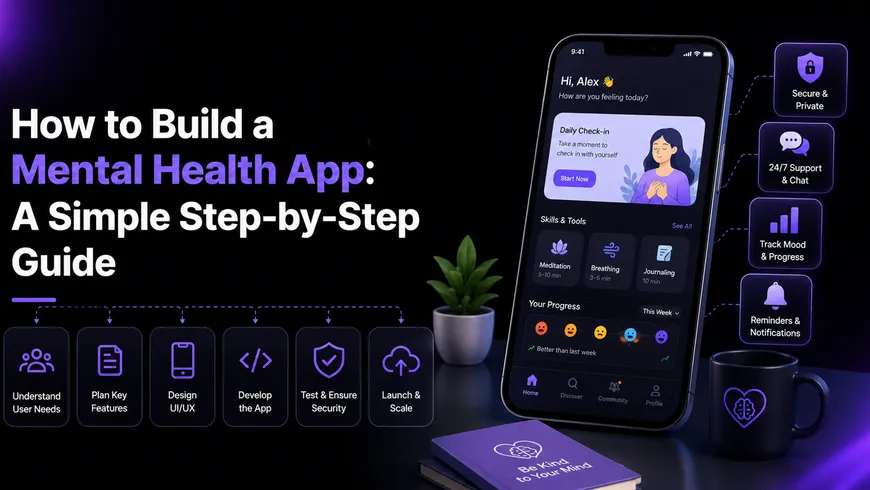
Here is how to build a mental health app in nine steps. Each one ends with an output you can check before moving on.
Step 1: Define the user, condition and outcome
Pick one audience and one problem, such as “adults with mild to moderate anxiety who want CBT skills between therapy visits.” Define how you will know it works, such as engagement and symptom score changes. Output: a one-page product brief.
Step 2: Choose your care model
Decide whether the app is self-guided, coach-supported, clinician-led or a mix. This decides your staffing, your licensure needs and your regulatory exposure. Output: a care model diagram.
Step 3: Decide your regulatory path
Work out whether you are a general wellness product or software that diagnoses or treats a condition, which the FDA may regulate as a medical device. Output: a regulatory memo reviewed by a specialist.
Step 4: Write requirements and a safety plan
Turn the requirement groups above into user stories, and write a crisis protocol: what the app does when someone expresses risk, who is notified and what the user sees. Output: a requirements backlog and a signed-off safety plan.
Step 5: Design for vulnerable users
Keep flows short, language gentle and controls obvious. Avoid streak pressure, guilt notifications and dark patterns. Output: clickable prototypes tested with real users.
Step 6: Build the MVP
Build the smallest set that delivers the outcome: onboarding, consent, one core therapeutic loop, tracking, a crisis path and notifications. Output: a working app on real devices.
Step 7: Secure the data
Encrypt data in transit and at rest, minimize what you collect, separate identity from clinical content where possible, and control every third-party SDK. Output: a threat model and a vendor register.
Step 8: Test with clinicians and users
Test content with licensed clinicians, usability with target users, the crisis flow end to end, accessibility, security and performance on older phones. Output: a test report and a go or no-go decision.
Step 9: Launch, measure and iterate
Launch to a small cohort, watch engagement and outcome measures, collect feedback and release in small increments. Output: a monthly learning review.
Key takeaway: Do not skip steps three and four. Regulatory and safety decisions made late are the most expensive rework in mental health software development.
What features should a mental health app MVP include?
A mental health app MVP should include onboarding with consent, one core therapeutic experience, mood or symptom tracking, reminders, a crisis resource path and secure account management. Add messaging, live sessions, integrations and AI later, once the core loop works.
| Feature | What it does | Priority |
|---|---|---|
| Onboarding and consent | Explains what the app is and is not, collects consent, sets expectations | MVP |
| Mood and symptom tracking | Daily check-ins and validated questionnaires | MVP |
| Core therapeutic content | CBT exercises, breathing, journaling or guided programs | MVP |
| Crisis path | Always-available link to crisis lines and emergency guidance | MVP |
| Reminders and nudges | Gentle prompts that respect the user | MVP |
| Secure messaging | Contact with a coach or clinician | Phase 2 |
| Video sessions and scheduling | Live therapy and booking | Phase 2 |
| Clinician dashboard | Progress views, alerts and notes | Phase 2 |
| Integrations | EHR, wearables, payments, SSO | Phase 2 |
| AI assistance | Summaries, guidance or chat within strict limits | Phase 3 |
What laws and regulations apply to mental health app development?
Four layers apply: HIPAA if you work with providers or plans, FTC rules on health data and advertising, FDA rules if you diagnose or treat, and state laws, which now include AI therapy chatbot rules. The mix depends on what your app claims and who it serves.
| Layer | What it covers | What to do |
|---|---|---|
| HIPAA | Privacy and security for provider and plan data | BAAs, encryption, access control, audit logs |
| FTC | Deceptive or unfair health data practices | Honor privacy promises; no health data for ads without consent |
| FDA | Software that diagnoses, treats or prevents disease | Classify your product; avoid unplanned medical claims |
| State law | Licensure, consent, AI therapy limits, privacy | Map your launch states and AI features |
| App stores | Health claims, data safety, minors | Review store policies before launch |
The FTC is not hypothetical. In its first action of its kind, BetterHelp agreed to pay $7.8 million and was banned from sharing consumers’ health data for advertising. Tracking pixels and ad SDKs inside a mental health app deserve the same scrutiny as your database.
On the FDA side, anything intended to diagnose or treat a condition may be software as a medical device, so read the FDA’s SaMD guidance and talk to a regulatory specialist before you write claims. The FDA’s Digital Health Advisory Committee discussed generative AI mental health devices in November 2025, focusing on evidence, suicide risk monitoring, clinician escalation and post-market surveillance.
Key takeaway: Your claims decide your regulation. Describe the product accurately, and let your lawyers approve every claim.
Can you use AI in a mental health app safely?
Yes, but state law is splitting three ways, so design for the strictest state you will serve. Illinois and Nevada restrict AI from delivering therapy, Utah permits mental health chatbots with disclosure and data rules, and trackers report that a 2026 wave added therapy restrictions in more states. A multistate compliance guide notes that the rules follow where the user is located, not where you are based, and California’s SB 243 requires companion chatbots to have suicide and self-harm protocols from January 2026.
- Disclose clearly that users are talking to AI, and repeat it where the law requires.
- Do not present AI as a therapist, and avoid diagnosis or treatment claims unless you have a regulatory plan.
- Build crisis detection and escalation, with human review and a visible route to crisis lines.
- Keep humans in the loop for clinical decisions, and log AI interactions for review.
- Never sell or share user conversations or health data for advertising.
- Red-team the system with clinicians before launch and after every major model change.
Key takeaway: Use AI for support, structure and summaries first. Let licensed humans make the clinical calls.
Planning a Mental Health or Digital Therapy Product?
EnactOn builds mental health apps with privacy-first architecture, safety-aware flows and human-reviewed AI acceleration, working alongside your clinical and regulatory advisers.
What architecture and tech stack do you need?
A mental health app needs a thin, secure architecture: mobile and web clients, an API layer, a handful of focused services, a protected data layer and clean integrations. Keep sensitive data in as few places as possible.
| Layer | What it does | Typical choices |
|---|---|---|
| Clients | iOS, Android and web apps, clinician console | Native or cross-platform mobile, React web |
| API layer | Auth, rate limits, role checks, versioned APIs | Gateway with OIDC and MFA |
| Core services | Programs, check-ins, notifications, messaging, scheduling | Node.js, .NET or Java services |
| Video and chat | Live sessions and secure messaging | WebRTC provider with BAA support |
| AI services | Summaries, guidance, safety classifiers | Hosted or private models with logging and guardrails |
| Data and security | Encrypted storage, key management, audit logs | Managed database, KMS, monitoring |
Two choices matter most. First, separate identity data from clinical and journal content so a single breach does less damage. Second, audit every third-party SDK, since analytics and ad tools are a common way health data leaks. If you also need to connect to clinics or payers, our enterprise software development work shows how we scope integration-heavy platforms.
How do you test and launch a mental health app?
Test the things that can hurt people first: the crisis flow, the content and the data handling. Then test usability, accessibility and performance, and launch to a small group before you scale.
- Clinical review: licensed clinicians approve content, language and escalation logic.
- Crisis flow testing: simulate risk statements and verify the app responds correctly every time.
- Usability with target users: watch real people complete onboarding and a first session.
- Accessibility checks: screen readers, text scaling and color contrast.
- Security testing: penetration test, dependency scan and SDK review.
- Device testing: real devices, including older phones and slow networks.
After launch, track a short list: activation (finished onboarding), weekly retention, completion of the core exercise, symptom score changes using validated questionnaires, and safety events handled. Share outcome data only in aggregate and with consent.
Key takeaway: Measure outcomes, not just downloads. Retention and symptom change tell you whether the app helps.
It’s Time To Start Building
Mental health app development works best when you treat safety, privacy and regulation as product features. Pick a narrow audience and outcome, decide your care model and regulatory path early, build a small MVP with a crisis path, and keep AI inside clear limits.
Your next step is simple: write your one-page product brief, list the five mental health software requirements you cannot compromise on, and ask a regulatory specialist to review your intended claims. Then sketch your onboarding and crisis flow before you write a line of code. If you want a partner for the build, our software engineering approach explains how we phase delivery.
EnactOn is a Clutch Certified engineering partner with 500+ products delivered for 350+ clients across 65+ countries, and medical is one of the largest industries in our Clutch client mix. For mental health software development, we combine senior-led architecture, human-reviewed AI acceleration and a four-gate QA pipeline, and we work alongside your clinical and regulatory advisers.
FAQs
What is a mental health app?
A mental health app is a mobile or web application that helps people understand, track, manage or treat their mental health. Examples include mood trackers, meditation tools, digital CBT programs, therapy and psychiatry platforms, and clinician tools for measuring progress. Some are general wellness products, while others make clinical claims and face stricter rules.
What are the steps in mental health app development?
There are nine: define the user and outcome, choose a care model, decide your regulatory path, write requirements and a safety plan, design for vulnerable users, build an MVP, secure the data, test with clinicians and users, then launch and measure. Each step should end with a checkable output. The regulatory and safety steps come early because changing them late is costly.
Who needs a mental health app and why?
Startups building direct-to-consumer support, therapy practices and clinics that want to extend care between visits, employers and health plans seeking scalable support, and schools or nonprofits reaching more people with limited staff. The common reason is access: demand for care exceeds clinician capacity, and apps can reach people sooner and at lower cost.
What are the core mental health software requirements?
The core requirements are clinical safety with a crisis path, plain-language consent, clinician-reviewed content, strong privacy and security, accessibility, useful integrations, privacy-safe analytics and AI governance. Write them as user stories before design begins. They shape your architecture as much as your screens.
Is a mental health app a medical device?
It depends on its intended use. A general wellness app that supports relaxation or mood tracking is usually treated differently from software that claims to diagnose, treat or prevent a condition, which may be regulated by the FDA. Your claims and marketing drive classification, so get regulatory advice before launch.
Do I need HIPAA compliance for a mental health app?
If you handle patient information for providers or health plans, you are likely a business associate and need HIPAA safeguards and BAAs. Direct-to-consumer apps may fall outside HIPAA but still face FTC rules and state privacy laws. Either way, treat mental health data as highly sensitive and never share it for advertising without clear consent.
Can I put an AI chatbot in my mental health app?
Yes, but the rules vary by state. Illinois and Nevada restrict AI from delivering therapy, Utah requires disclosure and limits data use for mental health chatbots, and more states added restrictions in 2026. Disclose that users are talking to AI, build crisis escalation, keep humans in the loop and avoid presenting the AI as a therapist.
What features should the first version include?
Include onboarding with consent, one core therapeutic experience, mood or symptom tracking, reminders, a crisis resource path and secure accounts. Add messaging, video sessions, a clinician dashboard, integrations and AI in later phases. A small, safe product that people use beats a large one they ignore.
What drives the cost of mental health app development?
The main drivers are the care model, the number of platforms, integrations, video and messaging, compliance and security work, and any AI features. Clinical content and safety testing add effort that general apps do not need. Ask for a phased estimate with a clear MVP instead of one number for everything.
How do I keep users safe if they are in crisis?
Build an always-visible crisis path with links to crisis lines and emergency guidance, test it thoroughly and define what happens when the app detects risk language. Have licensed clinicians review the protocol and keep humans involved in any escalation. Never rely on an app alone for emergencies.
How does EnactOn approach mental health app projects?
We start with discovery of your audience, care model and compliance needs, then use our Target-Market Alignment work to cut 30 to 40 percent of non-essential scope before building. Senior architects write the specification, AI speeds up delivery under strict human review, and every release passes a four-gate pipeline for functional, security, performance and deployment checks. We work alongside your clinical and regulatory advisers and do not provide clinical or legal advice.