A successful SaaS MVP is more than a simplified product—it's a strategic way to validate your idea, minimize risk, and learn from real users. This step-by-step guide shows how to build an MVP that lays the foundation for long-term growth.
SaaS MVP development allows businesses to validate product ideas with minimal cost and maximum learning.
Every breakthrough in SaaS once sounded like a half-baked idea. A simple chat app. A tool for editing documents in a browser. A platform that gamifies language learning. At first glance, these concepts felt incomplete, too small to matter. Then they grew into Slack, Google Docs, and Duolingo.
That is the paradox of an MVP: what begins as a stripped-down version often turns into the foundation for billion-dollar SaaS companies. By design, a Minimum Viable Product looks unfinished, yet it holds the clearest view into whether customers care enough to use and pay for it.
At EnactOn Technologies, we have seen this play out repeatedly. We have, like the rest of the tech world, been fascinated by MVPs. In the last decade, we have built MVP SaaS solutions for founders in over 20 countries. What convinced us most is that the MVP stage does not just test ideas, it prevents costly mistakes. With the right approach, it becomes a launchpad instead of a detour.
This is why we created this step-by-step guide. It is based on industry research, but also on what we have learned from shipping SaaS MVPs in fintech, healthcare, education, and consumer markets. These are the steps you will find in any MVP playbook, but at EnactOn, we approach them with a focus on clarity and avoidable errors that many founders overlook.
Why SaaS MVP Development Is So Popular Today
Let’s lay down some truth. SaaS MVP development has become popular because it reduces risk and accelerates market validation.
Numbers tell the story:
-
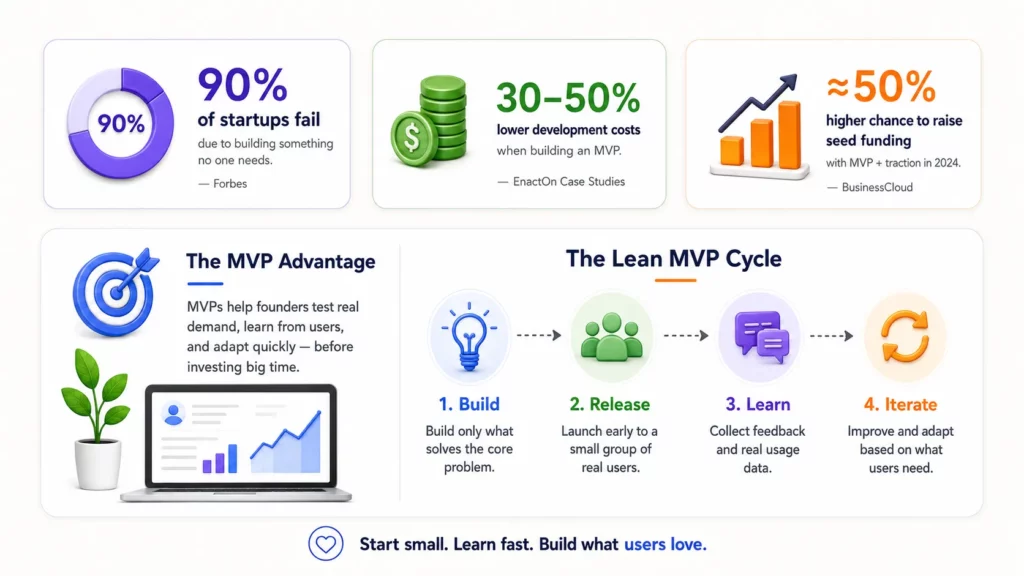
CB Insights’ 2026 analysis of 431 VC-backed startups that shut down since 2023 found that 70% ran out of capital, but the most telling root cause was poor product-market fit, cited by 43%. Explore our comprehensive breakdown of MVP statistics and industry benchmark data to see how structured validation shifts the odds.
-
A SaaS MVP typically costs $5,000–$20,000 with an experienced offshore team, a fraction of a full product build (see our breakdown on MVP development costs).
-
Startups with a working MVP were more than twice as likely to secure seed funding in their first year as those pitching only a concept, according to a Fundable survey reported by BusinessCloud. (See our actionable guide on how to get funding for an app or SaaS platform).
The rise of lean startup methodology encouraged this shift. Instead of betting everything on assumptions, founders now launch an MVP, gather real user data, and adapt quickly. This cycle of release, learn, and refine is faster and cheaper than traditional product launches.
SaaS MVPs are popular because they allow founders to validate demand before scaling.
Step 1: Define the Core Problem and Audience
SaaS MVP development begins with identifying the core problem your product will solve.
This step looks simple but makes or breaks the journey. Many MVP SaaS projects collapse because the product solves five small issues instead of one urgent pain point. Founders who take time to rigorously calculate market potential before writing code avoid chasing non-viable problem spaces.
At EnactOn, we guide founders to sharpen three questions:
-
Who exactly is your primary user group?
-
What top three pain points keep them stuck?
-
Which one is painful enough to pay for right now?
Founder lesson we learned: One HR tech client came to us with ten onboarding features in mind. After discovery workshops, we prioritized one must-have: automated ID verification. Within two months of launch, they had real adoption because the problem was urgent and narrow.
An MVP works only when centered on one validated problem for a clear audience.
Step 2: Prioritize Features That Matter
The heart of SaaS MVP development is selecting features that solve the problem, not showcase everything.
Every founder wants their product to shine. The mistake is to load an MVP with every future idea—one of the classic pitfalls to avoid before developing your MVP. We recommend breaking features into three lists:
-
Must-have features: Directly tied to solving the chosen problem.
-
Nice-to-have features: Helpful later, but not needed for launch.
-
Future vision features: Long-term differentiators, worth documenting but not building yet.
In practice, this discipline works. A fintech client once wanted multi-currency invoicing, analytics dashboards, and payment integrations all at once. We helped them set aside everything their first users didn’t need and start with one feature: automated GST compliance for Indian businesses. That single feature was enough to win their first paying users.
MVP features succeed when they are ruthless about the problem, not generous with extras.
Step 3: Choose the Right Tech Stack
Building a SaaS product requires choosing a tech stack that balances speed, cost, and scalability.
Founders often worry about being future-proof. The better approach is to ask: what helps us launch fastest while keeping doors open for growth?
Popular SaaS MVP stacks today include:
-
Frontend: React or Vue for flexibility and speed.
-
Backend: Node.js, Django, or Laravel for proven scalability.
-
Database: PostgreSQL or MongoDB for reliability.
-
Hosting: AWS, Azure, or GCP for infrastructure on demand.
Proven, widely used frameworks also keep MVP costs down compared with building custom foundations, and they make hiring easier later because more developers already know them.
The right stack for an MVP is lean, reliable, and leaves room to scale later.
Step 4: Design for User Experience First
SaaS MVP development requires UX-first design because users judge products in the first 10 seconds.
Great UX in an MVP is not about fancy animations. It is about clarity. Key principles we apply:
-
Simple navigation: Core tasks should take 3 clicks or less.
-
Consistency: Buttons, colors, and feedback should look and behave the same everywhere.
-
Onboarding flow: Explain value in under 30 seconds with tooltips, examples, or quick tours.
Good MVP design does not need a big budget. Put the design effort into the onboarding flow and the core task, because that is where trial users decide whether to stay.
MVP UX should make the value obvious, not the visuals impressive.
Step 5: Development and Iteration
The MVP SaaS development process is iterative: build, test, and refine in short cycles. (For an end-to-end framework of development milestones and agile sprints, see our comprehensive MVP development process guide).
At EnactOn, we apply four repeatable steps:
-
Build the smallest usable version of the core feature.
-
Release to a limited beta group.
-
Gather feedback and usage data.
-
Improve in 2–4 week sprints.
This mirrors lean startup methodology. Many of the MVPs we build change direction at least once after early testing. Those pivots saved both budget and time, because the product adapted before scale.
Iteration is not optional in MVPs; it is the process itself.
Step 6: Testing and Quality Assurance
MVPs must be reliable enough to use, even if limited in scope.
Our QA approach has two layers:
-
Functional testing: Every must-have feature must work end-to-end (refer to our mobile app testing checklist for structural test cases and regression controls).
-
Compliance and security checks: SaaS products must respect GDPR, HIPAA, or industry-specific regulations from the first release.
In one healthcare MVP, testing compliance early avoided six-figure redesign costs that would have come later.
MVPs can be minimal in features, but they must be stable and compliant.
Step 7: Launching an MVP
Launching an MVP is about gathering insights from early adopters, not chasing scale. For actionable tactical roadmaps, review our guide to proven MVP launch strategies.
Our recommended launch strategies include:
-
A closed beta or waitlist to build anticipation.
-
Early-access incentives like discounts or extended trials.
-
Analytics setup from day one to track activation and retention.
One SaaS client began with a single Tier-2 city rollout before going national. The feedback from local users helped them fix onboarding gaps, which later improved nationwide adoption.
Choose the right launch strategy to test, learn, and improve your MVP.
SaaS MVP vs Full Product: A Simple Comparison
SaaS MVPs and full SaaS products serve different purposes, timelines, and budgets. We often find ourselves guiding founders through the same crossroads when they are looking to build a SaaS product. Do you keep shaping an MVP or take the leap into a full product? A clear side-by-side view helps untangle that decision.
| Aspect | SaaS MVP | Full SaaS Product |
|---|---|---|
| Scope | 1–3 essential features | Complete suite with integrations |
| Timeline | 3–6 months | 12–24 months |
| Cost | $25k–150k | $200k+ |
| Purpose | Test demand and gather feedback | Scale adoption and revenue |
| Risk | Lower, controlled | Higher, requires proven product-market fit |
Learn when to start with an MVP and when to scale into SaaS.
Cost of Building a SaaS Product
A SaaS MVP typically costs $5,000–$20,000 with an experienced offshore team like ours, and $50,000–$250,000 with a US agency for similar scope. Where your product lands depends mostly on how many user types, integrations, and workflows it needs. For a granular financial breakdown by stage and complexity, explore our comprehensive guide on the cost to build an MVP or simulate your specific scope with our interactive MVP cost calculator.
Main cost drivers include:
- Feature set: Each must-have adds time and expense.
- Team model: In-house US developers average $100–150/hour, offshore partners range from $25–50/hour.
- Tech stack choice: Open-source reduces licensing fees.
- Timeline: Shorter deadlines require larger teams.
Typical ranges when we build a SaaS MVP at EnactOn:
| SaaS MVP type | Typical cost | Typical timeline |
|---|---|---|
| Basic: one user type, one core workflow, sign-up and billing | $5,000–$10,000 | 8–12 weeks |
| Standard: more roles, a few integrations, an admin dashboard | $10,000–$20,000 | 10–14 weeks |
| AI-powered: model integration, data pipeline, answer testing | $15,000–$35,000 | 10–16 weeks |
| Regulated: healthtech or fintech with compliance requirements | $20,000–$50,000 | 12–16 weeks |
MVP cost efficiency comes from leaving out what your first users don’t need, not from reducing quality.
How Long Does It Take to Build a SaaS MVP?
A Basic SaaS MVP usually takes 8–12 weeks from discovery to launch. The time goes roughly into one to two weeks of discovery and scoping, one to two weeks of design, five to six weeks of development, and one to two weeks of testing and deployment.
What stretches the timeline is rarely the code itself. The usual causes are scope that keeps changing during the build, third-party integrations with slow approval processes (payments, app marketplaces, enterprise systems), compliance reviews, and slow feedback from the founder’s side. Agreeing on the must-have list before development starts protects the timeline more than anything else.
SaaS MVP Paid Tester Acquisition Strategies
Acquiring paid testers proves real willingness to pay before scaling. For a step-by-step playbook on recruiting your first 100 beta champions, read our guide on tester acquisition strategies.
Effective strategies we apply include:
-
Freemium-to-paid model: Convert engaged free users into testers.
-
Lifetime deal offers: 30–50% discounts for early signups.
-
Community targeting: LinkedIn groups, Slack communities, or niche Reddit forums.
-
Accelerator partnerships: Founders’ cohorts often provide quality testers.
A SaaS HR product we supported gained 500 paid testers in six weeks by targeting HR managers through LinkedIn campaigns with pre-launch offers.
Paid testers reveal true market validation more than free trial users.
B2B SaaS MVP: What’s Different
A B2B SaaS MVP follows the same steps, but a few things change:
- Fewer users, deeper relationships: five to ten design partners who use the product every week teach you more than a thousand free sign-ups.
- The buyer is not always the user: build for the daily workflow of the person using it, and give the person paying a clear reason to renew, such as a report showing time or money saved.
- Some basics come earlier: user roles and permissions, data export, and answers to security questionnaires often matter before launch, even if single sign-on can wait.
- Sell before you build: letters of intent or paid pilots are stronger proof than a waitlist.
- One integration can beat new features: connecting to a tool your customers already use every day (a CRM, accounting software, or Slack) often drives adoption more than anything else on the roadmap.
Metrics That Define MVP Success
This is the baseline as far as we are concerned: An MVP is successful when people use it, return to it, and pay for it.
We track a handful of simple but powerful metrics for every MVP:
-
Activation rate: How many users complete the first key action?
-
Day-7 and Day-30 retention: Are they coming back?
-
Conversion rate: How many free users turn into paying testers?
-
Churn rate: How many leave after trying it?
-
Time to first revenue: How fast do you earn the first dollar?
Patterns repeat. When activation crosses 25% and Day-30 retention holds at 15% or more, scaling usually makes sense. These numbers mean the product has a pull, not just a push.
MVP success is measured in adoption, retention, and payment, not just downloads.
Common Mistakes Founders Make in SaaS MVP Development
Most SaaS MVPs fail due to lack of focus, not lack of technology.
Patterns we repeatedly see:
-
Overloading with features.
-
Postponing compliance checks.
-
Ignoring onboarding design.
-
Launching without analytics.
-
Avoiding early pricing tests.
Founders who avoid these pitfalls save themselves 6–12 months of wasted effort. Read our in-depth analysis of the 10 mistakes to avoid before developing your MVP to benchmark your product strategy.
Founder Psychology During the MVP Stage
The toughest challenges in SaaS MVP development often come from inside the founder’s head.
We have sat with countless founders at this stage, and many share the same doubts:
-
“What if it looks too raw?” The hesitation to show something simple is very real. Yet early users care more about whether it helps than how polished it looks.
-
“What if we cut too much?” Letting go of features is hard when you see the bigger vision. The truth is that restraint creates clarity.
-
“Should we even ask people to pay yet?” Many founders worry about charging too soon. In practice, pricing early shows you whether you have real demand or just polite curiosity.
A quick self-check: If you are endlessly refining features, only hearing feedback from friends, or avoiding pricing experiments, you may be stuck in the hesitation loop.
Explore successful SaaS MVPs and the lessons behind their growth.
Nuanced Founder Tips We’ve Learned
It wasn’t all self-doubt. Working with founders has given us lessons that go beyond playbooks:
-
“Friends’ feedback misleads.” Strangers are the real market.
-
“Price from day one.” Validation without payment is incomplete.
-
“Track actual logins.” Applause is noise, usage is proof.
The wisdom of experienced founders reminds us that adoption and payment are the only true validations.
Scaling Beyond MVP: When to Transition
An MVP should grow into a full product only once demand is repeatable.
We often ask founders three questions at this stage:
-
Are new users showing the same adoption and retention patterns as early testers?
-
Do paying customers renew or expand their use without needing discounts?
-
Is the product stable enough to handle larger loads without breaking?
When the answers are yes, scaling is safer. The SaaS MVPs that we saw scale smoothly typically had 500 or more active paying users before building out additional features. That base creates confidence that the investment ahead is justified.
The right time to scale is when your MVP proves demand across multiple groups, not just the first circle of users.
Future Trends in SaaS MVP Development
To build a SaaS product is changing drastically with AI and low-code tools.
Emerging trends include:
-
AI copilots and vibe coding practices dramatically compressing software engineering cycles.
-
No-code and AI app builders shortening the path to a clickable prototype, though production builds still need engineering review.
-
Advanced analytics for early pivots.
-
Global-first launches made possible by instant localization.
The next generation of MVPs will be faster to build and smarter to adapt.
Frequently Asked Questions on SaaS MVP Development
What is SaaS MVP development?
SaaS MVP development is the process of building a simplified version of a SaaS product with core features to test market demand, validate assumptions, and reduce launch risks.
Why is launching an MVP important for SaaS startups?
Launching an MVP helps SaaS startups validate demand before full investment. CB Insights’ 2026 analysis of 431 VC-backed startups that shut down since 2023 found poor product-market fit was the most telling root cause, cited by 43%. An MVP limits spending to what proves the idea, gathers user feedback early, and gives investors real traction to look at.
How much does it cost to build a SaaS product MVP?
With an experienced offshore team like EnactOn, a SaaS MVP typically costs $5,000–$20,000: $5,000–$10,000 for a Basic MVP with one core workflow and $10,000–$20,000 for more roles and integrations. AI-powered SaaS MVPs run $15,000–$35,000, and US agencies often quote $50,000–$250,000 for similar scope.
What are common mistakes in MVP SaaS development?
The most common mistakes in MVP SaaS development are adding too many features, delaying compliance checks, skipping onboarding design, ignoring analytics setup, and not validating pricing with paying users.
What strategies help acquire paid testers for a SaaS MVP?
Effective SaaS MVP paid tester acquisition strategies include freemium-to-paid upgrades, lifetime deals, niche community outreach, accelerator partnerships, and LinkedIn campaigns targeting decision-makers in the right industries.
How does lean startup methodology support SaaS MVP development?
Lean startup methodology supports SaaS MVP development by emphasizing build-measure-learn cycles. Startups release small versions, test with users, gather feedback, and iterate quickly, saving both time and capital.
Can you explain the different app categories available in the App Store?
Apple lets each iOS app pick a primary and optional secondary category: Games, Business, Health & Fitness, Education, Productivity, Social Networking, Utilities and others, for browsing and search placement. For an MVP, choose the category that captures its central use-case to boost discoverability.
SaaS MVP development remains the most reliable path to product validation before scale.
When founders commit to one problem, build only what matters, and validate with real users, they not only save money but create a foundation for growth. At EnactOn, every successful SaaS MVP we have built shared this pattern: focus, clarity, and willingness to adapt.
A SaaS MVP is not just a smaller version of a product, it is the foundation of a scalable one.