
Before you think about how to get funding for an app, you need to understand a hard truth. Investors do not fund ideas. They fund signals. If all you have is an idea and a deck, your chances are weak. Not zero, but weak.
Funding comes in stages, and each stage expects different proof.
At the earliest stage, you are not selling the app. You are selling your ability to execute. That means clarity of problem, clarity of user, and clarity of why you are the one building it.
If you skip this step and jump straight into investor meetings, you will waste time and burn credibility.
Ways to Get Funding for an App: From Bootstrapping to VC
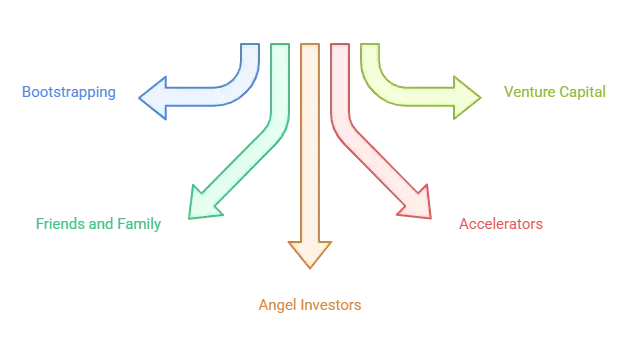
Bootstrapping Is Not a Step Down
If you are serious about how to get funding for an app, bootstrapping is often the smartest first move. It forces discipline. It forces focus. It also gives you leverage later.
Build a basic version. Not a perfect one. A usable one. Something that solves one painful problem for one type of user. Charge early, even if it feels uncomfortable. Revenue is the strongest signal you can show.
Many founders chase funding to avoid hard decisions. That is lazy. Investors can smell that instantly.
If you still think bootstrapping won’t help in long term, check these top bootstrapped companies. You will be amazed after seeing names.
Friends and Family Money Is Still Investor Money
When people talk about how to get funding for an app, they love skipping the uncomfortable part. Asking people you know.
Friends and family funding works only if you treat it professionally. Clear terms. Clear expectations. No emotional promises. If you cannot explain your app and risk clearly to someone who knows you, you are not ready for strangers.
This stage is less about the amount and more about momentum.
Angel Investors Want Evidence, Not Excitement
Angels are often the first “real” step when learning how to get funding for an app. They invest earlier than VCs, but they are not clueless. Most angels have built or funded companies before.
They want to see:
● A real problem
● Early users or strong validation
● A founder who understands numbers
● A clear next milestone
If your pitch sounds like a dream instead of a plan, you will lose them fast.
Learn about what investors look for when funding a startup here.
Accelerators Are Not Magic Tickets
Accelerators help when used correctly. They give structure, network, and sometimes small capital. But getting into one does not mean you cracked how to get funding for an app.
Accelerators expect speed. Weekly progress. Measurable outcomes. If you join one without a clear product direction, you will drown.
Apply only when you are ready to move fast.
Venture Capital Comes Later Than You Think
Most apps should not raise VC money early. That might hurt your ego, but it will save your company.
VC funding expects scale. Big market. Fast growth. A path to large returns. If you are still figuring out basic usage or retention, VC money will pressure you in the wrong direction.
Understanding how to get funding for an app also means knowing when not to raise.
| Aspect | Pros | Cons |
|---|---|---|
| Capital availability | You get access to large sums of money faster than bootstrapping | Easy money encourages careless spending |
| Speed of growth | Helps you hire faster and build quicker | Forces growth before product is truly ready |
| Credibility | Investor backing builds trust with customers and partners | Fake credibility hides weak fundamentals |
| Mentorship | Good investors bring experience and guidance | Bad investors interfere and slow decisions |
| Network access | Easier access to partners, talent, and future investors | Network pressure can push wrong priorities |
| Risk sharing | Financial risk is shared instead of personal savings only | Emotional pressure increases with other people’s money |
| Market expansion | Enables aggressive marketing and expansion | Expansion too early increases burn and churn |
| Valuation upside | Successful exit can multiply wealth | Dilution reduces your ownership and control |
| Accountability | External pressure enforces discipline and milestones | Constant reporting kills founder focus |
| Long-term outcome | Can lead to large exits and scale | Failure becomes public and harder to recover |
How to Pitch an App Idea: Cut the Drama, Show the Logic
Now let us talk about how to pitch an app idea, because this is where most founders embarrass themselves.
A pitch is not a story about your passion. It is a short argument about why this app should exist and why it should win.
If your pitch needs hype to sound interesting, the idea is weak.
Start With the Problem, Not the App
The first rule of how to pitch an app idea is brutal and simple. If the problem is not painful, stop.
Describe the problem in a way that makes the listener nod immediately. Use real scenarios. Real users. Real consequences.
Do not say “people struggle with productivity.” That is vague and useless. Say who struggles, when, and what happens because of it.
If you cannot make the problem feel obvious, no pitch will save you. When scoping your initial mobile MVP development, narrowing down to one core pain point ensures both users and investors immediately grasp your value proposition.
Your Solution Should Feel Inevitable
When explaining, your solution should feel like the natural answer to the problem you just described.
Avoid feature dumping. Investors do not care about ten features. They care about one clear value.
Explain what your app does in one sentence. If it takes more, you are confused.
Market Size Is About Focus First
People mess this up constantly when learning to pitch an idea. They talk about billion-dollar markets without owning a single niche.
Start small. Show that a specific group desperately needs this app. Show how many of them exist. Show how you reach them. Calculating market potential accurately demonstrates to investors that your initial serviceable obtainable market is grounded in reality.
Big markets are built from dominated niches, not slides. Executing structured MVP launch strategies gives you the early user acquisition numbers and engagement velocity needed to prove market demand.
Show Traction or Show Learning
If you have traction, show it clearly. Users, growth, retention, revenue. Keep it simple.
If you do not have traction yet, show learning. Experiments run. Feedback collected. Changes made. Decisions backed by data.
This is a critical part of pitching an app idea. Progress beats polish every time.
Business Model Should Be Obvious
Do not get fancy here. Explain how money comes in. Who pays. Why they pay. How often they pay. If you are building a freemium or consumer product, knowing exactly how free apps make money—whether through subscriptions, in-app purchases, or transaction fees—removes ambiguity during due diligence.
If you cannot explain your pricing without justifying it emotionally, it is not ready.
Investors do not expect perfection, but they expect logic.
The Team Slide Is Not a Resume Dump
When discussing the pitching plan, the team slide is where you answer one question. Why you.
Highlight relevant experience. Past wins. Unique insight. Ability to execute.
Nobody cares about irrelevant achievements. Keep it tight.
Ask for Money With a Reason
The worst pitches end with “we are raising X.” That is lazy.
Explain how much you are raising, why that amount, and what milestone it unlocks. Hiring. Product launch. Revenue target.
This shows maturity. It also shows you understand how to get funding for an app responsibly.
Do’s and Don’ts When You Pitch an App Idea for Funding
| Area | Do | Don’t |
|---|---|---|
| Problem | Clearly define one painful, specific problem | Describe a vague or universal problem |
| Opening | Start with the problem and who it affects | Start with your app name or vision |
| Explanation | Explain the idea in one clear sentence | Ramble or stack features |
| Validation | Show real users, feedback, or data | Say “people will love this” |
| Market | Focus on a niche you can dominate | Claim everyone is your customer |
| Differentiation | Show why you win differently | Say “no competitors” |
| Numbers | Know basic metrics and assumptions | Avoid numbers or guess them |
| Business model | Explain how money comes in simply | Say “we’ll figure it out later” |
| Traction | Show progress, even if small | Hide lack of progress |
| Team | Highlight relevant execution skills | Read resumes or titles |
| Ask | Clearly state how much you’re raising and why | Ask for money without a plan |
| Mindset | Stay calm and logical | Try to impress or oversell |
| Questions | Answer honestly and directly | Get defensive or dodge |
| Close | End with next steps or milestones | End abruptly or with hype |
Common Mistakes That Kill Your App Funding Chances
Let us be blunt.
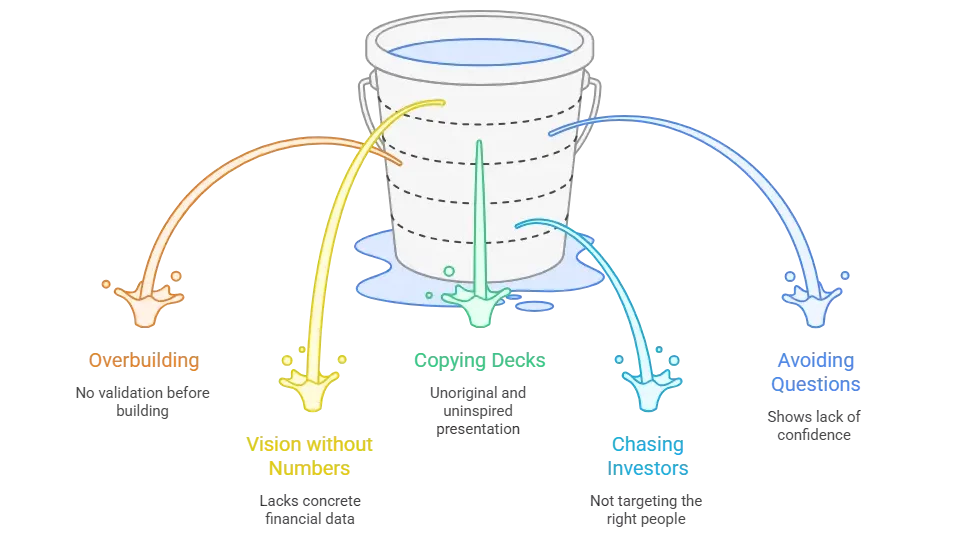
If you do these, your chances drop fast.
● Overbuilding before validation (one of the most common MVP development mistakes).
● Pitching vision without numbers.
● Copying decks from the internet.
● Chasing every investor instead of the right ones.
● Avoiding hard questions.
Understanding this also means understanding why most apps do not get funded.
How Funding and Pitching Work Together
Here is what most founders miss. Funding and pitching are not separate skills. They are connected.
Your pitch improves as your product improves. Your funding chances improve as your clarity improves.
The goal is not to impress. The goal is to convince logically.
Strong apps make pitching easier. Weak apps need theatrics.
Final Advice You Probably Need to Hear
If your idea cannot survive without funding, it is already in trouble. Funding should accelerate growth, not create it.
If your pitch depends on buzzwords, trends, or hype, rewrite it. If you cannot explain your app to a smart friend without slides, you are not ready.
Learn this by building something people want. Learn how to pitch an app idea by respecting the intelligence of the person listening.
Everything else is noise.
If you’re serious about funding, the fastest path is building proof. That’s where working with an MVP team pays off. You avoid overbuilding, cut wasted months, and launch something users can actually use and pay for. With experts, you get clearer scope, better execution, and cleaner metrics to show investors.
EnactOn provides founders with end-to-end MVP development services, helping you build the right MVP, validate it with real users, and walk into funding conversations with traction instead of a “trust me” story.
FAQs
1) When is the right time to look for funding for an app?
The right time is when you have clarity on the problem, a usable product, and early validation. This could be active users, paid customers, or strong pilot interest. Funding should help you scale what already works, not help you figure out basics.
2) Do I need investors to launch my app successfully?
No. Many apps start by bootstrapping or using small amounts of personal or friends and family capital. Investors become useful when growth opportunities are clear and capital can accelerate progress. If your app cannot survive without investors, the foundation is weak.
3) What do investors actually look for when funding an app?
Investors look for a real problem, a defined user group, early traction or learning, a logical business model, and a founder who can execute. They are less interested in ideas and more interested in proof and decision-making ability.
4) How do I pitch an app idea if it is still early stage?
Focus on the problem, your insight, and what you have tested so far. Share experiments, user feedback, prototypes, or early metrics. Early-stage pitching is about showing progress and thinking clearly, not showing perfection.
5) What is the biggest mistake founders make while raising funds?
Chasing money before building value. Many founders try to raise funds to validate their idea instead of using the product to do that. This leads to weak pitches, bad investor fit, and pressure to grow before the app is ready.



![Add Daily Streak Feature & Boost Retention [Developer's Guide]](/assets/images/Daily-Streak-Feature-CrngYAnj_Z1rD3F2.webp)