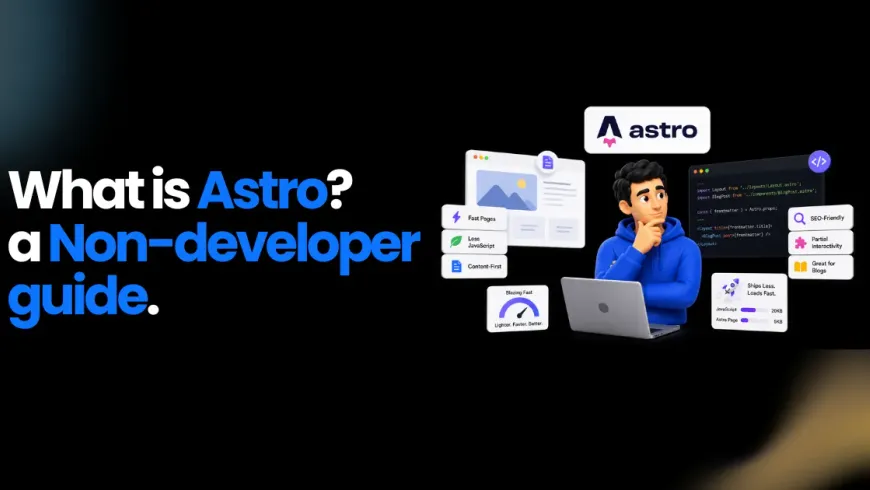
Astro is not a CMS, and it is not a drag-and-drop website builder.
It is the framework developers use to build the website itself.
For a founder or marketing lead, the practical question is simpler:
Can Astro give a business website strong performance and technical control without turning every page into a heavy JavaScript application?
For content-driven websites, that is exactly the problem Astro was designed to solve.
What Is Astro in Simple Terms?
Astro is a web framework used to build and render websites, with a particular focus on sites where content is more important than constant client-side interactivity.
Astro describes itself as a web framework for content-driven websites such as blogs, marketing sites, and e-commerce sites.
A simple way to picture it is:
Your content and data
Articles, service pages, product information, images, case studies, CMS content, APIs, or other data.
↓
Astro
Turns that information into the pages visitors receive.
↓
The visitor’s browser
Receives finished HTML for most of the page, plus JavaScript only where the experience actually needs it.
That last step is the important difference.
Many modern frameworks were designed first for web applications. Astro was designed first for content-rich websites.
Why Was Astro Created?
Astro was created because most content websites do not need to behave like large JavaScript applications.
A SaaS dashboard, collaborative editor, inbox, or social network may need substantial browser-side logic.
A typical company website usually does not.
A marketing page might contain:
-
A headline
-
Service or product information
-
Images
-
Customer logos
-
Case studies
-
FAQs
-
Navigation
-
A form
-
One or two interactive tools
Most of that page is content.
It does not need a large amount of JavaScript just to appear on screen.
Astro starts from that assumption. It does more rendering before the page reaches the visitor and adds browser-side JavaScript only where the page genuinely needs it.
Why that matters: a content-heavy website does not have to carry application-level JavaScript overhead simply because it was built with modern web technology.
How Does Astro Work?
Astro renders the non-interactive parts of a page as HTML and lets developers add JavaScript-powered components only where interactivity is needed.
Imagine a pricing page with:
-
A navigation menu
-
Product copy
-
Images
-
A comparison table
-
Testimonials
-
A pricing calculator
-
A lead form
The copy, images, table, and testimonials can be delivered as HTML.
The calculator needs JavaScript.
The mobile navigation may need JavaScript.
The rest of the page does not need to become a client-side application.
Astro calls these interactive areas client islands.
According to the official Astro islands documentation, framework components render to HTML by default, while client-side JavaScript is added when a component is explicitly hydrated in the browser.
Why that matters: the browser can spend less time downloading, parsing, and executing code that the page did not need.
What Makes Astro Different From Other Web Frameworks?
Astro’s documentation describes five core design principles: content-driven, server-first, fast by default, easy to use, and developer-focused.
For a business stakeholder, those principles translate into five practical differences.
1. Astro Is Built Around Content-Driven Websites
Astro is designed for websites where visitors primarily come to read, compare, research, browse, or discover information.
Common fits include:
-
Marketing websites
-
SaaS websites
-
Professional-services websites
-
Blogs and publishing sites
-
Documentation
-
Landing pages
-
Product directories
-
E-commerce storefronts
This focus lets Astro make performance decisions that would be harder for a framework designed mainly around highly interactive applications.
2. Astro Is Server-First
Astro prefers to render content before it reaches the visitor instead of automatically asking the visitor’s browser to do the work.
That does not mean every Astro page must be static.
Astro supports both prerendered pages and on-demand server rendering.
Why that matters: less unnecessary work on the visitor’s device can produce a faster and more predictable experience, especially on mobile devices and slower connections.
3. Client-Side JavaScript Is Opt-In
Astro does not automatically ship browser-side JavaScript for every component on the page.
Astro’s documentation describes this as zero JavaScript by default.
Developers can still add JavaScript wherever it is needed.
Why that matters: interactive features can remain interactive without forcing the entire page to carry the same JavaScript cost.
4. Astro Can Use React, Vue, Svelte, and Other UI Frameworks
Choosing Astro does not mean a development team has to abandon the UI frameworks it already knows.
Astro has official support for React, Preact, Svelte, Vue, SolidJS, and AlpineJS, and multiple supported UI frameworks can be used inside the same Astro project.
For example:
-
A React pricing calculator can remain React.
-
A Svelte interactive widget can remain Svelte.
-
A Vue component can remain Vue.
-
Astro can render the surrounding content as lightweight HTML.
Why that matters: a migration may be able to preserve useful interactive components and existing development expertise instead of rebuilding everything around one framework.
5. Static and Dynamic Rendering Can Coexist
Astro is static-first, not static-only.
Pages that do not need request-time data can be generated ahead of time.
Routes that do need request-time logic can use on-demand rendering.
A single Astro site can therefore use:
-
Static generation for articles, service pages, documentation, and landing pages
-
Server rendering for personalized or request-dependent routes
-
Client islands for interactive components
Why that matters: one dynamic feature does not force the entire website to use the same rendering model.
Why Is Astro Fast?
Astro’s performance advantage starts with reducing unnecessary browser-side work. It is a strong default, not a guarantee that every Astro website will automatically be fast.
A well-built Astro page can stay lightweight because most content is rendered before it reaches the browser and JavaScript is included selectively.
Independent data supports that lightweight default.
In Search Engine Journal’s analysis of April 2026 HTTP Archive and Chrome UX Report data, Astro recorded:
-
The lightest median page weight in the seven-platform comparison at 1.65 MB
-
The highest Lighthouse audit score in the comparison at 68
-
A 67% good Core Web Vitals rate
WordPress measured a 2.76 MB median page weight and a Lighthouse audit score of 44 in the same comparison, while approximately 49% of WordPress sites received a good Core Web Vitals score.
The same data also shows why performance should not be reduced to one platform ranking. Wix, Shopify, and Duda had higher real-world Core Web Vitals pass rates than Astro in that dataset.
So the useful conclusion is not:
“Every Astro site is faster than every website built with another platform.”
It is:
Astro gives developers a lightweight starting architecture, while real-world performance still depends on implementation, images, scripts, hosting, caching, third-party tools, and the complexity of the site.
What Does Astro’s Performance Mean for a Business Website?
The architecture matters because of what it can improve for the people using the site and the business operating it.
User Experience
Visitors can receive the main content quickly, while the browser has less unnecessary code to process before the page becomes usable.
Search Performance
Google recommends good Core Web Vitals for Search and user experience and states that Core Web Vitals, together with other page-experience aspects, align with what its core ranking systems seek to reward.
Speed is not a substitute for:
-
Relevance
-
Useful content
-
Links and authority
-
Search intent satisfaction
-
Technical accessibility
-
Competition
-
Other ranking signals
It is one part of the overall search and user experience.
Conversion and Engagement
A slow page adds friction between the search result, the landing page, and the action the visitor came to take.
A faster page does not guarantee more leads or sales, but it removes one common reason visitors leave before engaging with the content or offer.
Technical Control
A deliberately lightweight architecture can make it easier for developers to see which scripts, integrations, and interactive features are adding browser work.
What Types of Websites Can You Build With Astro?
Astro is strongest when content is central to the website and interactivity is selective rather than constant.
Marketing and Company Websites
Astro is a strong fit for:
-
SaaS marketing sites
-
Startup websites
-
B2B company websites
-
Professional-services websites
-
Product marketing sites
-
Campaign landing pages
-
Resource centers
These sites usually need strong content delivery, SEO control, analytics, forms, and selected interactive features without behaving like full web applications.
Blogs, Publishing, and Documentation
Astro works well for content-heavy sites that need:
-
Articles
-
Editorial content
-
Knowledge centers
-
Documentation
-
Case-study libraries
-
Resource libraries
It supports Markdown, MDX, content collections, APIs, databases, and CMS integrations.
E-commerce Storefronts
Astro can power product, category, editorial, and merchandising pages while commerce systems handle functionality such as inventory, cart, checkout, payments, and customer accounts.
Whether Astro is the right fit depends on how much of the storefront is content-led versus deeply application-like.
Large Content Directories
Astro can also suit:
-
Integration directories
-
Location pages
-
Product libraries
-
Comparison pages
-
Industry directories
-
Large programmatic content systems
This becomes attractive when many pages need to remain fast, crawlable, and easy to deliver without unnecessary browser-side code.
Can Astro Build Dynamic and Interactive Websites?
Yes. Astro can support both dynamic server-rendered routes and interactive browser components.
There are two different kinds of “dynamic” behavior to understand.
Request-Time Dynamic Pages
A page can be rendered on demand when the response depends on information available at request time, such as:
-
Personalized content
-
Session or cookie data
-
Authenticated experiences
-
Request-specific API data
Interactive Browser Features
A page can also include interactive islands for:
-
Forms
-
Calculators
-
Filters
-
Search
-
Animations
-
Carts
-
Interactive navigation
-
React, Vue, Svelte, or other supported components
Astro is therefore not limited to static brochure websites.
The important distinction is that dynamic behavior is added where the website needs it instead of becoming the default architecture for every part of every page.
When Is Astro Not the Right Choice?
Astro is not always the best default when the product is primarily a highly interactive web application rather than a content-driven website.
An application-focused framework may be a better starting point when:
-
Most screens sit behind a login
-
Nearly every route is personalized
-
Many components continuously share live client-side state
-
Real-time application behavior is the core product
-
The interface behaves more like desktop software than a content website
-
The existing application architecture already solves these requirements well
Examples can include complex project-management tools, collaborative editors, trading interfaces, and highly stateful SaaS dashboards.
Astro can support dynamic functionality, but the framework should match the dominant workload.
A company can also use Astro for its public marketing website while keeping the logged-in application on a different framework.
Is Astro a CMS?
No. Astro is a web framework. A CMS is only one possible source of content for an Astro website.
Astro can work with content from:
-
Headless CMS platforms such as Contentful, Sanity, Strapi, Storyblok, Hygraph, TinaCMS, and others
-
WordPress used as a headless CMS
-
Markdown or MDX
-
APIs
-
Databases
-
Astro content collections
-
Custom content systems
The two technologies solve different problems.
A CMS answers: Where does the content live, and how does the team manage it?
Astro answers: How is the website built and how is that content delivered to visitors?
The CMS, if one is needed, should be selected around the team’s editorial workflow, content structure, governance, integrations, and technical requirements.
Astro itself does not force a particular CMS choice.
How Do Non-Technical Teams Edit an Astro Website?
The editing experience depends on the content system connected to the site, not on Astro itself.
A common setup looks like this:
-
A development team builds the Astro website.
-
A CMS or other content source is connected.
-
Marketers edit content through that system.
-
Astro renders and delivers the updated website.
Depending on the company, the content workflow might use:
-
WordPress as a headless backend
-
A visual headless CMS
-
A structured enterprise CMS
-
Markdown or MDX for developer-managed content
-
A custom editorial system
So the practical distinction is:
Astro is developer-led to build, but the finished website does not have to be developer-dependent for routine content publishing.
Most “Astro JS for beginners” tutorials are aimed at developers learning the framework. A marketer or content editor does not need to learn Astro’s code syntax simply to update a properly configured website.
How Is Astro Different From WordPress and Website Builders?
Astro is a development framework. WordPress is a CMS and website platform, while tools such as Wix, Squarespace, and Webflow bundle more of the website-building and editing experience into a hosted product.
For teams evaluating a replatforming project, the tradeoffs become clearer when looking at direct comparisons:
- In Astro vs WordPress, the tradeoff centers on monolithic plugin convenience versus decoupled speed, security, and lower hosting overhead. For broader CMS evaluations, explore other modern WordPress alternatives.
- In Astro vs Wix, businesses weigh closed drag-and-drop convenience against full code ownership and perfect Core Web Vitals scores.
- In Webflow vs Astro, visual designer workflows are weighed against developer ergonomics, component reusability, and raw front-end execution.
At a high level:
| Header Label | Astro | WordPress | Hosted Website Builder |
|---|---|---|---|
| Main role | Web framework | CMS + website platform | All-in-one website platform |
| Content editor included | No | Yes | Yes |
| Front-end architecture | Developer-controlled | Theme/plugin-based | Platform-controlled |
| Rendering | Static and/or on-demand | Commonly server/database-driven, often with caching | Managed by the platform |
| Interactivity | Added where needed | Added through theme/plugins/custom code | Added through platform features |
| Technical flexibility | High | High, but shaped by WordPress architecture | Lower than a custom framework |
| Initial development need | Usually yes | Varies | Usually low |
This does not mean every WordPress site is slow or every hosted builder is restrictive. It means the operating models are different. Astro makes the most sense when the additional architectural control is valuable enough to justify professional development. If planning project timelines and budget, reviewing how much Astro development costs and vetting specialized Astro development companies helps clarify engineering scope before kickoff.
Is Astro Good for SEO?
Astro can provide a strong technical foundation for SEO, but the framework itself does not create rankings.
Astro can help developers produce crawlable HTML, control metadata and URLs, implement structured data, manage redirects, optimize images, and keep page delivery lightweight.
Those are useful technical foundations.
Rankings still depend on the complete search picture, including content quality, relevance, links, authority, intent satisfaction, competition, indexability, and other signals.
For this introductory article, the important takeaway is simple:
Astro can remove technical performance and rendering constraints, but it does not replace an SEO strategy.
Is Astro Production-Ready in 2026?
Yes. Astro is an actively maintained open-source framework with continued releases, broad framework and hosting support, commercial backing, and real production adoption.
In January 2026, The Astro Technology Company joined Cloudflare. Astro stated that the framework would remain free, open source, MIT-licensed, and platform-agnostic.
Astro 7 launched in June 2026. The current Astro 7.2 release was published in August 2026 and added, among other changes, experimental incremental static builds for large prerendered sites.
For a business evaluating technology risk, the relevant points are:
-
The framework is actively maintained.
-
Astro remains open source.
-
Deployment is not restricted to Cloudflare.
-
Major UI frameworks and hosting providers are supported.
-
New releases are continuing.
-
Astro is being used for production websites.
That makes Astro a very different decision today from betting on an experimental framework with an uncertain future.
What Has EnactOn Seen From Real Astro Migrations?
EnactOn has migrated more than 10 client websites from WordPress and other website platforms to Astro during the three months leading up to August 2026. Around 90% of those client sites subsequently saw improved search rankings and/or increased organic clicks in EnactOn’s post-migration tracking.
One recent WordPress-to-Astro migration also showed a clear before-and-after performance improvement in real-user field data.
| Mobile metric | Before migration | After migration |
|---|---|---|
| Core Web Vitals status | Failed | Passed |
| Largest Contentful Paint (LCP) | 2.7s | 1.0s |
| Time to First Byte (TTFB) | 1.7s | 0.5s |
In that project, EnactOn rebuilt the website in Astro while preserving the existing design, content, URLs, metadata, and SEO structure.
The organic-search figure should be interpreted appropriately.
It is first-party post-migration experience, not a controlled study proving that Astro alone caused every ranking or traffic improvement. Search visibility can also change because of content, links, technical corrections, competition, seasonality, and Google updates.
The individual migration gives a concrete before-and-after example of what changed on the rebuilt site.
For EnactOn, an Astro migration is therefore not simply a framework swap. The goal is to improve the technical foundation while preserving the design, content, URL structure, metadata, and SEO-critical elements that are already working.
When Should a Business Choose Astro?
Astro is worth serious consideration when the website is primarily content-driven and performance, organic visibility, technical control, and maintainability matter enough to justify a professionally built site.
Astro is a strong fit when:
-
Organic search is an important acquisition channel
-
The site is primarily marketing, publishing, documentation, product, or informational content
-
Performance problems keep returning
-
Plugin or platform dependencies are becoming difficult to control
-
The business wants more control over the front-end architecture
-
The team wants to choose its content system independently from the public website
-
Existing React, Vue, Svelte, or other supported components may need to be reused
-
The company is rebuilding an existing website and wants a cleaner long-term architecture
Astro is less compelling when:
-
The existing website is already fast, stable, easy to operate, and meeting business goals
-
The company has no access to development support and needs a completely self-service website builder
-
The project is fundamentally a highly stateful web application
-
The cost of rebuilding is unlikely to create a meaningful business or operational benefit
The correct question is not whether Astro is newer technology.
It is:
Does Astro solve a problem this website actually has?
What Is Astro, in One Sentence?
Astro is a content-focused web framework that renders most website content as lightweight HTML and adds client-side JavaScript, server rendering, UI frameworks, and dynamic functionality only where the website actually needs them.
That is what makes Astro attractive for modern marketing and content websites.
It starts with a lightweight architecture, but it can still support the interactivity, content systems, integrations, and dynamic features required by a serious business website.
EnactOn provides Astro development services for new websites and Astro migration services for companies rebuilding existing sites in Astro.
Build or migrate to a high-performance Astro website with expert guidance.
FAQs
What is Astro used for?
Astro is used to build content-driven websites such as marketing sites, blogs, documentation, landing pages, product pages, directories, and e-commerce storefronts. It is strongest when most of the page is content and only selected parts need client-side interactivity.
Is Astro a CMS?
No. Astro is a web framework. It can use content from a CMS, WordPress, Markdown, MDX, APIs, databases, content collections, or other sources.
Is Astro a JavaScript framework?
Yes. Astro is a JavaScript web framework, but it is designed to avoid automatically sending unnecessary JavaScript to the visitor’s browser. Developers can still add client-side JavaScript wherever it is needed.
Why is Astro fast?
Astro renders content to HTML and ships browser-side JavaScript only for components that need it. This can reduce JavaScript payload and browser execution on content-heavy pages.
Is Astro only for static websites?
No. Astro is static-first, not static-only. Pages can be generated ahead of time, while routes that need request-time logic can use on-demand server rendering.
Can Astro use React, Vue, or Svelte?
Yes. Astro officially supports several popular UI frameworks, including React, Vue, Svelte, Preact, SolidJS, and AlpineJS, and supported frameworks can be used together in one Astro project.
Do marketers need to learn Astro?
No. Developers build the Astro implementation. Marketers and content teams can work through the CMS or editorial system configured for the website.
Is Astro production-ready?
Yes. Astro is actively maintained, remains open source and platform-agnostic, and is on the Astro 7 release line in 2026.