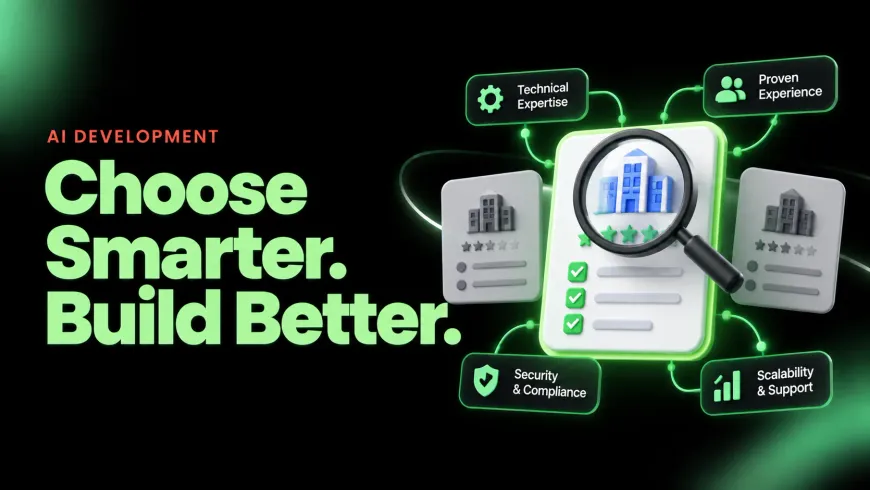
Knowing how to choose an AI development partner matters more than choosing the right model. Models are interchangeable and improve every few months, but the team that scopes, builds, and supports your AI system decides whether it reaches production or stalls as a pilot. The wrong partner usually looks impressive in the sales meeting and disappears when real data gets messy.
The stakes are high. More than 80% of AI projects fail, twice the rate of IT projects without AI, according to RAND. An MIT study found that about 95% of generative AI pilots at companies deliver no measurable impact on profit and loss. For founders, CTOs, and product leaders, the partner decision is where most of that risk is either removed or locked in.
This guide gives you a ten-factor evaluation framework, a scorecard, the questions to ask, specific advice for AI agent, healthcare, and integration projects, and the red flags that should end a conversation. It reflects how EnactOn runs AI development engagements, where every recommendation has to survive contact with production.
What Does an AI Development Partner Actually Do?
An AI development partner designs, builds, deploys, and maintains AI systems for your business, from data pipelines and models to the applications people use every day. The best partners also help decide which problems deserve AI at all. Their job ends at a working, monitored system, not a slide deck or a demo.
| Partner type | Strengths | Watch out for | Best for |
|---|---|---|---|
| Specialist AI studio | Deep model and LLM expertise | May lack full-stack or integration depth | AI-first products and complex models |
| Software firm with an AI practice | End-to-end delivery, integrations, QA, and support | AI depth varies widely between firms | AI features inside real business systems |
| Freelancers and contractors | Low cost and fast start | Single points of failure, limited QA | Small, well-scoped experiments |
| Platform vendor services | Deep knowledge of one platform | Solutions tied to that vendor | Teams committed to a single platform |
For most businesses, a software firm with a strong AI practice is the safest choice, because AI only creates value once it is connected to your systems and users. Comparing established AI software development companies is a good way to see what that looks like in practice.
What Are the Key Factors in Choosing an AI Partner for Digital Transformation?
The key factors in choosing an AI partner for digital transformation are production experience, problem framing, data engineering depth, integration skill, evaluation discipline, security, governance, transparent pricing, team continuity, and post-launch support. Use these ten factors to apply how to choose an AI development partner in a structured, comparable way.
-
Production track record. Ask for AI systems running today with real users and usage data, not only pilots or demos.
-
Problem framing before technology. Strong partners challenge your use case, define a success metric, and sometimes tell you AI is the wrong tool.
-
Data engineering depth. Most AI work is data work, so look for experience cleaning, structuring, and governing messy business data.
-
Integration capability. The partner must connect AI to your CRM, ERP, databases, and workflows, not just call a model API.
-
Evaluation discipline. Ask how they measure accuracy before launch, with test sets built from your real cases.
-
Security and compliance. Check access controls, data handling, and experience with rules such as HIPAA, GDPR, or SOC 2 where relevant.
-
Governance and human review. Look for human approval of high-impact actions and review of all AI-generated code and output.
-
Transparent pricing. Expect phased estimates, published rates or minimums, and clarity on running costs such as model usage and hosting.
-
Team continuity. Confirm the senior engineers in the pitch stay on the project instead of handing it to a separate team.
-
Post-launch support. Agree on monitoring, retraining, model updates, and response times before you sign.
How Should You Score Partners Against These Factors?
The best way to choose an AI solutions partner is to score every candidate against the same weighted criteria, using evidence rather than claims. Weight the factors that match your biggest risk; a regulated business should weight security higher than speed.
| Factor | Suggested weight | Evidence to request |
|---|---|---|
| Production track record | 20% | Two references with live systems and usage data |
| Problem framing | 10% | A discovery plan and an example of a use case they rejected |
| Data and integration depth | 20% | Architecture of a past project with similar systems |
| Evaluation discipline | 15% | A sample evaluation report or test plan |
| Security, compliance, governance | 15% | Security policies, access model, compliance experience |
| Pricing and contract clarity | 10% | Phased estimate, rates, IP and exit terms |
| Team continuity and support | 10% | Named team members and a support SLA |
Score Your Shortlist With a Partner Who Builds to Production EnactOn starts every AI engagement with a scoped proof of concept on your data, so you can judge the team on real results before committing to a full build. Talk to a Solution Expert →
How Should You Choose an AI Agent Deployment Partner?
When working out how to choose an AI agent deployment partner, focus on three proofs: agents running in production, a clear guardrail design, and an evaluation process that runs on every change. Agents take actions in your systems, so a partner who only builds chatbots or demos is not ready for this work. Knowing how to build an AI agent makes these checks easier to apply, and voice projects add telephony and latency checks, covered in our comparison of AI voice agent development companies.
-
Guardrail design. Ask how they limit tool permissions, cap steps and cost per task, and require human approval for high-impact actions.
-
Evaluation sets. The partner should test the agent on real past cases and track task success, wrong actions, and escalations.
-
Observability. Every prompt, tool call, and decision should be logged and traceable after launch.
-
Supervised rollout. Expect a phased launch where autonomy grows only as metrics hold.
In short, how to choose an AI agent deployment partner comes down to how they handle failure. Ask what happens when the agent is wrong, and judge the partner on the specificity of the answer.
What Is the Best Way to Choose Healthcare AI Development Partners?
The best way to choose healthcare AI development partners is to verify their compliance practice before their AI skills. Patient data raises the cost of mistakes: healthcare breaches cost an average of $7.42 million in 2025, the highest of any industry, according to IBM.
-
Signed business associate agreement. The partner must sign a BAA before touching protected health information (PHI).
-
PHI-safe AI design. Ask how they minimize PHI sent to models and which model providers are covered by a BAA.
-
Clinical workflow fit. Look for experience with EHR integration, HL7 and FHIR standards, and clinician review of AI output.
-
Audit-ready delivery. Expect audit logs, access reviews, and documentation your compliance team can inspect.
A partner should be able to walk through a HIPAA compliance checklist for software development without hesitation. It also helps when they can point to practical AI agent use cases in healthcare such as intake, scheduling, and documentation support.
How Do You Choose a Partner for AI Integration Projects?
If you are deciding how to choose a development partner for AI integration projects, start with their integration record, not their AI portfolio. Integration projects add AI to systems you already run, so the hard parts are APIs, data mapping, authentication, and change management.
-
Legacy system experience. Ask for projects that connected AI to older ERPs, CRMs, or on-premise databases.
-
Data mapping skill. The partner should document how fields, records, and identifiers move between systems.
-
Fallback design. Every AI step needs a safe fallback when the model or an external API fails.
-
Change management. Look for training, rollout plans, and documentation for the people who will use the system.
Many integration projects start with AI workflow automation that connects existing apps, then add agents or custom models once the data flows are stable.
What Questions Should You Ask Before Signing?
These questions matter most when deciding how to choose an AI development partner, because they force specific, verifiable answers. Vague responses to any of them are a warning sign.
-
Which AI systems you built are running in production today? Ask for the users, usage volume, and what changed after launch.
-
How will you validate our use case before a full build? Look for a time-boxed proof of concept with a defined success metric.
-
Who exactly will work on our project? Get names, roles, and time allocation for the delivery team.
-
How do you review AI-generated code and output? Expect human review of every change and automated tests in the pipeline.
-
How do you measure accuracy before and after launch? Ask to see a sample evaluation report.
-
Who owns the code, prompts, models, and data? Your business should own all of it, with full access to repositories.
-
What will this cost to run each month? Get estimates for model usage, hosting, and support, not only the build.
-
What happens if we want to switch partners? Confirm documentation, handover, and exit terms in writing.
What Red Flags Should Make You Walk Away?
Walk away from partners who promise outcomes before seeing your data, avoid naming the team, or cannot show live systems. Part of learning how to choose an AI development partner is learning which answers disqualify one.
| Red flag | Why it matters |
|---|---|
| Guaranteed accuracy before discovery | Accuracy depends on your data, which they have not seen |
| Only demos, no production references | Demos hide integration, scale, and maintenance problems |
| Every use case gets a yes | Good partners reject weak use cases to protect your budget |
| No evaluation or testing plan | Errors will reach your users and customers first |
| Unclear IP ownership | You may not own the system you paid for |
| Build quote with no running costs | Model and hosting costs can exceed expectations quickly |
| Senior team disappears after signing | Delivery quality drops when the people who scoped the work leave |
How Should You Structure the First Engagement?
Structure the first engagement as a short, paid discovery or proof of concept with a clear success metric, followed by a phased build. This limits your exposure and shows how the partner works before you commit a large budget. If you still need to decide what to build first, start with our guide on how to choose an AI consulting partner.
| Phase | Typical duration | What you should receive |
|---|---|---|
| Discovery and readiness | 2 to 6 weeks | Prioritized use cases, data assessment, roadmap, estimate |
| Proof of concept | 4 to 6 weeks | Working prototype tested on your data against a metric |
| Production build | 3 to 6 months | Integrated, tested, monitored system in production |
| Support and improvement | Ongoing | Monitoring, retraining, and feature updates under an SLA |
Startups validating a new AI product can follow the same pattern at a smaller scale. Teams in that position often compare AI MVP development companies that specialize in fast, low-risk first releases.
How Does EnactOn Work as an AI Development Partner?
EnactOn works as an AI-first development partner using Intent-Driven Engineering: senior architects define the specification first, AI accelerates the build under strict human review, and raw AI-generated code never enters production. Each release passes four gates covering functionality, security, performance, and deployment.
-
Phased, low-risk start. Projects start at USD 5,000, and a proof of concept typically takes 4 to 6 weeks.
-
One team from roadmap to support. The same in-house engineers, designers, and QA professionals handle discovery, build, deployment, and monitoring.
-
Market-first discovery. Each build is shaped around the users, regulations, and systems in the market it serves.
-
Verified client feedback. EnactOn holds a 4.8/5 rating on Clutch, with an hourly range of USD 25 to 49.
Conclusion
The right AI development partner is the one that can prove production results, frame the problem honestly, and stay accountable after launch. Model choice, frameworks, and pricing all matter less than whether the team can turn your data and systems into something people use every day.
Use the ten factors and scorecard in this guide to compare two or three candidates on evidence, then start with a paid proof of concept. That is how to choose an AI development partner without betting your budget on a sales pitch.
With 13+ years in business, 350+ clients, and a 4.8/5 rating on Clutch, EnactOn has delivered 500+ projects across 65+ countries. It keeps a 95% client retention rate, and its 80+ in-house engineers, designers, and QA professionals stay accountable from proof of concept to production.
FAQs
What is the best way to choose an AI solutions partner?
The best way to choose an AI solutions partner is to score two or three candidates on the same weighted criteria using evidence, not claims. Ask for production references, a sample evaluation report, and a named delivery team. Then run a short paid proof of concept with the strongest candidate before committing to a full build.
How much does it cost to hire an AI development partner?
Costs depend on scope, location, and team seniority. Discovery and roadmap work often starts around USD 5,000, proofs of concept typically run USD 10,000 to 50,000, and production systems cost more. Hourly rates range from about USD 25 to over USD 150 depending on region and specialization.
Should I choose an onshore or offshore AI development partner?
Both can work well. Onshore partners offer easier time-zone overlap, while offshore partners often provide strong engineering depth at lower rates. Judge any partner on production references, communication cadence, and team continuity rather than location alone.
Who owns the code and models built by an AI development partner?
Your business should own the code, prompts, model configurations, and data, and this should be written into the contract. Confirm you will have full repository access during the project, not only at handover. Third-party models and APIs remain under their providers’ licenses.
How long before an AI development partner shows results?
A good partner should show measurable results within the first proof of concept, typically 4 to 8 weeks. Production systems usually take 3 to 6 months. If a partner cannot show progress against a metric within the first two months, revisit the engagement.
What is the difference between an AI development partner and an AI consulting firm?
An AI consulting firm focuses on strategy, use-case selection, and roadmaps. An AI development partner builds, deploys, and maintains the actual systems. Many projects benefit from a partner that covers both, because hand-offs between strategy and build teams are a common cause of failure.
How do I choose a partner for AI projects that touch legacy systems?
Knowing how to choose a development partner for AI integration projects with legacy systems starts with their integration record. Ask for examples of AI connected to older ERPs, CRMs, or on-premise databases, plus their approach to data mapping and fallbacks. A short integration spike before the main build reduces risk.
What should a healthcare AI partner provide before starting?
A healthcare AI partner should sign a business associate agreement before accessing PHI and explain how PHI is minimized in AI workflows. They should also confirm which model providers are covered under a BAA. Ask for audit logging, access control, and documentation practices up front.
Can a small team build enterprise-grade AI?
Yes, if the team has strong engineering discipline. Enterprise-grade AI depends on evaluation, security, integration, and monitoring practices more than headcount. Check how the team reviews code, tests models, and supports systems after launch.
What should be in an AI development contract?
The contract should cover scope and phases, success metrics, IP ownership, data handling, security obligations, running cost estimates, support terms, and exit and handover clauses. For regulated data, include a business associate agreement or data processing agreement as required.
How does EnactOn work with clients as an AI development partner?
EnactOn starts with discovery or a proof of concept, then builds in phases with human review of every AI-assisted output and a four-gate release process. Projects start at USD 5,000 and EnactOn holds a 4.8/5 rating on Clutch. The same in-house team stays with the project from roadmap through support.