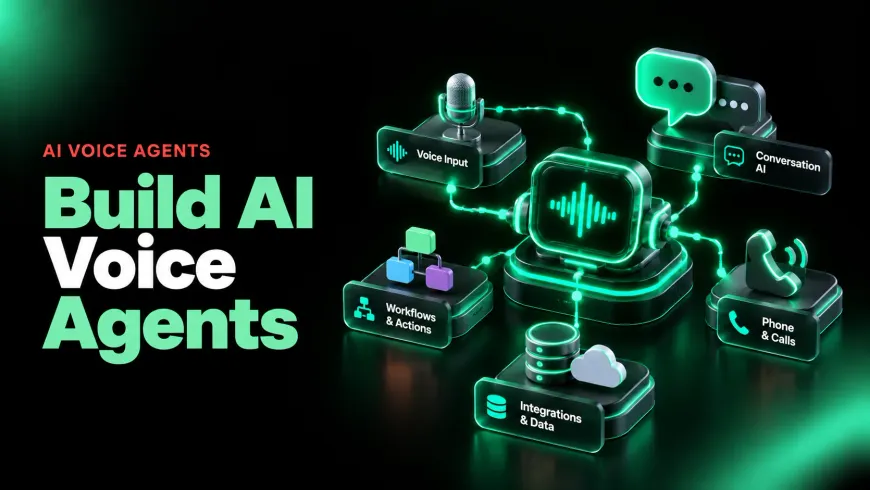
Learning how to build AI voice agents comes down to one challenge text agents never face: real-time conversation. An AI voice agent listens to a caller, understands what they need, decides what to do, and answers out loud, often while booking, updating, or looking up records in your systems. If any part of that chain is slow or brittle, callers hear awkward silences, get interrupted, or hang up.
Demand is growing fast. The voice agents market is projected to grow from about USD 2.32 billion in 2025 to USD 27.45 billion by 2032, a 42% annual growth rate, according to MarketsandMarkets. Gartner predicted that conversational AI would cut contact center agent labor costs by $80 billion by 2026, with one in ten agent interactions automated. Businesses that answer calls at scale are the first to feel that shift.
This guide is for founders, product leaders, and operations teams planning a voice agent for support, scheduling, sales, or orders. It explains how voice agents work, the architecture options, how to beat latency, a nine-step build process, the tech stack, costs, and common mistakes. It reflects how EnactOn approaches AI agent development for voice: specification first, AI-accelerated build, and human review at every step.
What Is an AI Voice Agent and How Does It Work?
An AI voice agent is software that holds spoken conversations over the phone or in an app and completes tasks during the call. Most voice agents work as a pipeline: speech-to-text (STT) turns the caller’s words into text, a large language model (LLM) decides what to say and which tools to use, and text-to-speech (TTS) speaks the reply. All of this has to happen in about a second to feel natural. The agent logic itself, meaning tools, memory, and guardrails, follows the same principles as any other agent, covered in how to build an AI agent.
| Component | What it does |
|---|---|
| Telephony or WebRTC | Connects the agent to phone numbers, SIP trunks, or in-app and web audio. |
| Voice activity detection (VAD) and turn detection | Detects when the caller starts and stops speaking, so the agent knows when to respond. |
| Speech-to-text (STT) | Transcribes the caller’s speech in real time, ideally streaming partial results. |
| LLM and tools | Understands intent, follows the conversation, and calls tools such as calendars, CRMs, or order systems. |
| Text-to-speech (TTS) | Turns the reply into natural-sounding speech, streamed as it is generated. |
| Orchestration | Coordinates the pipeline, handles interruptions, and manages call state and transfers. |
What Can AI Voice Agents Do for a Business?
AI voice agents handle high-volume, repeatable calls such as appointment booking, order taking, status updates, lead qualification, and first-line support. AI phone agents work best where callers want a fast answer to a predictable question and a human is available for the rest.
| Use case | What the agent does | Business outcome |
|---|---|---|
| Inbound support | Answers FAQs, checks order or account status | Shorter queues and lower cost per call |
| Appointment scheduling | Books, reschedules, and confirms appointments | Fewer missed calls and no-shows |
| Order taking | Takes phone orders and sends them to the POS | More orders captured at peak times |
| Lead qualification | Asks qualifying questions and books sales calls | Faster response to new leads |
| Outbound reminders | Calls customers about payments, renewals, or visits | Higher completion rates |
| After-hours coverage | Answers calls overnight and on weekends | No lost callers outside business hours |
Restaurants were early adopters; this guide to an AI voice ordering system for restaurants shows how phone orders flow straight into the kitchen.
Healthcare is another strong fit for scheduling, reminders, and intake, as these AI agent use cases in healthcare show, provided patient data is handled under HIPAA.
What Does a Voice AI Agent Architecture Look Like?
There are two main options for a voice AI agent architecture: a cascaded pipeline that chains STT, an LLM, and TTS, and a speech-to-speech model that listens and speaks natively. Cascaded pipelines give more control and easier debugging, while speech-to-speech models can sound more natural with lower latency but offer less control.
| Factor | Cascaded pipeline (STT, LLM, TTS) | Speech-to-speech model |
|---|---|---|
| Control | High; each stage can be tuned or swapped | Lower; one model handles everything |
| Latency | Good when every stage streams | Often lower, with fewer hand-offs |
| Tool calling | Mature and predictable | Improving, varies by model |
| Debugging | Transcripts at every step | Harder to trace decisions |
| Voice choice | Any TTS voice, including custom voices | Limited to the model’s voices |
| Best for | Business-critical calls with integrations | Natural, open-ended conversation |
Most production business agents use a cascaded pipeline today, because reliable tool calling, transcripts, and compliance logging matter more than the last bit of naturalness.
Why Is Latency the Hardest Problem in Voice Agents?
Voice agent latency is the hardest problem because people expect replies almost instantly. A study of turn-taking across 10 languages found that speakers keep gaps between turns short, with each language’s average within 250 milliseconds of the cross-language mean, according to research published in PNAS. Long pauses make an agent sound broken, even when its answers are correct.
| Stage | What adds delay | How to reduce it |
|---|---|---|
| Turn detection | Waiting too long to decide the caller has finished | Tuned endpointing and semantic turn detection |
| Speech-to-text | Transcribing only after the caller stops | Streaming STT with partial results |
| LLM response | Large models and long prompts | Smaller models, short prompts, streaming tokens |
| Tool calls | Slow APIs during the call | Caching, pre-fetching, and short filler phrases |
| Text-to-speech | Generating full sentences before speaking | Streaming TTS that starts on the first words |
| Network | Services hosted far apart | Co-locate services near the telephony region |
The goal is a voice-to-voice response of about one second or less for most turns. Reducing voice agent latency is mostly about streaming every stage and keeping services close together, not about choosing a single faster model.
How Do You Build AI Voice Agents Step by Step?
Here is how to build AI voice agents in nine steps: define the calls and success metric, design the conversation, choose channels, pick the tech stack, connect tools and data, handle turn-taking, add guardrails and compliance, test with real audio, and launch with monitoring.
Step 1: Define the Calls and a Success Metric
List the call types the agent will handle and the ones it must transfer. Pick a metric such as containment rate, booking completion, or average handling time, and record today’s baseline.
Step 2: Design the Conversation and Escalation Paths
Write sample conversations for each call type, including confused, angry, and off-topic callers. Define exactly when the agent hands off to a person and what context it passes along, so callers never repeat themselves.
Step 3: Choose Telephony and Channels
Decide whether the agent answers phone numbers, in-app voice, web calls, or several. Phone calls need a telephony provider or SIP trunk, while app and web voice typically use WebRTC for lower latency and better audio quality.
Step 4: Pick the AI Voice Agent Tech Stack
Select STT, LLM, and TTS components based on latency, accuracy for your callers’ accents and languages, voice quality, cost per minute, and data privacy terms. Test candidates on recordings of real calls, not on clean studio audio.
Step 5: Connect Tools and Business Data
Give the agent tools for the actions it must take, such as checking availability, creating bookings, or looking up orders. Keep each tool fast and narrowly scoped, and use least-privilege credentials.
Step 6: Handle Interruptions, Silence, and Turn-Taking
Callers interrupt, pause, and talk over background noise. Support barge-in so the agent stops speaking when interrupted, tune silence handling, and use short acknowledgments while slow tools run.
Step 7: Add Guardrails and Compliance
-
Disclosure and consent. Tell callers they are speaking with an AI and follow call-recording consent rules for each region.
-
Outbound calling rules. Check regulations such as the US TCPA before placing automated outbound calls.
-
Sensitive data. Mask payment and personal data in transcripts and logs, and keep regulated data under the right agreements.
-
Action limits. Require confirmation before high-impact actions such as cancellations or payments.
Step 8: Test With Real Call Audio
Run the agent against recorded or simulated calls with real accents, background noise, and edge cases. Track task completion, transfer rate, response latency, and transcription errors after every change.
A focused AI proof of concept is the right place for this testing. It shows whether the agent meets your latency and completion targets before you fund a full rollout.
Step 9: Launch, Monitor, and Improve
Start with a share of calls or one call type, with people reviewing recordings and transcripts. Monitor containment, transfers, latency, and caller feedback, and add failed calls to your test set every week.
Test Your Voice Agent on Real Calls First EnactOn builds a voice agent proof of concept on your call types and systems, measuring latency, completion, and cost before you commit to a full rollout. Discuss Your Idea →
Which Tools Make Up the AI Voice Agent Tech Stack?
The AI voice agent tech stack has six layers: telephony or WebRTC, speech-to-text, the LLM, text-to-speech, orchestration, and monitoring. Knowing how to build AI voice agents well means choosing each layer for latency and reliability, not brand. Common options are listed below.
| Layer | Common options | What to evaluate |
|---|---|---|
| Telephony | Twilio, Vonage, Telnyx, SIP trunks | Regions, call quality, number porting, cost per minute |
| Real-time audio (WebRTC) | LiveKit, Daily | Latency, scaling, SDK support |
| Speech-to-text | Deepgram, AssemblyAI, OpenAI Whisper | Streaming speed, accent accuracy, languages |
| LLM | Leading hosted LLM APIs, smaller models for routing | Tool-calling reliability, speed, cost |
| Text-to-speech | ElevenLabs, Cartesia, cloud TTS services | Naturalness, time to first audio, voice options |
| Orchestration | Pipecat, LiveKit Agents, or managed voice platforms | Interruption handling, control, observability |
How Much Does It Cost to Build an AI Voice Agent?
AI voice agent cost has two parts: a one-time build and ongoing per-minute usage. Build costs follow the same tiers as other AI agents, from about USD 5,000 to 15,000 for a single-task agent to USD 35,000 to 65,000 for multi-agent systems, with enterprise platforms costing more. Usage costs for telephony, speech-to-text, the LLM, and text-to-speech are billed per minute and scale with call volume.
| Cost item | What drives it |
|---|---|
| Build | Number of call types, integrations, languages, and compliance needs |
| Telephony | Call minutes, phone numbers, and regions |
| Speech-to-text and text-to-speech | Audio minutes and voice quality tier |
| LLM usage | Model choice and conversation length |
| Monitoring and support | Call review, retraining, and updates |
Integration depth and compliance requirements usually move the build price more than the voice stack does. This guide to the cost to build an AI agent breaks down the build tiers in detail.
Should You Use a Voice AI Platform or Build a Custom Pipeline?
Use a managed voice AI platform for fast pilots and simple call flows, and build a custom pipeline when you need deep integrations, strict compliance, custom voices, or lower per-minute costs at scale. Many teams pilot on a platform and move high-volume flows to a custom pipeline later.
| Factor | Managed voice platform | Custom pipeline |
|---|---|---|
| Time to launch | Days to weeks | Weeks to months |
| Control | Limited to platform features | Full control of every stage |
| Integrations | Common tools via connectors | Any system, any logic |
| Cost at scale | Platform fee per minute | Lower per-minute cost at volume |
| Compliance | Depends on platform terms | Designed around your requirements |
If you would rather hire a team than build in-house, compare AI voice agent development companies and AI agent development companies on live voice deployments, latency results, and support terms.
What Mistakes Break AI Voice Agents?
Most voice agents fail because of slow responses, poor interruption handling, or no clean path to a human, not because the LLM is weak.
| Mistake | What callers experience | How to prevent it |
|---|---|---|
| Non-streaming pipeline | Long, awkward silences | Stream STT, LLM, and TTS end to end |
| No barge-in support | The agent talks over them | Stop speech instantly when the caller interrupts |
| Testing only with clean audio | Misheard names, numbers, and addresses | Test with real accents and background noise |
| No human handoff | Callers stuck in loops | Clear transfer rules with context passed along |
| Slow tool calls mid-call | Dead air while data loads | Cache, pre-fetch, and use short acknowledgments |
| Missing disclosure or consent | Distrust and legal exposure | Disclose AI use and follow recording rules |
How Does EnactOn Build AI Voice Agents?
EnactOn builds AI voice agents with Intent-Driven Engineering: senior architects define call types, tools, guardrails, and latency targets in a written specification before development begins. AI accelerates the build under strict human review, raw AI-generated code never enters production, and every release passes four gates covering functionality, security, performance, and deployment.
-
Proof of concept first. A focused proof of concept typically takes 4 to 6 weeks and is tested on your real call types.
-
Integration depth. Agents connect to the CRMs, calendars, POS, and helpdesk systems your team already uses.
-
Market-first discovery. Each agent is shaped around the languages, regulations, and caller behavior of the market it serves.
-
Verified client feedback. EnactOn holds a 4.8/5 rating on Clutch.
Conclusion
A good AI voice agent is a fast, well-integrated system around a model: streaming at every stage, clean interruptions, reliable tools, clear handoffs, and honest testing on real calls. Getting those basics right matters more than picking the newest model.
Start with one high-volume call type, set a latency and completion target, and prove it on real audio before scaling. That is how to build AI voice agents that callers actually stay on the line with.
EnactOn has delivered 500+ projects for 350+ clients across 65+ countries over 13+ years, holds a 4.8/5 rating on Clutch, and keeps a 95% client retention rate. Its 80+ in-house engineers, designers, and QA professionals take voice agents from proof of concept to production with human review at every step.
FAQs
What is the easiest way to build an AI voice agent?
The easiest way to learn how to build AI voice agents is to start with one call type on a managed voice platform. Connect a phone number, write a clear prompt, add one or two tools, and test with real callers. Move to a custom pipeline once you need deeper integrations or lower costs at scale.
How long does it take to build an AI voice agent?
A simple voice agent pilot can be ready in 2 to 4 weeks. Agents with several call types and integrations usually take 6 to 12 weeks. Enterprise deployments with compliance requirements and many systems take longer.
What is the AI voice agent cost per minute?
AI voice agent cost per minute depends on the telephony provider, speech-to-text and text-to-speech services, LLM, and call length. Each component is billed separately, and costs drop per minute at higher volumes. Get quotes for your expected call volume before choosing a stack.
Can AI phone agents use my existing phone number?
Yes. AI phone agents can answer your existing number through call forwarding, SIP trunking, or by porting the number to a telephony provider. Many businesses start by forwarding only overflow or after-hours calls to the agent.
How do you make a voice agent sound natural?
Keep responses short, stream every stage to cut delays, support interruptions, and choose a high-quality TTS voice. Write prompts for spoken language, not written text, and test with real callers to catch awkward phrasing.
Can AI voice agents handle multiple languages?
Yes, many speech-to-text, LLM, and text-to-speech services support multiple languages. Accuracy varies by language and accent, so test each language with real callers. Some agents detect the caller’s language automatically and switch.
Are AI voice agents legal for business calls?
They are legal in most markets when used correctly. Disclose that callers are speaking with an AI, follow call-recording consent rules, and check outbound calling regulations such as the US TCPA. Regulated data, such as health or payment information, needs extra safeguards.
What latency should a voice agent target?
Aim for a voice-to-voice response of about one second or less for most turns. People keep gaps between conversational turns short, so longer pauses sound unnatural. Streaming every stage and co-locating services are the most effective fixes.
When should a voice agent transfer to a human?
Transfer when the caller asks for a person, the request falls outside the agent’s scope, the caller is frustrated, or confidence is low. Pass the conversation summary and caller details so the human agent can continue without repeating questions.
Do I need a custom voice for my AI agent?
Not usually. High-quality stock voices work well for most businesses. A custom or cloned voice can strengthen brand identity, but it requires proper consent from the voice owner and adds cost.
Can EnactOn build an AI voice agent for my business?
Yes. EnactOn starts with a proof of concept on your real call types, typically in 4 to 6 weeks, then builds the production agent with integrations and human review at every step. Projects start at USD 5,000, and EnactOn holds a 4.8/5 rating on Clutch.