

Most AI startup ideas are noise. Fifty bullet points, no market context, no viability signal, no sense of whether the idea is defensible or just a ChatGPT wrapper dressed up as a business.
This list is different. Every AI startup idea below includes the market opportunity, the target customer, the core AI function, and an honest assessment of what makes it worth building in 2026 versus what makes it difficult.
The AI market crossed $300 billion in 2025 and is projected to reach $1.8 trillion by 2030, according to Statista. But most of that value is captured by a small number of companies. The opportunity in 2026 is not building another general-purpose model. It is building vertical AI tools that solve specific, expensive problems for specific industries.
Use this list as a research starting point, not a replacement for your own validation.
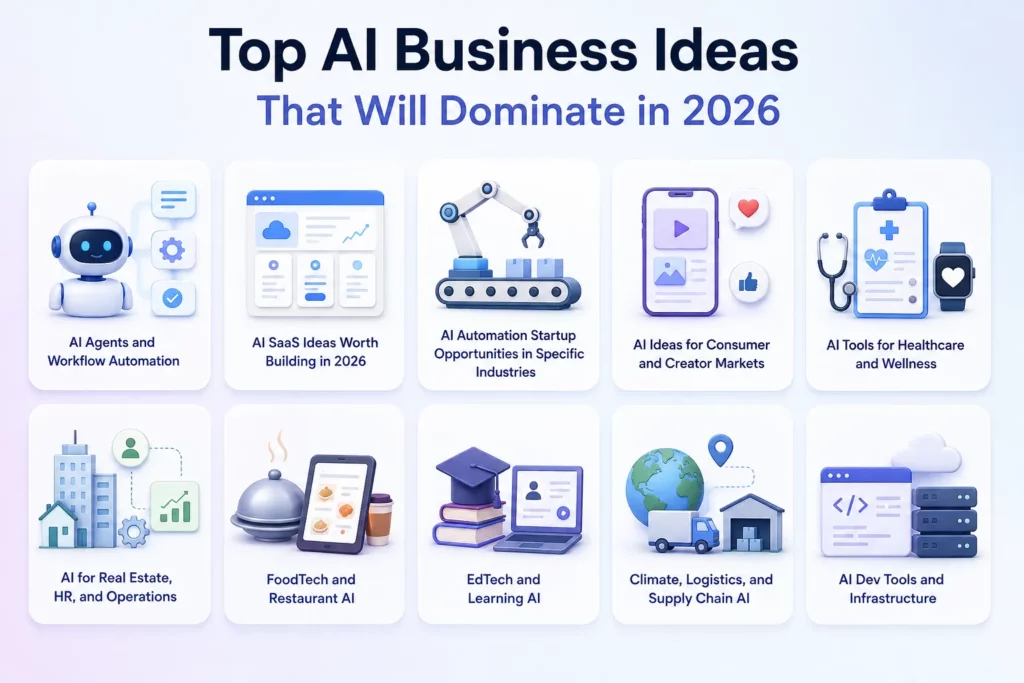
Category 1: AI Agents and Workflow Automation
Vertical AI agents are the single biggest opportunity in 2026. These are AI systems that autonomously complete multi-step workflows within a specific domain, replacing expensive human labor for repeatable tasks.
1. AI Legal Intake and Document Summarization for SMBs
Problem: Small law firms and solo attorneys spend 3 to 5 hours per week reviewing intake documents and summarizing case files.
Target customer: Solo attorneys and small law firms with 2 to 10 staff.
AI function: LLM-powered document parsing, key clause extraction, risk flagging, and plain-English summarization.
Market: The global legal services market exceeds $500 billion. AI penetration in the SMB legal segment is minimal. Competition at this specific segment level is low to medium.
Why it works: Attorneys bill at $150 to $400 per hour. Automating even two hours of document review per week delivers immediate, calculable ROI that makes the product easy to sell.
2. AI Recruiting Agent for Niche Technical Roles
Problem: Hiring managers at growth-stage companies spend 15 or more hours per hire on screening, coordination, and interview scheduling.
Target customer: HR teams at Series A to Series B startups hiring in fintech, healthtech, or climate tech.
AI function: Resume parsing, candidate scoring against role requirements, automated interview scheduling, and async video screening.
Market: The global recruitment market exceeds $500 billion. Focusing vertically on technical roles in a specific industry reduces competition significantly.
Why it works: Reducing time-to-hire by 50% is a direct revenue lever for scaling companies. The ROI is visible to the buyer immediately.
3. AI Medical Scribe for Outpatient Clinics
Problem: Physicians spend 35 to 50% of their working time on clinical documentation, directly reducing the number of patients they can see each day.
Target customer: Outpatient clinics, independent practices, and specialty physicians.
AI function: Real-time ambient transcription and structured SOAP note generation in EHR-compatible formats.
Market: The clinical documentation market exceeds $50 billion. Competition is growing but significant geographic and specialty-level opportunity remains.
Why it works: Returning two to three hours of physician time per day directly increases clinic revenue. The product pays for itself within the first month for most buyers.
4. AI Accounts Payable Automation for Mid-Market Companies
Problem: Finance teams at mid-market companies manually process hundreds to thousands of invoices per month across multiple vendors and payment terms.
Target customer: Finance teams at companies with $5 million to $50 million in annual revenue.
AI function: Invoice extraction, three-way matching against purchase orders and receipts, approval routing, and anomaly detection.
Market: The AP automation market exceeds $5 billion and is growing. The mid-market segment under $50 million ARR is underserved by current enterprise solutions.
Why it works: Manual AP processing costs $10 to $25 per invoice. Automation reduces that to under $2. The math sells the product.
Learn what factors influence your MVP development costs.
5. AI Customer Support Agent for E-Commerce Brands
Problem: Growing e-commerce brands cannot afford a full customer support team but need 24/7 response capability for order status, returns, and product questions.
Target customer: DTC e-commerce brands with $1 million to $20 million in annual revenue.
AI function: LLM-based conversational agent trained on product catalog, order management data, return policy, and brand tone.
Market: The customer service software market exceeds $12 billion. The vertical-specific segment for DTC e-commerce with brand voice training has low direct competition.
An AI agent development company can help e-commerce businesses build and integrate these customer support agents with their product catalogs, order management systems, CRM platforms, and other business tools.
Category 2: AI SaaS Ideas Worth Building in 2026
These are best AI SaaS ideas worth building in 2026 because they target defined user segments with clear monetization paths and address problems that general-purpose tools do not solve with enough specificity.
6. AI Contract Review Tool for Freelancers and Agencies
Problem: Freelancers and small agencies sign contracts without proper legal review because they cannot afford hourly attorney fees for routine engagements.
Target customer: Independent contractors, creative agencies, and consulting firms.
AI function: Contract risk clause identification, plain-English summary, recommended negotiation points, and comparison against market standard terms.
Market: There are 60 million or more freelancers in the US alone. No dominant player serves this specific segment. This is a strong AI startup idea with low competition at the SMB level.
Why it works: Freelancers lose money on bad contracts every day. A tool that costs $30 per month and protects against a single bad $5,000 engagement pays for itself immediately.
7. AI SEO Content Brief Generator for Niche Industries
Problem: Content teams waste hours researching keyword clusters, competitor gaps, and structural requirements before writing a single article.
Target customer: Content teams at healthcare, legal, and fintech companies where generic content tools produce non-compliant or low-authority output.
AI function: Automated SERP analysis, semantic cluster mapping, expert authority identification, and section-by-section brief generation with compliance guidance.
Market: The content marketing industry exceeds $65 billion. Vertical-specific tools serve a clearly differentiated segment with lower competition than generic SEO tools.
Why it works: Generic SEO tools produce generic content. Regulated industries need industry-specific guidance that general tools cannot provide.
8. AI Proposal Generator for Service Businesses
Problem: Consultants, agencies, and B2B service providers spend 5 to 8 hours per proposal, with high loss rates on first-draft submissions.
Target customer: Digital agencies, management consultants, and B2B service providers.
AI function: Proposal generation from a discovery call transcript or intake brief, with pricing logic, scope structuring, and persuasion optimization based on industry benchmarks.
Market: There are tens of millions of service businesses globally. Proposal-to-close conversion improvement is a direct revenue driver, creating strong willingness to pay.
Why it works: A 10% improvement in proposal win rate for an agency doing $500,000 in annual revenue translates to $50,000 in additional top-line revenue. The ROI is immediate and personal.
Which AI path is right for your MVP?
AI Development
Custom machine learning models, predictive data pipelines, and intelligent software integration.
AI Agent Development
Deploy autonomous AI agents that act, execute tasks, and interface directly with your existing systems.
9. AI Competitive Intelligence Platform for B2B SaaS
Problem: B2B SaaS companies monitor competitors manually through spreadsheets, Google Alerts, and ad hoc research that misses most signal.
Target customer: Product and marketing teams at B2B SaaS companies with $1 million to $10 million in ARR.
AI function: Automated tracking of competitor pricing changes, feature releases, review sentiment shifts, hiring signals, and messaging updates.
Market: The competitive intelligence market exceeds $2 billion and grows at 12% annually. The early-stage SaaS segment under $10 million ARR is underserved by current enterprise tools.
Why it works: Every product and pricing decision is better when made with current competitive context. The tool serves both the product team and the sales team simultaneously.
Explore effective strategies for a successful MVP launch.
10. AI-Powered Onboarding Flow Builder
Problem: SaaS companies see 40 to 60% of new signups never complete onboarding, directly reducing activation and increasing churn.
Target customer: Product teams at early-stage SaaS companies that cannot afford enterprise customer success platforms.
AI function: User behavior analysis, dynamic onboarding path generation based on role and usage patterns, and automated intervention triggers for at-risk users.
Market: Core part of the $20 billion customer success platform market. Strong potential as a standalone tool for products under $1 million ARR.
Why it works: Improving activation rates by 20% for a SaaS product with 1,000 monthly signups and $100 MRR per user adds $20,000 per month in recurring revenue.
Ready to build your AI startup idea into a real product?
EnactOn builds AI-first MVPs: LLM integrations, AI agents, automation workflows, and SaaS platforms. We start with your business problem and build only what the market actually needs.
Plan Your MVP Build
Category 3: AI Automation Startup Opportunities in Specific Industries
These AI automation startup opportunities exist because large industries have expensive, repetitive processes where AI can replace or dramatically accelerate human labor with a clearly calculable return.
11. AI Insurance Claims Pre-Screening
Target customer: Property and casualty insurers, independent claims adjusters.
Problem: Manual claims intake and initial review creates backlogs, delays payouts, and misses fraud signals.
AI function: Document intake completeness check, coverage eligibility verification, fraud signal detection, and automated routing to the appropriate adjuster queue.
Market: The global insurance industry exceeds $1.5 trillion in premiums. Even small processing efficiency gains translate to tens of millions in savings for a mid-size insurer.
Why it works: Claims processing is the most expensive operational function in insurance. Speed and accuracy both have direct financial impact.
12. AI Inventory Forecasting for Independent Retailers
Target customer: Independent retail stores and small chains with 1 to 20 locations.
Problem: Manual ordering leads to chronic overstock and stockout cycles that cost margin and customer satisfaction.
AI function: Demand forecasting using POS data, seasonal patterns, local event calendars, and weather data.
Market: Independent retail represents hundreds of billions in annual inventory spend. AI forecasting tools at this segment level are significantly underpenetrated.
Why it works: A 10% reduction in overstock and a 10% reduction in stockouts translates directly to improved cash flow and customer retention. Retailers feel the impact immediately.
13. AI Grant Writing Assistant for Nonprofits
Target customer: Small to mid-size nonprofit organizations with limited development staff.
Problem: Grant writing is time-intensive, highly specialized, and beyond the capacity of many small nonprofits, causing them to miss funding they are eligible for.
AI function: Grant opportunity matching based on organizational profile, eligibility screening, application section drafting, and deadline management.
Market: The global nonprofit sector exceeds $500 billion in activity. AI tooling for this segment is almost nonexistent, making this a strong AI startup idea with low competition.
Why it works: Every additional grant application submitted has a calculable funding upside. Nonprofits that win one additional grant cover the cost of the tool many times over.
14. AI Lease Abstraction Tool for Commercial Real Estate
Target customer: Property managers, CRE firms, and corporate real estate teams.
Problem: Reviewing and extracting key terms from commercial leases is manual, slow, and error-prone. Missed clauses lead to costly compliance failures.
AI function: Extraction of key terms, critical dates, rent escalation clauses, renewal options, obligations, and risk flags from commercial lease documents.
Market: The commercial real estate market exceeds $3.5 trillion in value. Legal document AI has clear enterprise buyers with strong willingness to pay.
Why it works: A single missed lease renewal clause can cost a company $500,000 or more in renegotiation disadvantage. Prevention ROI is enormous.
15. AI Compliance Monitoring for Financial Advisors
Target customer: Registered Investment Advisors and independent financial advisors in the US.
Problem: Financial advisors must monitor client communications and transactions for SEC and FINRA compliance. Manual review is slow, inconsistent, and misses violations.
AI function: Automated scanning of client email and meeting notes for prohibited language, suitability violations, and disclosure failures.
Market: There are 300,000 or more registered advisors in the US alone. Compliance failure carries fines of $50,000 to $500,000 or more, creating strong willingness to pay for a solution.
Why it works: The cost of the product is trivially small compared to a single regulatory violation. The buyer already knows the cost of failure.
Category 4: AI Ideas for Consumer and Creator Markets
16. AI Personal Finance Coach for Gig Workers
Target customer: Freelancers, rideshare drivers, delivery workers, and other gig economy participants.
Problem: Gig workers have irregular income, no employer benefits, and poor access to financial planning advice. Tax surprises, missed savings opportunities, and underinsurance are endemic.
AI function: Income smoothing analysis, quarterly tax estimation, automated savings allocation, and personalized financial guidance based on actual income patterns.
Market: There are 60 million or more gig workers in the US alone. Traditional personal finance tools are designed for salaried employees and fail to serve irregular income earners.
Why it works: Gig workers face real and expensive financial problems that no current tool addresses specifically. The product addresses genuine pain with a clear, frequent use case.
17. AI Meal Planning and Grocery Optimization App
Target customer: Families and individuals who cook at home and want to reduce grocery spend and food waste.
Problem: Households waste 30 to 40% of purchased groceries. Meal planning is time-consuming and grocery shopping is inefficient without a system.
AI function: Weekly meal plan generation based on dietary preferences, existing pantry inventory, local grocery pricing, and seasonal produce availability.
Market: The US grocery market exceeds $800 billion annually. Even a small share of the meal planning and grocery optimization segment represents a significant business.
Why it works: Saving a family $100 per month in groceries makes the product’s value immediately tangible. Engagement is high because meal planning is a weekly activity.
18. AI Language Learning Tutor for Professional Contexts
Target customer: Professionals learning a language for business communication, negotiation, or client interaction in a specific industry vertical.
Problem: Generic language learning apps teach everyday vocabulary but fail to teach industry-specific terminology, professional communication styles, or business negotiation language.
AI function: Role-based conversation simulation, industry-specific vocabulary curation, real-time pronunciation and grammar correction, and adaptive difficulty based on progress.
Market: The global language learning market exceeds $60 billion. Vertical-specific professional tools face significantly less competition than consumer apps like Duolingo.
Why it works: Professionals pay more for tools that address their specific context. A product that teaches medical Spanish or business Mandarin commands premium pricing that a general app cannot.
19. AI Video Script to Short-Form Content Repurposer
Target customer: B2B content teams, legal educators, medical educators, and professional services firms that produce long-form video content.
Problem: Long-form video content is expensive to produce and largely undistributed because repurposing it into short clips is manual and time-intensive.
AI function: Transcript analysis, key-moment extraction, automated short-clip identification, caption generation, and format optimization for LinkedIn, YouTube Shorts, and Instagram.
Market: The creator economy exceeds $100 billion. B2B and professional vertical content represents lower competition than consumer creator tools.
Why it works: Repurposing one 60-minute webinar into 12 short clips multiplies content output without additional production cost. The ROI calculation is simple for any marketing team.
20. AI Study Plan Generator for Professional Certification Exams
Target customer: Professionals preparing for CPA, bar exam, GMAT, medical boards, or other high-stakes certification exams.
Problem: Generic study guides do not adapt to individual weak areas, available study time, or the specific exam format a person is preparing for.
AI function: Diagnostic assessment of current knowledge, adaptive study schedule generation, personalized question bank curation, and progress-based content adjustment.
Market: The global test prep market exceeds $30 billion. Professional certification prep has strong willingness to pay because exam failure has direct career and financial consequences.
Why it works: A product that reduces study time while improving pass rates has an obvious and emotionally resonant value proposition. The buyer is highly motivated and has clear stakes.
Category 5: AI Tools for Healthcare and Wellness
21. AI Mental Health Screening Tool for Primary Care
Target customer: Primary care physicians and family medicine clinics.
Problem: Most primary care visits do not include structured mental health screening, despite the fact that 1 in 5 adults experiences a mental health condition annually.
AI function: Patient-facing screening questionnaire with automated risk scoring, provider summary generation, and escalation recommendations based on clinical guidelines.
Market: Mental health is a $500 billion global market. The gap between primary care and mental health referrals represents a massive unmet clinical need.
Why it works: Structured screening tools that generate provider summaries reduce the time burden that prevents primary care physicians from addressing mental health routinely.
22. AI Physical Therapy Exercise Adherence Platform
Target customer: Physical therapy clinics and sports medicine practices.
Problem: Patient adherence to home exercise programs is below 50% on average, extending recovery times and reducing clinical outcomes.
AI function: Computer vision-based form assessment via smartphone camera, real-time feedback during exercises, progress tracking, and automated check-in messaging.
Market: The physical therapy market exceeds $45 billion in the US. Adherence solutions have direct clinical and business impact for providers.
Why it works: Better adherence means faster patient recovery, better clinical outcomes, and higher patient satisfaction scores, all of which matter directly to the clinic.
23. AI Prior Authorization Automation for Specialty Clinics
Target customer: Specialty physician practices in cardiology, oncology, orthopedics, and neurology.
Problem: Prior authorization requests take 2 to 3 days on average and require significant administrative staff time, delaying patient care and reducing clinic throughput.
AI function: Automated PA request preparation, payer policy matching, clinical documentation packaging, and submission tracking with escalation triggers.
Market: Prior authorization costs the US healthcare system over $35 billion annually in administrative burden. The ROI for any tool that reduces this burden is immediate.
Why it works: Every delayed authorization is a delayed procedure. Clinics with high authorization denial rates lose significant revenue. Speed and accuracy both have financial value.
24. AI Care Coordination Tool for Chronic Disease Management
Target customer: Primary care practices and patient-centered medical homes managing patients with diabetes, hypertension, or heart failure.
Problem: Coordinating care across multiple providers, monitoring patient status between visits, and ensuring medication adherence is manual and fragmented.
AI function: Patient status monitoring from connected device data, care gap identification, automated outreach for missed appointments or lab follow-ups, and care team coordination.
Market: Chronic disease management is a $600 billion market segment within US healthcare. Value-based care contracts are driving willingness to invest in tools that reduce hospitalizations.
Why it works: Reducing one hospital readmission can save $15,000 or more. Practices under value-based contracts have direct financial incentive to use tools that prevent them.
25. AI Symptom Triage Chatbot for Urgent Care Clinics
Target customer: Urgent care chains and independent urgent care clinics.
Problem: Urgent care clinics handle a high volume of walk-in patients with varying acuity levels. Intake triage is slow, manual, and inconsistent.
AI function: Patient-facing symptom intake with AI-driven acuity scoring, preliminary diagnosis probability, and routing to the appropriate care level or provider.
Market: The urgent care market in the US exceeds $35 billion. Tools that improve patient flow and staff efficiency have clear financial value for clinic operators.
Why it works: Faster triage means higher patient throughput. Higher throughput means more revenue per clinic hour without adding staff.
Category 6: AI for Real Estate, HR, and Operations
26. AI Property Description and Listing Optimizer
Target customer: Real estate agents and property management companies.
Problem: Most property listing descriptions are generic, inconsistently formatted, and fail to highlight the features that drive buyer or renter interest.
AI function: Automated listing description generation from property photos, specifications, and neighborhood data, optimized for the target buyer or renter profile.
Market: The global real estate market exceeds $3.5 trillion. Agents who close faster earn more. Any tool that accelerates listing performance has direct commission value.
Why it works: Better listings generate more showings. More showings generate faster closes. The ROI is visible within the first few listings the agent publishes.
27. AI Exit Interview Analysis Platform
Target customer: HR teams at companies with 100 or more employees experiencing meaningful employee turnover.
Problem: Exit interview data is collected inconsistently, analyzed manually, and rarely results in systemic action. Turnover patterns go undetected until they become expensive.
AI function: Structured exit interview collection, sentiment analysis, theme extraction, and trend reporting with root cause recommendations.
Market: Employee turnover costs US companies $1 trillion annually. Tools that help identify preventable turnover patterns have clear enterprise value.
Why it works: Reducing turnover by even 10% saves most mid-size companies hundreds of thousands of dollars annually. The ROI conversation writes itself.
28. AI Shift Scheduling Optimizer for Shift-Based Industries
Target customer: Restaurant groups, retail chains, and healthcare facilities with hourly or shift-based workforces.
Problem: Manual shift scheduling takes managers 3 to 5 hours per week, results in overstaffing and understaffing cycles, and fails to account for employee preferences and skills.
AI function: Demand-based schedule generation, employee preference matching, overtime prevention, and compliance with labor law constraints by jurisdiction.
Market: Over 80 million hourly workers in the US alone. Scheduling software is a large and competitive market, but AI-native scheduling with demand integration is still underpenetrated.
Why it works: Overstaffing by one employee per shift at a restaurant chain with 50 locations costs $500,000 or more per year. Optimization tools pay for themselves rapidly.
29. AI Vendor Due Diligence Automation
Target customer: Procurement and legal teams at companies with large and growing vendor bases.
Problem: Vendor due diligence reviews are manual, inconsistent, and time-consuming. High-risk vendors often pass initial review because the process lacks depth at scale.
AI function: Automated web research, regulatory and sanctions screening, financial health signals, ESG compliance checks, and risk scoring with auditable documentation.
Market: Procurement software is a $10 billion market. Vendor risk management is a growing category driven by regulatory pressure and supply chain failures.
Why it works: A single supply chain failure or sanctioned vendor relationship can cost millions. Tools that prevent those failures have ROI that is easy to quantify.
30. AI Employee Policy Q&A Bot
Target customer: HR teams at mid-market and enterprise companies.
Problem: HR teams spend significant time answering routine employee questions about policies, benefits, and procedures that could be answered automatically.
AI function: Natural language Q&A trained on the company’s HR policies, employee handbook, benefits documentation, and FAQs.
Market: HR technology is a $35 billion market. Internal AI knowledge bases have strong adoption potential at any company with 100 or more employees.
Why it works: HR teams at companies with 500 employees receive thousands of routine questions per year. Automating even 60% of those saves 200 or more hours of HR staff time annually.
Category 7: FoodTech and Restaurant AI
31. AI Menu Pricing Optimization for Restaurants
Target customer: Independent restaurants and small chains with 1 to 20 locations.
Problem: Most restaurants set menu prices based on intuition and historical cost, missing revenue optimization opportunities that are visible in demand and competitor data.
AI function: Dynamic pricing recommendations based on ingredient cost data, competitor pricing signals, demand patterns by day and hour, and margin optimization targets.
Market: The global restaurant industry exceeds $3 trillion. Margin improvement tools for independent operators have strong demand given the industry’s thin average margins of 3 to 5%.
Why it works: A 2% margin improvement for a restaurant doing $1 million in annual revenue is $20,000 in additional profit. The ROI is concrete and immediate.
See how AI voice ordering can transform restaurant operations.
32. AI Food Waste Prediction and Reduction System
Target customer: Restaurants, catering companies, and food service operations.
Problem: The average restaurant wastes 4 to 10% of purchased food, a direct cost that compounds across every service period.
AI function: Demand forecasting for prep quantities based on historical orders, weather, reservations, and local events, with real-time prep guidance.
Market: Food waste costs the global restaurant industry $100 billion annually. Tools that reduce it have an immediate and visible financial return.
Why it works: Reducing food waste by 30% for a restaurant spending $300,000 per year on food saves $9,000 to $30,000 annually. The tool pays for itself quickly.
33. AI Catering Proposal Generator
Target customer: Catering companies and event food service providers.
Problem: Building custom catering proposals is time-consuming and often inconsistent, leading to pricing errors, missed upsell opportunities, and slow response times.
AI function: Proposal generation from event parameters including guest count, event type, dietary requirements, and budget, with menu recommendations and pricing optimization.
Market: The global catering market exceeds $350 billion. A tool that reduces proposal time from 2 hours to 20 minutes gives caterers a clear competitive advantage in responsiveness.
Why it works: Faster proposals win more business. Caterers who respond within hours consistently outperform those who take 24 to 48 hours to send a quote.
34. AI Customer Sentiment Aggregator for Restaurant Groups
Target customer: Multi-location restaurant groups and franchise operators.
Problem: Restaurant groups manage reviews across Google, Yelp, TripAdvisor, and delivery platforms manually, missing patterns that indicate systemic operational issues.
AI function: Automated review aggregation, sentiment analysis by location and theme, operational issue identification, and response drafting.
Market: The restaurant review and reputation management market is growing rapidly as multi-location operators compete on online reputation for delivery and reservation traffic.
Why it works: A single 0.3 drop in average rating on Google Maps reduces reservation traffic measurably. Operators who monitor and respond to review signals outperform those who do not.
35. AI Loyalty Program Personalization Engine
Target customer: Restaurant groups and retail chains with existing loyalty programs.
Problem: Most loyalty programs offer generic rewards based on spend thresholds, missing the opportunity to personalize incentives to individual preferences and behavior.
AI function: Customer behavior analysis, personalized reward and offer generation, churn prediction, and win-back campaign triggers.
Market: The loyalty management market exceeds $10 billion globally. Personalization within existing programs is a clear upgrade path with measurable revenue impact.
Why it works: Personalized offers outperform generic promotions by 3 to 5 times in redemption rates. Higher redemption drives more visits and higher average order value.
Category 8: EdTech and Learning AI
36. AI Corporate Training Content Generator
Target customer: L&D teams at mid-market and enterprise companies.
Problem: Creating custom training modules is expensive, slow, and often outsourced to agencies that charge $5,000 to $50,000 per course.
AI function: Training content generation from subject matter expert interviews or existing documentation, formatted for LMS delivery with quizzes and assessments.
Market: The corporate training market exceeds $370 billion globally. Content creation costs are the largest single budget line for most L&D functions.
Why it works: Reducing training content creation costs by 70% while maintaining quality is a decision that makes itself. Every L&D team has a backlog of content they cannot afford to build.
37. AI Student Engagement Prediction for Online Courses
Target customer: Online course platforms and universities with significant online enrollment.
Problem: Online courses have average completion rates below 15%. Platforms cannot identify at-risk students before they drop off.
AI function: Behavioral signal analysis including login frequency, assignment completion rates, video engagement, and forum participation, with early warning and automated intervention.
Market: The online education market exceeds $350 billion globally. Completion rate improvement directly drives learner outcomes, platform reputation, and revenue retention.
Why it works: A 10% improvement in course completion rates for a platform with 50,000 enrolled students is a meaningful business outcome and a strong product marketing claim.
38. AI Rubric-Based Essay Feedback Tool for Higher Education
Target customer: University faculty and online degree programs with high essay volume.
Problem: Providing meaningful, timely feedback on student essays is one of the most time-intensive tasks in education, particularly at scale.
AI function: Rubric-aligned essay analysis, strength and weakness identification, specific improvement suggestions, and formatted feedback ready for instructor review and delivery.
Market: Higher education spends over $600 billion annually in the US alone. Tools that reduce faculty workload while improving student outcomes have strong institutional buyers.
Why it works: Faculty time is the most constrained resource in education. Any tool that preserves quality while reducing time input is immediately valuable.
39. AI Personalized Flashcard Generator from Lecture Notes
Target customer: University students and professional exam candidates.
Problem: Creating effective study flashcards from lecture notes and readings is time-consuming and often done poorly, reducing study efficiency.
AI function: Key concept extraction from uploaded notes, question-and-answer flashcard generation, spaced repetition scheduling, and performance-based card prioritization.
Market: The student productivity tools market is large and growing. Exam preparation tools have strong consumer willingness to pay, particularly for professional certification exams.
Why it works: Students will pay for tools that visibly improve their exam performance. A product that generates a study-ready deck from raw notes in under two minutes has a compelling value demonstration.
40. AI Course Recommendation Engine for Upskilling Platforms
Target customer: Professional upskilling platforms and corporate L&D portals.
Problem: Most course recommendation on learning platforms is based on popularity or categories, not on the learner’s specific skill gaps, career goals, and learning history.
AI function: Skill gap analysis from LinkedIn data or self-assessment, career pathway modeling, personalized course sequencing, and progress-based recommendation adjustment.
Market: The professional development market exceeds $100 billion. Personalization is the primary differentiation lever for platforms competing for enterprise L&D contracts.
Why it works: Relevant course recommendations increase completion rates and return visits. Platforms with better recommendations retain learners longer and convert more enterprise contracts.
Category 9: Climate, Logistics, and Supply Chain AI
41. AI Carbon Footprint Tracker for SMBs
Target customer: Small and medium businesses seeking to measure and report their carbon footprint for regulatory compliance or ESG goals.
Problem: Carbon footprint measurement is complex, data-intensive, and currently inaccessible to most businesses below the enterprise level.
AI function: Automated carbon data collection from utility, travel, and supplier records, emissions calculation by category, reduction opportunity identification, and report generation.
Market: ESG reporting requirements are expanding globally. The market for SMB sustainability tools is early and underpenetrated, making this one of the more interesting AI startup ideas with low competition.
Why it works: Regulatory pressure is creating a new category of mandatory compliance tool. Being early in a compliance-driven market with a strong, accessible product is a durable advantage.
42. AI Last-Mile Delivery Route Optimizer
Target customer: Local delivery businesses, courier services, and e-commerce fulfillment operations with small fleets.
Problem: Manual route planning by dispatchers is inefficient, inconsistent, and fails to account for real-time variables like traffic, delivery time windows, and vehicle capacity.
AI function: Real-time route optimization factoring in traffic data, delivery time windows, driver availability, vehicle capacity, and customer priority.
Market: The last-mile delivery market exceeds $150 billion globally. Optimization tools at the SMB level are significantly underpenetrated compared to enterprise logistics software.
Why it works: Reducing delivery time per route by 15% directly reduces fuel cost and increases deliveries per driver per day. The financial impact is calculable and immediate.
43. AI Procurement Risk Analysis Tool
Target customer: Procurement teams at manufacturing and retail companies with complex supplier networks.
Problem: Supply chain disruptions caused by supplier financial instability, geopolitical risk, or operational failures are difficult to predict with manual monitoring.
AI function: Continuous supplier risk monitoring using financial signals, news sentiment, regulatory filings, and geographic risk factors, with automated alerts and alternative supplier recommendations.
Market: Supply chain risk management is a $5 billion market growing rapidly after high-profile disruptions in recent years. Demand for predictive tools is strong across manufacturing sectors.
Why it works: A single supply chain disruption can cost a mid-size manufacturer millions. Tools that provide advance warning of supplier risk have ROI that is easy to quantify.
44. AI Supplier Diversity Reporting Automation
Target customer: Enterprise procurement teams and government contractors required to report on supplier diversity metrics.
Problem: Supplier diversity reporting requires manual data collection across dozens of vendor categories, certification statuses, and spend calculations.
AI function: Automated spend categorization, diversity certification tracking, report generation for regulatory and compliance submissions, and gap analysis for diversity goals.
Market: Government contracting and enterprise procurement compliance is a large and growing market. Diversity reporting requirements are expanding in scope and frequency.
Why it works: Companies with government contracts face real penalties for non-compliance. Tools that automate reporting eliminate a manual burden with clear regulatory stakes.
45. AI Freight Cost Prediction and Benchmarking
Target customer: Logistics managers and supply chain teams at companies that ship significant freight volume.
Problem: Freight rates fluctuate significantly and most companies lack the data infrastructure to predict costs accurately or benchmark their rates against market.
AI function: Freight rate forecasting based on market data, lane history, and capacity signals, with benchmark comparison to market rates and carrier recommendation.
Market: The global freight brokerage market exceeds $400 billion. Cost visibility tools have clear ROI for any company with $1 million or more in annual freight spend.
Why it works: Overpaying for freight by 10% relative to market rates is a hidden cost that most companies cannot see without benchmarking data. Visibility is immediately valuable.
Category 10: AI Dev Tools and Infrastructure
46. AI Code Review and Technical Debt Identifier
Target customer: Engineering teams at growth-stage startups and mid-market companies.
Problem: Code review is time-consuming, inconsistent, and often fails to catch systemic issues like growing technical debt that compounds over time.
AI function: Automated code analysis for style consistency, complexity metrics, security vulnerabilities, deprecated patterns, and technical debt quantification with prioritized remediation guidance.
Market: Developer tools is a $25 billion market. Tools that save engineering time have strong and fast adoption cycles.
Why it works: Engineering teams that reduce code review time by 30% ship faster. Technical debt visibility helps engineering leaders make the case for remediation investment.
47. AI API Documentation Generator
Target customer: Development teams building or maintaining APIs for internal or external use.
Problem: API documentation is consistently underprioritized, out of date, and a major source of friction for developer adoption and integration.
AI function: Automated documentation generation from code annotations and API schemas, plain-English endpoint explanation, use case example generation, and change detection with documentation updates.
Market: Every software company with an API has this problem. Developer experience is a measurable product metric for any platform business.
Why it works: Poor API documentation directly reduces developer adoption. A tool that produces complete, accurate, readable documentation automatically addresses a universal pain point.
48. AI Database Query Optimizer for Non-Technical Users
Target customer: Business analysts and operations teams who need data insights but cannot write SQL.
Problem: Non-technical users depend on engineering or data teams to pull reports and answer data questions, creating bottlenecks that delay business decisions.
AI function: Natural language to SQL translation, query optimization, result explanation in plain English, and visualization recommendations.
Market: Business intelligence is a $30 billion market. The segment of non-technical users who need data access without developer dependency is massive and growing.
Why it works: Every time a business analyst has to wait for an engineer to pull a report, a decision is delayed. Tools that eliminate that dependency have immediate organizational value.
49. AI Infrastructure Cost Forecasting Tool
Target customer: Engineering and finance teams at cloud-native startups and scale-ups.
Problem: Cloud infrastructure costs are unpredictable, often spike without warning, and exceed budgets at growth stages because usage growth is difficult to model accurately.
AI function: Usage pattern analysis, cost forecasting by service and team, anomaly detection, and optimization recommendations with estimated savings per action.
Market: Cloud spending by startups exceeds hundreds of billions annually. Cost management tools have strong adoption among companies where AWS or GCP bills are a significant operational expense.
Why it works: A startup spending $50,000 per month on cloud infrastructure that reduces that by 20% saves $120,000 per year. The tool pays for itself in the first month.
50. AI Security Vulnerability Triage for Development Teams
Target customer: Engineering teams at startups and scale-ups without dedicated security staff.
Problem: Security scanners generate hundreds of vulnerability alerts per week. Most development teams lack the expertise to prioritize them accurately, resulting in alert fatigue and missed critical issues.
AI function: Vulnerability severity contextualization based on your specific architecture, prioritized remediation queue, plain-English risk explanation, and fix guidance generation.
Market: Cybersecurity is a $200 billion market. Developer-focused security tools are one of the fastest-growing segments.
Why it works: Most startups cannot afford a full-time security engineer but face real vulnerability risks. A tool that gives an engineering team security prioritization at a fraction of the cost of a hire solves a genuine and urgent problem.
Which AI Startup Idea Should You Build First?
The best AI startup ideas in 2026 share three characteristics. They target a specific industry with an expensive manual process. They have a clear and calculable ROI for the buyer. And they use AI where it genuinely replaces repetitive work or improves a decision, not where it adds complexity for its own sake.
Do not build an AI product because AI is trending. Build it because there is a specific workflow you can make dramatically faster, cheaper, or more accurate. According to Statista, AI investment continues to grow across every major vertical. The infrastructure is available. The question is whether you have identified a specific enough problem to build a product that earns its place in that market.
Pick the idea that sits closest to a problem you understand deeply, a customer you can reach, and a market large enough to justify the investment. Then validate it before you build it.
Conclusion
The 50 AI startup ideas in this list span healthcare, legal, finance, real estate, education, logistics, and developer tools. Every one of them represents a real industry problem where AI can deliver a calculable, defensible return for a specific buyer.
The ideas that will succeed are the ones where the founder understands the customer’s world well enough to build exactly the right tool, not the most impressive one. Narrow scope, real ROI, and an obsessive focus on the buyer’s actual workflow are what separate successful AI products from expensive demos.
Start with the idea where you already have the customer relationships, the domain knowledge, or the unfair data access that gives you a genuine edge. Then, validate the problem with real potential buyers before spending a dollar on development.
EnactOn builds AI-first MVPs for founders and startups across every vertical: LLM integrations, AI agents, automation pipelines, and scalable SaaS architecture. We have delivered 500+ projects across 65+ countries, and we start every engagement with your business problem, not your tech stack.
Choose your next step
Understand the Process
See how our end-to-end MVP development process works across each build phase.
Get a Scoping Estimate
Explore AI-first MVP development services to estimate timeline, tech stack, and scope.
Get expert guidance to plan, build, and launch your project with confidence.
FAQs
What makes an AI startup idea viable in 2026?
Three things: a specific industry with an expensive manual process, a clearly calculable ROI for the buyer, and an AI function that genuinely replaces or improves a workflow rather than adding unnecessary complexity. Ideas that check all three boxes have buyers who can justify the purchase, a clear value proposition, and a defensible product if the AI delivers consistently.
Should I build a broad AI platform or a narrow vertical tool?
In 2026, narrow vertical tools win more often than broad platforms. A general-purpose AI writing tool competes with OpenAI, Anthropic, and dozens of well-funded startups. An AI grant writing tool for nonprofits competes with almost no one and has a buyer who will pay a premium for domain-specific quality. Start narrow. Expand once the vertical is proven.
How much does it cost to build an AI MVP in 2026?
A focused AI MVP with LLM integration, a clean user interface, and basic user authentication typically ranges from $25,000 to $60,000 with an experienced development partner. Products requiring fine-tuned models, vector databases, real-time processing, or complex integrations can range from $60,000 to $150,000 or more. The most important cost control lever is scope: define exactly what the AI does and for whom before starting development.
How do I validate an AI startup idea before building?
Talk to 15 to 20 potential buyers in your target industry. Do not pitch the product. Ask about the specific workflow you want to automate: how long it takes, what it costs, what happens when it goes wrong, and whether they would pay to solve it. If 8 or more of 20 conversations show genuine frustration and express willingness to pay, you have enough signal to build a validation prototype.
Do I need to build my own AI model or can I use existing APIs?
For most AI startup ideas in 2026, existing APIs from OpenAI, Anthropic, Google, or open-source models are the right foundation. Building a custom model from scratch requires significant data, compute, and ML expertise that most early-stage startups do not have. Use existing models for the core AI function. Differentiate through the quality of your data pipeline, your domain-specific prompting, your workflow integration, and your user experience.

Contact Us
Let’s Turn Your Idea Into Your Success Story

13+ years of Experience

65+ Countries

350+ Customers
