
How You Can Turn Your Idea Into an App: A Practical Blueprint from Concept to Launch in 2026
Everyone has ideas. Most of them are decent. The gap is execution, and execution is boring on purpose. It is meetings, specs, testing, and fixing the same thing three times because users behave like users, not like your imagination.
If you want to turn your idea into an app, you need to stop treating it like a “big dream” and start treating it like a product pipeline. Products are built by reducing risk in the right order. First you reduce “nobody wants this.” Then you reduce “people want it but can’t use it.” Then you reduce “people use it but won’t pay.” Only after that do you polish.
This article is the exact mindset and process you need to turn your idea into an app without wasting months building a fancy thing nobody asked for.
Why Most Ideas Never Turn Into a Real Product
Most ideas do not die because they are bad. They die because the builder makes predictable, expensive mistakes.
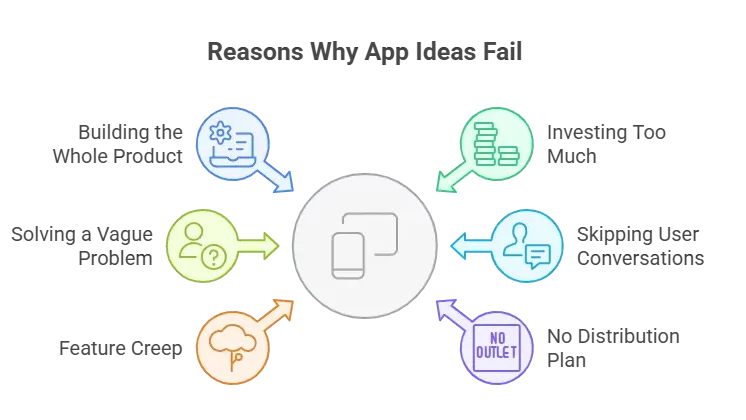
1) Building the whole product instead of an MVP
This is the #1 killer. People say “MVP” and then build a full-blown platform anyway. They add logins, dashboards, roles, integrations, analytics, settings pages, and a UI that looks like a spaceship.
That is not ambition. That is procrastination disguised as “vision.”
An MVP is not a smaller version of the final product. It is the smallest version that proves the core value. If your app’s promise is “book appointments in 30 seconds,” the MVP proves booking in 30 seconds. It does not need a rewards system, referrals, advanced admin controls, or five themes.
If you want to turn your idea into an app, treat features like debt. Every extra feature delays feedback, adds bugs, and increases cost.
2) Investing too much before you learn anything
People spend money on the wrong things early:
● A full UI design system before the core flow works
● A custom backend when no one is using the app yet
● Big paid ads before retention exists
● Legal, branding, and naming wars before validation
Spending early can feel productive because it creates movement. It also creates a trap: once you invest, you feel forced to “make it work,” even if the idea needs a pivot.
3) Solving a vague problem
“I want to build an app for fitness” is fluff. “I want to build an app that helps vegetarian gym beginners hit 120g protein using Indian home food” is a problem with a sharp edge.
Vague ideas create vague apps. Vague apps do not get used.
4) Skipping real user conversations
If you build based on assumptions, you will ship a product for an imaginary customer who always behaves, always reads, and always clicks the button you want.
Real users are messy. They misunderstand labels. They ignore onboarding. They forget passwords. They want shortcuts. If you avoid user conversations, you choose fantasy over reality.
5) Feature creep from insecurity
This happens when you think:
“If I add more features, people will like it.”
No. People like products that do one job cleanly. A bloated product looks expensive and confusing. Confusion kills activation.
6) No distribution plan
Even a solid app fails if nobody hears about it. If your plan is “launch and hope,” that is not a plan. You need a realistic path to the first 50 users and the first 10 paying users.
How You Can Turn Your Idea Into an App
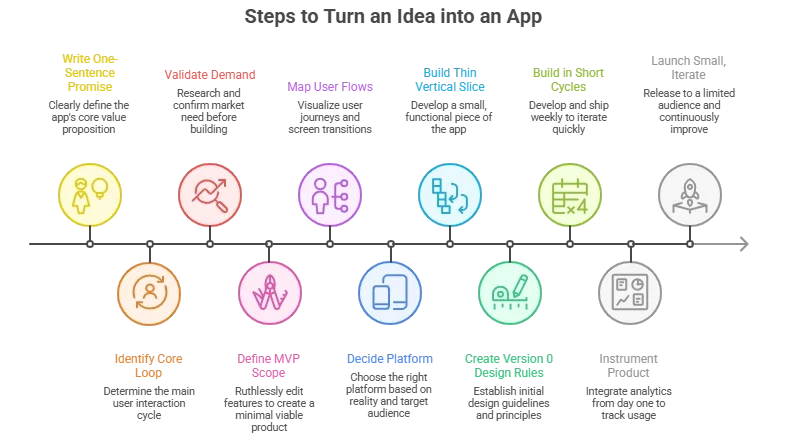
Here’s a process that actually works. Follow it in order. Skipping steps is how you waste months.
Step 1: Write the one-sentence promise
Force clarity:
“This app helps [specific user] achieve [specific outcome] by [specific mechanism].”
Example: “This app helps small agencies create client-ready proposals in 10 minutes by generating a structured draft from a short intake.”
If you cannot write this sentence, your idea is not ready. And yes, I said it.
Step 2: Identify the core loop
The core loop is the repeatable action that delivers value and makes the user come back.
Examples:
●Create → share → get feedback → improve
●Track → get insight → adjust → track again
●Request → receive → resolve → repeat
●Your MVP should mainly support this loop. Everything else is secondary.
Step 3: Validate demand before you build
To turn your idea into an app without gambling, validate fast:
Pick two of these:
●10 customer interviews with people who match your target user
●Landing page + waitlist with a clear promise and one CTA
●Clickable prototype (Figma is enough) to test if users understand the flow
●Concierge MVP: do the work manually behind the scenes for 5–10 users
Your goal is proof of pain and proof of willingness. You want people saying, “I need this,” and showing it with time, data, or money.
Step 4: Define MVP scope like a ruthless editor
Create a list with three buckets:
Must have (MVP):
●The minimum flow that delivers the promise
Nice to have (later):
●Useful enhancements after feedback
Ego features (kill):
●Anything that exists mainly to look impressive
Most founders keep ego features. That decision is usually trash. Kill them.
Step 5: Map user flows and screens
Do not jump into development yet. First map:
●Entry point (how users start)
●Steps to reach the outcome
●Confirmation (how they know it worked)
●Next action (what they do after success)
Then create a simple screen list. This becomes your build blueprint.
Step 6: Decide platform based on reality
To turn your idea into an app, choose the platform that matches usage:
●Mobile-first habit or on-the-go use: iOS/Android
●Workflows, forms, dashboards: web app first
●Unsure: responsive web app first, then mobile if traction proves it
Do not choose based on what sounds cool. Choose based on user behavior.
👉 Check our mobile app development services
Step 7: Build a thin vertical slice
A thin slice means one full journey end-to-end, even if everything is basic:
●UI works
●Data saves
●User reaches the outcome
This is better than building 10 half-finished modules.
Step 8: Create version 0 design rules
You do not need a full brand system. You need consistency:
●1–2 fonts
●2–3 text sizes
●1 primary button style
●Clear spacing rules
Readable beats pretty. Every time.
Step 9: Build in short cycles and ship weekly
Plan 1–2 week sprints:
●Sprint goal = one measurable improvement to the core loop
●End of sprint = usable build, tested, shared with users
This is how you turn your idea into an app that improves fast instead of a project that drags.
Step 10: Instrument the product from day one
Track basics:
●Activation (did they reach the first success?)
●Retention (did they return?)
●Conversion (did they pay or take the monetization step?)
●Drop-off points (where they quit)
Without this, you are guessing. Guessing is expensive.
Step 11: Launch small, then iterate
Launch to:
●20–50 target users
●A niche community
●Existing network
●One clear channel you can repeat
Collect feedback in a structured way:
●What did you expect?
●What confused you?
●What did you love?
●What would make you pay?
Then improve the core loop again. That is the job.
Learn MVP launch strategies here.
Step 12: Add monetization once value is proven
●Subscription (simple, predictable)
●Pay-per-use (great for occasional users)
●Tiered plans (only when you know what different users need)
●Monetization options:
Price is a test. Do not overthink it. Set a starting price, observe behavior, adjust.
If you do all this, you will turn your idea into an app that has traction, not just screenshots.
Conclusion
If you want to turn your idea into an app, stop romanticizing the build and start attacking risk in the right order. Validate the pain. Define the core loop. Build the smallest version that delivers real value. Ship fast. Listen harder than you talk. Improve what users actually touch.
Most people fail because they build a full product in their head, then try to build it in real life. The smarter move is to build proof first, then build polish.
Your idea is not special. Your execution can be.
EnactOn takes you from messy idea to a market-ready app without the usual chaos. We run a scope sprint to lock the one promise and core loop, cut the ego features, and turn it into a build-ready backlog with clear specs.
Then we design, develop, test, and ship a thin vertical slice fast, so you get real users, real feedback, and a real product you can grow. We have delivered 500+ projects for 350+ clients across 65+ countries. If you want your MVP built right the first time, talk to EnactOn.
FAQs
How do I know if my idea is worth turning into an app?
If at least 10 target users say they have the problem and would switch from their current workaround, and a few join a waitlist or pay for a manual version, it’s worth building.
Should I build an MVP or a full product first?
MVP. Building the full product first is usually a waste because you’re guessing. Prove the core value with the smallest working flow, then expand based on real usage.
How long does it typically take to turn an idea into an app?
A basic MVP can be done in 4–8 weeks if the scope is tight. If your MVP needs 30 screens and 10 features, it’s not an MVP, it’s scope creep.
What’s the biggest mistake founders make when building their first app?
They add features to feel safer. That makes the app slower to build, harder to use, and harder to iterate. Users want one clear outcome, not a buffet.
Do I need coding skills to turn my idea into an app?
No, but you do need product clarity. You can validate with interviews, landing pages, and prototypes. For building, you can use no-code or hire devs, but you must control scope and priorities.