
SaaS MVP Paid Tester Acquisition Strategies: The Blueprint for Your First 100 Paying Users
If you’ve been building your SaaS MVP for months and finally reached the point where it “works”, even if it’s held together by duct tape, half-functional automation, and a back-end that cries when someone refreshes twice, now comes the next reality check:
How do you get real users to test it? And not just random users, paid testers.
Because here’s the uncomfortable truth: If you launch your MVP and no one pays, you don’t have a product. You have a project.
Paid testers validate four things at once:
● Your offer
● Your messaging
● The perceived value
● Whether someone is willing to part with money, even a small amount, for the solution
So instead of shouting into the void hoping someone beta-tests your SaaS for free, let’s talk about the smartest SaaS MVP paid tester acquisition strategies.
11 SaaS MVP Paid Tester Acquisition Strategies
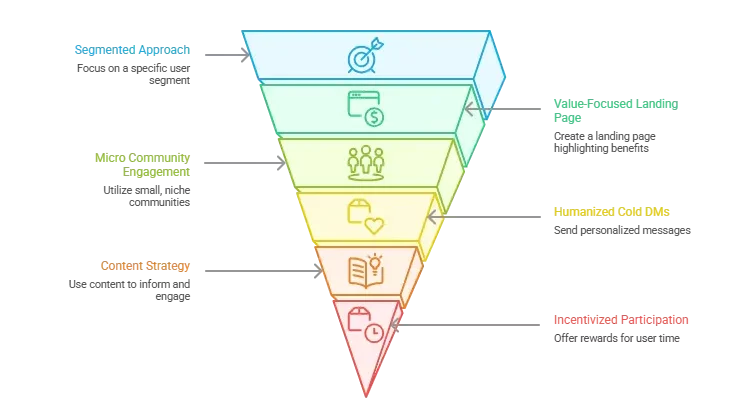
1. Start With a Small, Specific Segment
You’re not targeting “business owners.” That’s vague and useless.
You’re targeting:
● Freelance video editors who struggle to track revisions
● Shopify store owners managing influencer approvals
● HR teams onboarding remote interns
● Sales reps drowning in proposal formatting
The smaller and clearer the segment, the easier it becomes to find users and the faster you get meaningful feedback.
Why? Because specificity = relatability. Relatability = sign-ups.
Generic messaging attracts nobody. A hyper-targeted message attracts the exact frustrated humans who want what you’re building.
2. Build a Value-Focused Landing Page With a Paid Waitlist
No fancy UI. No full website. Just a clear landing page answering:
● What problem does your tool solve?
● Who is it for?
● Why now?
● What makes it different from existing tools?
● What do they get during the paid testing phase?
Then add a button that says:
Join the Paid Beta, Early Access Spots: 20
Price: $29 (one-time)
This creates urgency and scarcity. People pay because they don’t want to miss out, not because they fully understand what you built.
Now you’re applying one of the most effective SaaS MVP paid tester acquisition strategies without annoying pop-ups or fake hype.
3. Leverage Micro Communities, Not Big Platforms
Posting in a generic Facebook group won’t do anything.
Posting in a 200-person Slack community where everyone has the exact problem you’re solving?
That’s gold.
Places to look:
● Slack groups
● Discord servers
● LinkedIn creator groups
● Niche subreddits
● Paid private communities
● Industry mastermind groups
● Bootcamp alumni spaces
These people already hang out together, already talk about their problems, and if one person tests your MVP and likes it, others will follow.
4. Use Cold DMs, But Make Them Human
Cold DMs aren’t evil. Bad cold DMs are.
The trick isn’t pitching. The trick is diagnosing.
Example:
Hey, quick question.
How are you currently handling <problem your tool solves>?
Are you satisfied with that workflow or is it annoying/time-consuming?
If they respond, then you invite them.
A working closing line:
I’m building a tool that solves exactly that.
I’m offering a paid beta to 20 testers.
You’ll get lifetime access + direct input into features.
Want details?
Keep it short. No paragraphs. No essays.Consult an expert for free now
5. Use Content Wisely, Not as a Distraction
A lot of SaaS founders burn months creating content because it feels productive.
Content alone won’t bring paid testers unless:
● It speaks directly to the problem
● It showcases your messaging clarity
● It’s posted where your audience exists
Micro content formats that work:
● “Before vs after” workflows
● Walkthroughs of how people currently waste time
● Screenshots of real UI progress
● “What we’re building and why” narratives
● A simple teaser video
This positions you as someone solving a problem rather than someone begging for feedback.
6. Incentivize Their Time, Not Just Their Payment
People will pay to be testers, but they’ll pay more if there’s clear benefit:
● Lifetime access
● Priority support
● Exclusive roadmap influence
● Recognition as founding members
A psychological shift happens:
They stop being testers and start being ambassadors.
This is where early loyal users come from, the people who eventually defend you online when someone compares you to a competitor.
SaaS MVP paid tester acquisition strategies focus on trust, perceived value, and reciprocity, not discounts.
7. Run a “Founding Members” Pre-Sale
People love being early.
Not just for money, for status.
A founding member pre-sale could look like:
Tier 1: $19, Early Beta Access
Tier 2: $49, Beta + Lifetime Plan
Tier 3: $149, Lifetime + Feature Influence + Name on Website
Congratulations, you just turned testers into co-creators.
8. Use Partnerships With Audience Hubs
No audience? Borrow one.
Reach out to:
● Newsletter authors
● Podcast hosts
● Niche influencers
● YouTube educators
● Course creators
● Software review channels
Pitch them something irresistible:
“I can offer your audience exclusive access to a private beta. 20 spots only.”
Creators love exclusivity. Their audience loves being early. You get testers who already trust the person promoting it.
9. Make the Onboarding Feel Like a Conversation
Once testers join, don’t just dump a login link in their inbox.
Give them:
● A welcome email
● A short video
● A guided workflow
● A clear expectation for feedback
Treat onboarding like a conversation, not a transaction.
Because onboarding isn’t just about using the tool, it’s about building connections.
When onboarding feels personal, churn disappears.
10. Collect Feedback Without Making Users Feel Like Employees
Don’t bombard them with surveys.
Instead:
● Ask one question at a time
● Use in-app prompts
● Ask for “voice of customer” feedback in their exact words
● Watch how they use the product instead of assuming
The fastest way to kill momentum is to make your users feel like they’re doing homework.
Keep it conversational. Keep it flowing.
Check examples of SaaS MVP and see how they implemented feedback to evolve their products.
11. Document Wins and Share Progress Publicly
Every time:
● Someone signs up
● Someone gives good feedback
● A feature gets validated
● A tester says “This helped me save 2 hours”
Share it.
Social proof fuels more signups.
You’re not showing off, you’re proving the product is moving forward.
This reinforces trust, urgency, and legitimacy, the core of SaaS MVP paid tester acquisition strategies.
Once You Get 20–50 Paid Users, Shift Strategy
After this stage, the game changes.
Now you move from 1-to-1 tactics to scalable ones:
● Affiliates
● Ambassador programs
● Retargeting ads
● Webinars
● Case studies
● Referral loops
Because at this point, you’re not validating whether someone will pay, you’re validating whether the product deserves to scale.
Once you understand that SaaS MVP paid tester acquisition strategies aren’t about hype, ads, or chasing thousands of users, but about validating the product with the right small group of buyers, everything becomes clearer.
You don’t need everyone.
You just need the right 20–50 real testers who pay, give feedback, and help shape the future of your SaaS product development.
Top Platforms for Testing Your Saas Mvp With Real-world Users
Alright, here’s the blunt truth: most founders think testing means throwing a link on Product Hunt and praying. That’s not validation. That’s coping.
If you want structured feedback from real humans, not your cousin, not your co-founder, not your imaginary ICP, you need platforms where people actually get paid to test software and give meaningful feedback.
Here are platforms worth using if you’re serious about validating your MVP before you embarrass yourself with a full launch:
| Platform | Best For | Rough Pricing Range | Strengths (NEW) | Limitations (NEW) | Suitable MVP Stage (NEW) |
| UserTesting | Onboarding flow testing, UI/UX journey feedback | $$$ (High) | Real-time reactions, diverse tester pool, advanced task scripts | Expensive for early founders, requires clear testing structure | Polished MVP or v1 |
| User Interviews | Interviews with niche ICP and B2B audiences | $$–$$$ | High targeting accuracy, professional tester base | Slower turnaround time, requires moderation | Early concept to mature MVP |
| PlaybookUX | Automated moderated and unmoderated tests | $$ | Unlimited seats, flexible study formats, AI tagging of insights | Results can feel generic unless tasks are specific | Early MVP to post-launch refinement |
| BetaTesting (BetaBound) | Recruiting early adopters and stress-testing usability | $$ | Scalable tester pool (10–200), ongoing cycles ideal for bugs | Not ideal for deep product feedback interviews | MVP → Beta → Public release |
| Testbirds | International testing, device compatibility | $$–$$$ | Strong compliance testing, diverse device support | Complex onboarding, suited more for enterprise | Mature MVP or scaling globally |
| Trymata (TryMyUI) | Honest raw usability reactions | $–$$ | Fast turnaround, emotional reactions captured | Not always structured feedback, tester quality varies | Early MVP refinement |
| Validately (UserZoom) | Prototype and workflow validation | $$ | Enterprise-level analytics, multi-session studies | Now enterprise-skewed after Cisco acquisition | Prototype → MVP |
| Respondent | Profession-specific validation (HR, PMs, engineers) | $$–$$$ (Tester reward separate) | High-quality testers, actual domain experience | Requires well-built interview script | Concept → Pre-MVP interviews |
| TestingTime | Remote moderated sessions with European testers | $$ | Scheduling automation with testers, compliance-friendly | Best for EU markets, limited niche segments outside | MVP refinement |
| Loop11 | Quantitative UX metrics and A/B testing for flows | $$ | Heatmaps, conversion funnels, benchmark scoring | Less human feedback tone, more data-focused | MVP → Scale-stage optimization |
1. UserTesting
You already mentioned it, and yes, it’s one of the OGs. Great for:
● UI/UX feedback
● First-time user journey
● Voice + screen recordings
● A/B experiments
Downside? It’s pricey. Good if you want polished insights, bad if you’re a broke indie founder.
2. User Interviews
This one is gold. You get access to specific demographics and do actual structured interviews.
Good for:
● SaaS MVP validation
● Pain point exploration
● Feature prioritization
You can filter testers by job title, industry, tools they currently use, super useful if you’re solving a niche workflow.
3. PlaybookUX
Basically the calmer, more balanced cousin of UserTesting.
Supports:
● Automated usability tests
● Pototype testing
● Panel testing
● Recorded video interviews
It also allows unlimited teammates, helpful if you actually have a team and not just your inner chaos.
4. BetaTesting (formerly BetaBound)
This platform gives you access to paid beta testers for new products, and it’s specifically made for MVPs.
Perfect if you want:
● Early adopters
● Larger tester pools (10–200 testers)
● Structured feedback cycles
If your SaaS MVP paid tester acquisition strategies include scaling validation with volume, this platform’s great.
5. Testbirds
Used heavily in Europe. Best for:
● Mobile apps
● Enterprise workflows
● International user testing
● Multi-device compatibility
If your product needs localization or multi-market fit, this helps avoid painful surprises later.
6. Trymata (TryMyUI)
Raw, honest, sometimes painful feedback, exactly what most founders avoid and exactly what they need.
You’ll get:
● Screen recordings
● Voice reactions
● Task-based usability scoring
Competitor comparisons
If someone rage-clicks a button, you’ll hear it.
7. Validately
Now part of UserZoom (Cisco bought it and made it enterprise-ish). Still useful for:
● Prototype walkthroughs
● Feature validation
● Continuous product testing
If you’re testing onboarding or workflow efficiency, it’s solid.
8. Respondent
Think of it as the recruitment platform for serious user interviews.
Best for:
● B2B SaaS
● High-ticket workflow solutions
● Professional audiences (HR, PMs, Developers, Finance Teams)
If your users are specialists, not random consumers, this is your playground.
9. TestingTime
You can recruit testers from different countries and time zones easily.
Supports:
● Remote moderated interviews
● First impression testing
● Prototype testing
● Concept validation
Useful if you need global feedback without timezone headaches.
10. Loop11
This is more analytics-heavy, great if you’re optimizing UX at a deeper level.
It gives:
● Heatmaps
● Click tracking
● Funnel drop-off points
● Task-based success data
This helps you move from “feedback feels” to “data says fix this immediately.”
Quick Snapshot, What to Use for What
| Use Case | Best Platforms |
| First Impression Testing | UserTesting, Trymata |
| Prototype Validation | PlaybookUX, Validately |
| Niche SaaS ICP Interviews | User Interviews, Respondent |
| Volume-Based Early Beta | BetaTesting, Testbirds |
| Global Testing | TestingTime, Testbirds |
| Analytical + UX Tracking | Loop11 |
How to Use These Platforms Without Wasting Money

A lot of founders burn budget because they treat testing like a checkbox.
Here’s the smarter flow:
1. Test messaging first (landing page validation)
→ Use User Interviews / Respondent
2. Test prototype or clickable demo
→ PlaybookUX / Trymata
3. Run guided usability tests with target ICP
→ UserTesting / Validately
4. Open limited paid beta with onboarding workflow
→ BetaTesting / Testbirds
5. Run retention + feature prioritization tests
→ Loop11 + follow-up interviews
This way, you’re not just collecting opinions, you’re collecting actionable patterns.
Closing Thought
Building a SaaS MVP is work, technical work, emotional work, and communication work. Paid testers aren’t just testers, they’re early believers. Treat them like partners and you’ll build something that grows because it deserves to, not because you pushed it.
If you apply even half of these strategies, you won’t be begging for beta users, they’ll be applying to get in.
FAQs
1. How many paid testers do I actually need for a SaaS MVP?
Around 10–30 paid testers are enough to validate demand. Once feedback shifts from fixing core issues to asking for improvements, you’re past validation and ready to refine or scale.
2. Should I validate messaging before testing the product itself?
Yes. If people don’t understand or care about your value proposition, product testing won’t matter. A landing page with a clear offer and paid waitlist quickly proves if messaging resonates.
3. How do I choose the right user testing platform for my MVP?
Pick based on audience and depth of insight needed. UserTesting or Trymata for usability, User Interviews or Respondent for niche roles, and BetaTesting or Testbirds for structured beta cycles.
4. Should paid testers receive lifetime access as part of the beta program?
Lifetime access can attract serious early adopters and reward commitment. Keep it capped and exclusive so it boosts perceived value without affecting long-term pricing.
5. When do I stop collecting feedback and start scaling user acquisition?
Once onboarding feels smooth, retention improves, and feedback becomes feature-focused instead of bug-focused, it’s a sign your MVP is ready to scale and reach broader audiences.