
Food Delivery Services Explained: The Business Mechanics Every Founder Should Understand First
Food delivery services look simple from the outside: a user picks a restaurant, places an order, someone prepares the food, and a delivery partner drops it off. But behind that quick tap-and-eat convenience, there’s a tightly integrated system involving logistics, routing, software workflows, vendor partnerships, payment gateways, and customer experience loops.
Whether you’re curious about the industry or planning to build a restaurant platform, understanding the end-to-end process helps you see the moving parts clearly.
Let’s break it down step-by-step.
How Food Delivery Services Work? (Core Ecosystem)
Food delivery business isn’t just an app. It’s a three-sided marketplace:
● Customers – People placing orders.
● Restaurants – Kitchens preparing the food.
● Delivery Partners / Couriers – People delivering the food.
And then there’s a backend layer that makes everything work:
● Tech platform (app + admin + dashboard)
● Location services (maps, routing algorithms)
● Payment systems
●Support system
● Marketing systems (discounts, loyalty, subscriptions)
Think of it like a machine where every part needs to run smoothly, or the whole system collapses.
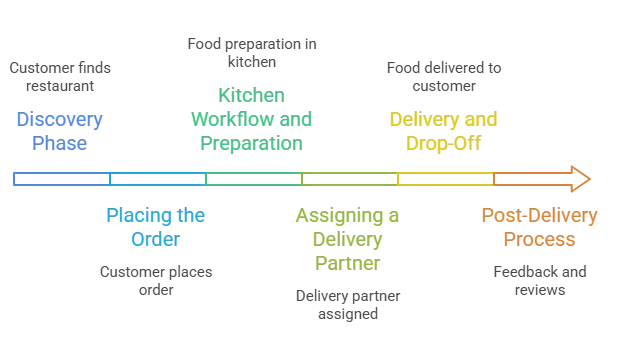
Step-by-Step Workflow: What Happens When Someone Orders Food?
1. Discovery Phase
Before anything is sold, users need to see what’s available. Discovery includes:
● Showing restaurants based on distance and availability
● Filters like vegetarian, budget-friendly, ratings, fast delivery, etc.
● Search functionality
● Promotions and deal banners
This step sets the tone for user experience.
2. Placing the Order
Once a user selects a restaurant and adds items, the system:
● Calculates taxes and delivery charges
● Applies offers or coupons
● Verifies item availability (some platforms sync stock levels in real time)
● Confirms payment
Payment options usually include:
● Online payments (UPI, credit/debit cards, wallets)
● Cash on delivery (declining but still present in many regions)
● Pay later options
Once the payment is processed, the order enters the restaurant dashboard.
3. Kitchen Workflow and Preparation
Inside the restaurant dashboard:
● The order shows up with items, modifiers (extra cheese, spice level, etc.)
● The kitchen accepts the order or rejects it if capacity is full
● Estimated preparation time is updated
Kitchen systems often include:
● Ticket printers
● Digital kitchen display systems (KDS)
● Task-based checklists
The goal is speed + accuracy.
4. Assigning a Delivery Partner
Delivery isn’t random. Platforms use routing logic to match:
● Closest available courier
● Vehicle type (bike, cycle, car, scooter)
● Distance to restaurant and customer
● Traffic and road constraints
● Partner ratings and reliability score
The courier accepts the job, heads to the restaurant, and updates status:
Arrived → Picked → On the way → Delivered
Real-time GPS tracking updates both the restaurant and customer.
5. Delivery and Drop-Off
Couriers follow optimized routes. On reaching, they:
● Verify the order code
● Drop food at customer location
● Mark delivery complete
Some platforms allow:
● Contactless delivery
● Leave at door
● Meet outside
Delivery time expectations now define customer satisfaction more than food taste. On average customers don’t want to wait for more than 40 minutes for their food to be delivered.
6. Post-Delivery Process
After food arrives, the system triggers:
● Rating prompts
● Review requests
● Customer support chat
● Loyalty or re-order nudges
This feedback loop is used to:
● Improve restaurant ranking
● Improve courier performance scores
● Improve app personalization
Explore some of the food delivery app ideas here
Key Systems Behind the Scenes
Here’s what keeps everything running:
● Order Management System (OMS)
Tracks creation, modification, and completion.
● Restaurant Dashboard / POS Integration
Avoids manual order entry chaos.
● Delivery Management System
Optimizes courier assignment and routing.
● Customer Support + Incident Resolution
Handling issues like wrong items, missing cutlery, delayed delivery, or refunds.
● Payment Gateway + Settlement System
Split payments between restaurant, platform, and courier.
If you’re running a restaurant and want to manage orders, delivery, inventory, and customer experience without juggling multiple systems, EnactOn builds custom restaurant management software tailored to your workflow. From POS to mobile ordering to analytics, we help you streamline operations and scale.
Business Models Used in Food Delivery
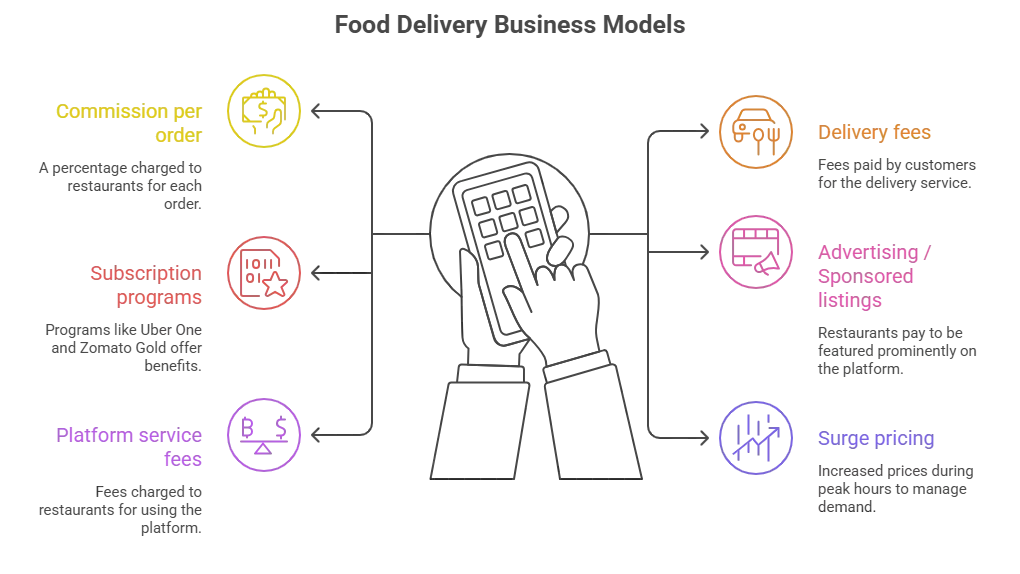
Different platforms earn revenue through different models:
● Commission per order (percentage charged to restaurants)
● Delivery fees paid by customers
● Subscription programs (like Uber One, Zomato Gold)
● Advertising / Sponsored listings
● Platform service fees
● Surge pricing during peak hours
Multiple streams reduce dependency and improve scaling profitability.
Challenges in Food Delivery Operations
Even big platforms fight these common operational headaches:
● Peak hour surge delays
● Cold/incorrect orders
● Courier shortage in bad weather
● Fraud (fake refunds, ghost bookings)
● High operational cost
● Restaurant inconsistency
● Maintaining real-time availability
Scaling isn’t just about tech, it’s about logistics maturity.
Learn more about the Customer Satisfaction and Challenges in Online Food Delivery in this research paper.
How Restaurants Benefit from Food Delivery Platforms
Restaurants adopt delivery because it helps them:
● Reach more customers
● Operate with lower seating capacity
● Increase sales during idle hours
● Automate ordering and payments
● Use analytics for better planning
But restaurants also need their own systems to reduce chaos.
Future of Food Delivery
The next evolution of food delivery is already shaping up:
● Drone-based delivery
● AI-powered kitchens
● Predictive ordering
● Subscription-based menus
● Fully automated cloud kitchens
● Loyalty-driven personalization
● Eco-friendly packaging systems
Convenience is still the core driver, but automation will redefine margins and delivery time.
Build Your Own Custom Food Delivery or Restaurant Platform
Whether you’re planning a marketplace like Swiggy or want an internal delivery solution for your chain, EnactOn can design and develop custom food delivery software with:
● Order management
● Delivery assignment logic
● Custom POS integration
● Real-time tracking
● Analytics dashboards
● Inventory sync
● Loyalty & customer engagement features
You don’t need generic software, you need a system built for your operations. Connect with our experts now.
Final Thoughts
Food delivery services work through a carefully orchestrated workflow involving restaurants, logistics, couriers, and tech infrastructure. The platform bridges demand and supply while optimizing experience for all parties.
If you’re planning to enter the food delivery space, or you’re a restaurant owner looking to streamline operations, the key is building systems that scale, not duct-taping random tools together.
And if you want help building that system, you already know where to find it.
FAQs
1. How do food delivery apps make money?
Most platforms use a combination of revenue streams like order commissions, delivery fees, advertising placements, subscription programs, surge pricing, and platform service fees. Some also charge restaurants extra for premium placement, analytics access, or faster payment settlements.
2. Do restaurants need separate software even if they use delivery platforms like Swiggy or Uber Eats?
Yes. Marketplace apps handle orders and logistics, but they don’t manage internal workflow like inventory, dine-in orders, staff activity, menu updates, loyalty programs, or central reporting across multiple outlets. Restaurants still need their own POS or custom restaurant management software to stay organized and scalable.
3. How do delivery partners get assigned to an order?
Once a restaurant accepts an order, the system uses routing algorithms to match the closest available delivery partner based on distance, traffic, rider performance, and restaurant prep time. The courier confirms the trip and heads to the restaurant, and real-time tracking begins.
4. Can small restaurants build their own food delivery platform instead of joining big apps?
Absolutely. Many restaurants build their own ordering and delivery systems to avoid paying high commissions. Custom platforms offer control over branding, customer experience, pricing, and loyalty programs, and can integrate with existing tools like POS, CRM, and inventory.
5. What technology is required to build a food delivery system?
A modern platform requires a frontend interface (web or app), backend service, order management system, routing logic, payment gateway, courier app, restaurant dashboard, and an admin system. Tools like Google Maps API, Razorpay/Stripe, and frameworks like React, Node.js, Flutter, or Python are commonly used.