GloriaFood is shutting down. If you haven’t heard yet, you will soon. Oracle, which acquired the platform back in 2021, has started sending partner emails and showing in-app banners that say the same thing: the offering will be retired on April 30, 2027, and Oracle will not be offering a direct replacement.
For restaurants and agencies that have been running online ordering through GloriaFood for years, this is a gut punch. The platform was one of the very few in the market that offered a genuinely free online ordering system with zero commissions. No marketplace cuts. No per-order fees. Just a widget on the restaurant’s website and a clean way to take orders directly.
So now everyone is scrambling. The conversations happening in restaurant forums, WordPress communities, and agency Slack groups are all variations of the same question: “Which platform do we move to?”
That’s the wrong question.
Moving to Another SaaS Doesn’t Solve the Problem
The instinct to find a “GloriaFood alternative” makes sense on the surface. You need something to replace it, and SaaS platforms are the obvious answer. Pick a new tool, migrate the menus, update the website widget, and move on.
But that’s exactly what everyone did with GloriaFood, and here’s what happened: a platform that thousands of restaurants and agencies had built their digital ordering on was shut down by a corporate decision made thousands of miles away, with no replacement and twelve months to figure it out.
Jumping to another SaaS doesn’t remove that risk. It resets the clock on it.
Every SaaS platform you move to comes with the same exposure: their pricing decisions are not yours, their roadmap is not yours, and their exit strategy is definitely not yours. What Oracle did with GloriaFood can happen with any vendor. An acquisition, a strategic pivot, a shift in product focus,and suddenly the platform your restaurant or agency depends on is gone.
There’s also the cost side of it. GloriaFood markets itself as free, and the base plan genuinely is. But anyone who uses it seriously quickly finds themselves stacking Gloriafood paid add-ons:
-
Online payments: $29/month plus around 2% per card transaction
-
A sales-optimized website: $9/month
-
Advanced promotions and marketing: $19/month
-
Branded mobile apps: $59/month
-
The GloriaFood POS system: $49/month per location, with a two-year commitment
That’s $166/month in fixed fees per location before a single transaction is processed. Add in the 2% card fee on a restaurant doing $100,000/year in card volume ($2,000/year), plus reservation deposit fees at $0.50 per accepted guest, and a single busy location can easily be spending $5,000 to $5,500 per year on what’s supposed to be a “free” platform.
Any SaaS you switch to will have its own version of this structure. You’ll pay, you’ll get locked in, and you’ll hope they don’t shut down before you do.
Build Your Own Ordering Platform
Turn the GloriaFood shutdown into an upgrade. We use our battle-tested core to accelerate your platform development, plan the rollout, and keep every restaurant client on your side.
There’s a Better Path: Own the Platform
The reason GloriaFood’s shutdown stings so much is that restaurants and agencies had zero control over the decision. They did nothing wrong. They used the product, paid for the add-ons, built their workflows around it,and it’s still being taken away from them.
The only way to avoid being in that position again is to own the ordering stack rather than rent it.
This doesn’t mean building an online ordering system from scratch. It means using a GloriaFood clone,a platform that mirrors everything GloriaFood does and provides you the flexibility to customize it based on your needs, running it as your own. Your branding, your pricing, your infrastructure, your call on when and how it evolves.
When you own the platform:
-
There’s no vendor deciding to retire it.
-
There’s no pricing change that lands in your inbox without warning.
-
There’s no third party sitting between your restaurant and its customers.
-
You’re the one capturing the SaaS revenue, not paying it out.
==========================
Running restaurants on GloriaFood? Don’t wait until 2027.
We have a customizable GloriaFood clone that mirrors everything your restaurants are already used to,online ordering, QR menus, reservations, POS, and full white-label capability. Own the platform instead of renting it again.
👉 Check Gloriafood clone solution
==========================
Who Should Build an Online Ordering App Like GloriaFood?
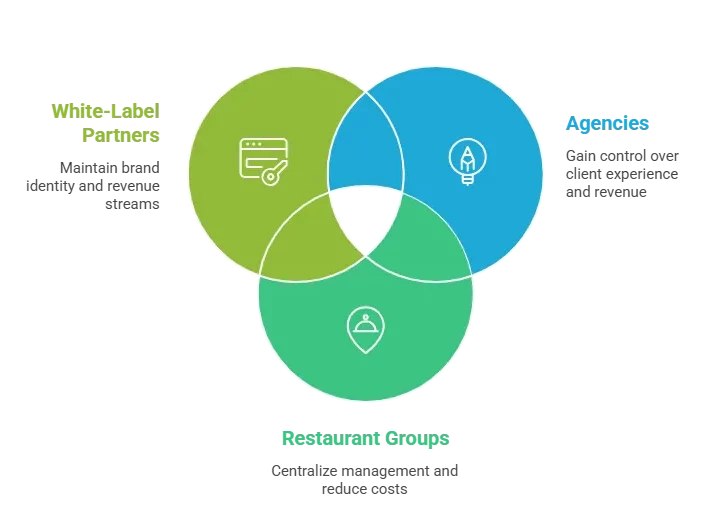
Build your own ordering app like Gloriafood. This isn’t the right move for every restaurant. A single-location neighborhood diner with straightforward pickup orders might be fine moving to another SaaS and calling it a day. But for a significant portion of GloriaFood’s user base, ownership makes far more sense than renting.
Agencies managing restaurant websites and ordering
If your agency manages online ordering for a portfolio of restaurants, GloriaFood’s shutdown just exposed how fragile that model is when every client runs on the same third-party platform. One vendor decision wiped out the foundation of your service offering.
Owning a GloriaFood-style platform changes the dynamic completely. You stop reselling someone else’s product and start offering your own. Your clients pay you. You control the experience, the support, the branding, and the roadmap. When a client grows and needs something custom, you can build it. When a vendor would have sent an EOL notice, you don’t, because the platform is yours.
For agencies, the economics of ownership also tend to be far better at scale. Instead of paying SaaS fees for 20, 30, or 50 restaurant clients, you absorb the platform cost once and earn recurring revenue across the entire portfolio.
Restaurant groups and multi-location operators
Running multiple restaurant locations on a SaaS platform means paying per-location fees that compound fast. The $49/month POS add-on alone becomes $490/month across 10 locations, $980/month across 20. That’s before the payment fees, the website subscriptions, and the restaurant marketing add-ons stack up.
A shared, owned platform spreads those infrastructure costs across all locations while giving headquarters centralized control over menus, promos, pricing, and reporting. It also removes the per-location billing math that SaaS vendors are very good at.
White-label partners and resellers
GloriaFood had a well-developed partner program. Agencies and resellers could white-label the platform under their own brand, enroll restaurants, and earn recurring revenue while GloriaFood handled the underlying tech.
When Oracle shuts GloriaFood down, all of that goes away. Every white-label partner loses the engine that their product runs on.
A GloriaFood clone built for white-label use gives those partners a direct replacement, same business model, same revenue structure, but on infrastructure they actually control. There’s no more scenario where the vendor decides your product is “not consistent with its strategic vision.”
What a GloriaFood Clone Gives You?
A GloriaFood clone isn’t a rough prototype. It’s a full ordering platform that mirrors the core GloriaFood feature set:
-
Online ordering widgets for restaurant websites and Facebook
-
Mobile-friendly menus with scheduling, online food delivery zones, and upsells
-
QR code ordering for dine-in and table-specific flows
-
Reservation management and deposit collection
-
Promotions, coupons, and basic marketing tools
-
A back-office dashboard for menus, orders, and reporting
-
White-label branding so it looks like your product, not someone else’s
Because the UX mirrors GloriaFood, existing restaurant staff already know how to use it. Migrations are straightforward ,menus, hours, delivery zones, and order flows can be rebuilt quickly without retraining a team on an entirely unfamiliar system.
The difference is that when you own the clone, you set the pricing. You decide what’s included in the base plan and what’s a paid add-on. You negotiate directly with payment providers instead of absorbing a platform-imposed 2% fee. You keep the margin instead of passing it to a vendor.
Build Your Own Ordering Platform
Turn the GloriaFood shutdown into an upgrade. We use our battle-tested core to accelerate your platform development, plan the rollout, and keep every restaurant client on your side.
The Real Cost Comparison
Here’s what a single restaurant location on GloriaFood’s “full” setup looks like on an annual basis:
| Cost Component | Monthly | Annual |
|---|---|---|
| Online payment add-on | $29 | $348 |
| Sales-optimized website | $9 | $108 |
| Advanced promotions | $19 | $228 |
| Branded mobile apps | $59 | $708 |
| GloriaFood POS | $49 | $588 |
| Fixed fees total | $166 | $1,992 |
| Card transaction fees (2% on $100k/yr) | — | $2,000 |
| Reservation deposit fees ($0.50 × 3,000 guests) | — | $1,500 |
| Total per location per year | ~$5,492 |
For an agency with 20 restaurant clients running a similar setup, that’s roughly $110,000 per year in platform-related costs flowing to a vendor,before anyone considers what happens when that vendor shuts down.
An owned GloriaFood-style platform doesn’t eliminate payment processing costs, but it removes the platform markup, collapses the add-on stack into a single controllable cost, and lets the partner or group capture the recurring revenue instead of paying it out.
The investment to build your own ordering app like Gloriafood is a one-time cost. The savings and the revenue compound every year after that.
Conclusion
GloriaFood’s retirement is a frustrating situation for a lot of restaurants and partners who did nothing wrong. But it’s also a useful wake-up call about what it means to build your own ordering app on infrastructure you don’t control.
The restaurants and agencies that come out of this in the strongest position won’t be the ones that found the fastest SaaS alternative. They’ll be the ones who used the forced Gloriafood migration as an opportunity to stop renting their ordering stack and start owning it.
A fully customizable GloriaFood clone makes that possible without starting from zero. Same familiar workflows. Full ownership. No more waiting for an EOL notice that isn’t yours to send.
Whether you’re an agency managing 10 restaurants or a multi-location group tired of stacking SaaS fees, there’s a faster path forward. With dedicated restaurant management software and custom online ordering, you get a fully branded, commission-free platform you actually own, built on the same workflows your team already knows.
FAQs
Is GloriaFood really shutting down?
Yes. Oracle has officially confirmed all GloriaFood products will be retired on April 30, 2027. Restaurants and partners are receiving direct emails and seeing in-app notices. Oracle will not offer a direct replacement, leaving all users to migrate independently.
Why shouldn’t I just move to another SaaS after GloriaFood shuts down?
Every SaaS carries the same risk,a vendor decision can kill your ordering setup overnight. Beyond platform risk, add-ons for payments, POS, apps, and promos can push annual costs past $5,000 per location with no ownership or control.
What exactly is a GloriaFood clone?
A GloriaFood clone is a ready-to-launch ordering platform that mirrors GloriaFood’s full feature set, online ordering, QR menus, reservations, promotions, and a back-office dashboard, but runs under your own brand, on infrastructure you fully own and control.
Who should consider owning a GloriaFood-style platform?
Agencies managing multiple restaurant clients, multi-location restaurant groups, and white-label partners who resold GloriaFood are the best fit. Anyone operating at scale will find ownership far more cost-effective and far less risky than paying per-location SaaS fees indefinitely.
How does owning a clone compare to staying on SaaS cost-wise?
A fully loaded GloriaFood setup costs roughly $5,492 per location annually. For an agency with 20 clients, that’s over $100,000/year going to a vendor. Owning a clone absorbs the cost once and keeps recurring revenue with you instead.


![How Much Does It Cost to Build an AI Agent in 2026? [Realistic Pricing & Token Economics]](/images/blog-placeholder.svg)