
How to Tell Your Clients About the Platform Migration (Email Templates for White-Label Resellers)
If you are a white-label GloriaFood reseller, your restaurants do not know they are on GloriaFood. They know the platform by your brand name. So when GloriaFood shuts down on April 30, 2027, the GloriaFood reseller email templates you use to communicate with clients cannot read like a panicked migration notice. They have to read like a routine product upgrade from a partner who has everything under control.
Done badly, that first message triggers a wave of churn. Done right, it deepens client trust and sets you up to move them onto something stronger, a platform you actually own. This guide gives you the exact email templates to send, explains why this conversation is trickier than it looks, and shows you how to use this moment to build a more defensible business.
Why GloriaFood Reseller Email Templates Need a Different Approach
Most resellers underestimate how delicate this messaging is. The dynamics are different from a standard SaaS migration because your clients do not know there is a third party in the picture at all.
They think your brand is the platform. When you tell a restaurant their ordering system is changing, they hear it as your system breaking. There is no Oracle to blame, no GloriaFood to point at, just you, suddenly making changes to a product they thought was stable.
Any wrong word triggers comparison shopping. The moment a restaurant senses instability, they start asking other vendors what they offer. Words like “shutting down,” “deadline,” or “forced migration” turn a sleepy account into a flight risk overnight.
They do not care about backend changes until they do. If the migration goes smoothly, restaurants want zero awareness of it. If anything breaks, they want a full explanation. Your messaging needs to set the right expectations without over-explaining the technical details.
Restaurants run on tight margins and tighter calendars. Adding “deal with platform stuff” to their plate is unwelcome. Your job is to remove anxiety, not add to it.
The right GloriaFood reseller email templates get ahead of all of these dynamics. They position the change as a positive upgrade, signal that you are in full control, and give the client a clear next step that requires almost nothing from them.
The Three-Email Sequence That Keeps Clients Calm
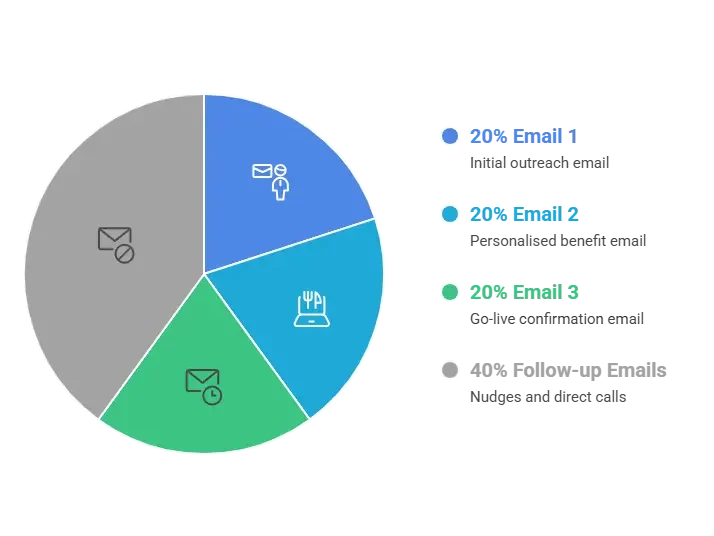
The GloriaFood reseller email templates in this guide are structured as a three-email sequence sent over two to three weeks. Each email has a specific job, and none of them mention GloriaFood, Oracle, or any backend vendor by name. To your client, this is your platform getting better.
Email 1: The Heads-Up
Send this as soon as you have decided to migrate, even before you have finalised the new infrastructure. The goal is simply to make sure the client hears about the upgrade from you first.
Subject: Upcoming upgrade to your [Your Platform Name] ordering system
Hi [First Name],
Quick heads-up: we are rolling out a major upgrade to [Your Platform Name] over the next few weeks. This is a significant infrastructure improvement that brings better performance, new features, and stronger reliability to your online ordering setup.
The good news: you do not need to do anything right now. We are handling the entire transition for you, and we will move [Restaurant Name] onto the upgraded platform without any disruption to your customers or daily operations.
Over the next couple of weeks, we will be reviewing your specific setup delivery zones, menu, payment processor, customer database, all of it to make sure everything carries over cleanly. Once we have finalised the rollout plan for your account, I will send you a clear timeline and a short summary of what changes and what stays exactly the same.
If you have questions in the meantime, just reply to this email or call me at [Your Number]. Otherwise, sit tight we have got this handled.
Talk soon, [Your Name]
This email does three things at once: it breaks the news on your terms, signals that you are in control, and removes any pressure for the client to act. They reply “thanks for handling this” and go back to running their restaurant.
Email 2: The Plan and Timeline
Send this one to two weeks after the first email, once you have finalised the new infrastructure and migration plan.
Subject: Your [Your Platform Name] upgrade: rollout plan inside
Hi [First Name],
Quick update on the [Your Platform Name] upgrade I mentioned a couple of weeks ago.
We have finalised everything for [Restaurant Name]. Here is what you will get out of the upgrade:
- [Specific benefit 1: e.g., faster, better-looking customer mobile experience]
- [Specific benefit 2: e.g., built-in loyalty program your customers can use]
- [Specific benefit 3: e.g., direct integration with your POS system]
Here is what happens next:
- Week of [Date]: We rebuild your menu, delivery zones, and payment setup on the upgraded platform using your existing data. You do not need to do anything during this phase.
- Week of [Date]: We run end-to-end testing and do a 30-minute walkthrough with your kitchen and front-of-house team.
- [Go-live Date]: We switch your website’s “Order Online” button over to the upgraded platform. Your customers will not notice anything except a smoother ordering experience.
A couple of small asks from you:
- Reply to this email confirming you are good to proceed.
- Let me know if there is a specific day you would prefer we avoid for go-live (peak service days, events, etc.).
Everything else, we have got.
Best, [Your Name]
This email is where you reinforce confidence. You have made decisions. You are managing the rollout. The client signs off and gets out of the way.
Get the exact checklist of how to move your restaurants to the new platform here.
Email 3: Pre-Launch Confirmation
Send this three to five days before go-live. Its job is to remove last-minute surprises and confirm that everything is ready on both sides.
Subject: Quick reminder: your [Your Platform Name] upgrade goes live [Day]
Hi [First Name],
Quick note that your [Your Platform Name] upgrade is set to go live on [Day, Date] at [Time].
Here is what will happen on that day:
- Your existing ordering link will automatically redirect to the new platform. Your customers will not need to do anything differently.
- Your menu, delivery zones, customer database, and payment setup will all be live and ready from the moment we switch over.
- I will be monitoring the new system throughout [Day] and am available on [Your Number] if anything needs immediate attention.
One thing to flag your team about: if any of your front-of-house or kitchen staff use a tablet or device to manage incoming orders, they may see a slightly different interface from [Go-live Date] onwards. We will send you a one-page quick reference guide for the new dashboard before the cutover so no one is caught off guard during service.
If anything has changed on your end a menu update, a change to your delivery zones, a preferred time adjustment reply to this email before [Date] and we will fold it into the final setup.
Otherwise, everything is on track. Looking forward to getting you live on the upgraded system.
[Your Name]
This final email lands the sequence cleanly. The client feels informed, the go-live feels managed, and your team has a clear confirmation to proceed.
How to Use These GloriaFood Reseller Email Templates Across Your Full Portfolio
Sending GloriaFood reseller email templates to five restaurants is straightforward. Sending them to fifty or two hundred requires a proper system so no client falls through the gap.
Stagger your outreach by priority. Do not send all three emails to all clients simultaneously. Start with your highest-value, most active accounts. Work down to lower-activity accounts over the weeks that follow. This keeps the volume of responses and follow-ups manageable at each stage.
Personalise the benefit bullets in Email 2. The placeholder benefits in Email 2 are where most resellers get lazy. A generic list of features lands flat. A benefit that speaks directly to how that restaurant operates “your loyalty program will now carry forward automatically” or “your POS integration will be handled in the background, no re-setup required” lands as genuine reassurance.
Track every response. Build a simple spreadsheet: one row per restaurant, columns for each email sent, response received, go-live date confirmed, and any issues flagged. At fifty clients, one missed response is one client who goes live unprepared. At two hundred, an untracked portfolio becomes a client retention problem.
Follow up on silence. If a client does not respond to Email 1 within five to seven days, send a short, friendly nudge, not a re-send. Reference the original email, ask for a simple confirmation, and offer a ten-minute call. If they still do not respond, call them directly. Silence is usually a buried inbox, but left alone it becomes quiet churn.
Do not skip Email 3. Many resellers send Emails 1 and 2 and assume the client will remember the go-live date. They will not. Email 3 is the confirmation that prevents a restaurant manager from being caught off guard mid-service.
Why This Migration Is Also Your Best Opportunity to Own Your Platform
Right now, your entire client base depends on someone else’s roadmap, someone else’s pricing decisions, and someone else’s shutdown risk. You experienced exactly what that costs you when GloriaFood announced its end-of-life. Every alternative SaaS platform you could move to UpMenu, Restolabs, Flipdish, ChowNow carries the same risk. In two or three years, that vendor could pivot, get acquired, or shut down. You will be writing these same GloriaFood reseller email templates all over again, for a different platform name.
The smarter move is to use this moment to upgrade your business model entirely. Instead of becoming a reseller for the next SaaS, launch your own ordering platform software you actually own, white-labeled to your brand, with no vendor sitting between you and your clients.
This is exactly what EnactOn’s GloriaFood clone solution is built for. The backend is production-ready and fully customisable, so features can be added or removed based on what your specific reseller business needs. You launch under your own brand, your own domain, your own pricing and your clients never go through another shutdown migration.
Here is why owning changes the conversation completely:
No more shutdown risk for your clients. You own the platform. You decide if and when it ever changes. The conversation you are having with clients today never has to happen again.
Bigger margins, no per-restaurant fees. SaaS partner programs take a meaningful cut of every client subscription. With your own platform, you keep 100 percent of what each restaurant pays you. Across 20 or 50 clients, that difference compounds fast.
Full white-label control. Your brand on the customer-facing app, your domain, your emails, your dashboard. Restaurants experience your platform not someone else’s wrapped in your logo.
Customisation on your terms. Need a delivery feature that no SaaS offers? An integration their roadmap will not prioritise? With a customisable codebase, you build what your clients actually need instead of waiting on someone else’s product team.
A defensible business asset. A reseller business is only as stable as the platform you resell. A platform business where you own the software is fundamentally more valuable, more sellable, and more durable.
The pitch to clients writes itself. You are not just upgrading their ordering system you are upgrading it onto infrastructure you own and control. That is the strongest retention message you will ever send.
What This Actually Costs You: A Reseller Margin Breakdown
Most resellers choose a post-GloriaFood path on gut feel what looks easiest, what peers are using, what offers the fastest onboarding. Almost nobody runs the actual numbers. When you do, the difference between renting a platform and owning one is too large to ignore.
Take a typical reseller portfolio of 25 restaurants. Here is roughly what each option costs over five years:
| Option | Upfront | Ongoing Monthly | 5-Year Spend | Your Cut Per Sale | Shutdown Risk |
|---|---|---|---|---|---|
| UpMenu (~$89/client/mo) | $0 | ~$2,225 | ~$133,500 | Markup only | Present |
| Restolabs (~$59/client/mo) | $0 | ~$1,475 | ~$88,500 | Markup only | Present |
| Flipdish (~€89/client/mo) | $0 | ~$2,400 | ~$144,000 | Markup only | Present |
| ChowNow (~$149/client/mo) | $0 | ~$3,725 | ~$223,500 | Markup only | Present |
| Owned Clone Platform | One-time licence | Hosting only | Fraction of SaaS spend | Full subscription | None |
Over five years, the cheapest SaaS option still costs roughly $90,000 and you own nothing at the end of it.
The difference is even sharper at the per-restaurant level:
| Path | Annual Cost Per Restaurant | What Stays in Your Pocket |
|---|---|---|
| SaaS partner programmes (typical) | $700–$1,800 paid to the vendor | Whatever margin you can stack on top |
| Your Own Platform | Hosting overhead only (amortised) | The entire subscription each restaurant pays you |
If you charge each restaurant $99 per month, the math is stark: on a SaaS where the vendor pockets $69, your take-home is $30 per month per client. On a platform you own, your take-home is closer to $90 or more per month after hosting overhead. Same client, same price tag, three times the margin.
Stretch that across a real client base. Fifty restaurants on a SaaS reseller programme clears roughly $18,000 in annual net margin. Fifty restaurants on your own platform clears closer to $55,000 plus you are sitting on a sellable platform asset that compounds in value as you onboard more clients.
This is no longer a discussion about features or onboarding speed. It is a discussion about whether you want to keep cutting cheques to the next vendor in line, or finally start collecting them.
Final Thoughts
How you handle the platform migration conversation is not a small thing. It is the moment your clients decide whether you are the kind of partner they want to keep working with. Use the right GloriaFood reseller email templates, frame the change as an upgrade, never mention the shutdown, follow the three-email sequence, and you will come out of this period with every client intact.
But do not stop at retention. Use this moment to upgrade what you are actually offering. The resellers who treat the GloriaFood shutdown as a one-time migration project will hold their ground. The resellers who treat it as a chance to launch their own platform will come out of it with a fundamentally stronger business, better margins, no vendor risk, and an asset that is actually theirs.
The emails go out either way. Make sure the platform you are moving clients onto is one worth staying on for the next decade.
If you want to see what a fully customisable, white-label ordering platform looks like under your own brand, get in touch with the EnactOn team we will walk you through the backend, talk through the customisations that make sense for your client base, and show you exactly what a transition off GloriaFood onto your own platform looks like.
Frequently Asked Questions
When should I send the first GloriaFood reseller email templates to my clients?
Send your first email as soon as you have committed to migrating ideally six to eight weeks before you plan to start the rollout. Early notice is the single biggest predictor of client retention during forced migrations. The worst outcome is a client noticing something wrong, or hearing about industry shutdowns through other channels, before they hear from you directly.
Should I send one big announcement or break it into multiple emails?
Break it into three emails sent over two to three weeks. The first is a heads-up framing the migration as an upgrade. The second covers the rollout plan and timeline. The third is a pre-launch confirmation three to five days before go-live. Spreading the communication out keeps clients calm and avoids the overwhelm that can trigger churn or comparison shopping.
Should I tell my clients that GloriaFood is shutting down?
No. If you white-labeled the platform, your clients do not know GloriaFood exists, and there is no benefit to introducing that name. Frame the change as an upgrade to your platform better infrastructure, new features, no disruption. Mentioning a third-party shutdown only raises questions like “wait, who else is involved in my ordering system?” and erodes exactly the trust your white-label setup was designed to build.
How do I stop clients from panicking when they read the upgrade email?
Lead with control, not crisis. The first sentence should signal that you already have a plan, that they do not need to do anything right now, and that you will handle the rollout on their behalf. Avoid alarming words like “shutdown,” “deadline,” or “urgent action required.” Frame it as “we are upgrading your ordering platform with new features and improved infrastructure.” Same event, completely different emotional response.
What should I do if a client does not reply to the migration email?
Follow up within five to seven days with a short, friendly nudge not a re-send. Reference the original email, ask specifically for their go-live date confirmation, and offer a ten-minute call if they have questions. If they still do not respond, call them directly. Silence usually means the email got buried in their inbox, but left unaddressed it can quietly become churn.
Should I move clients to another SaaS or to my own platform?
If you can pull it off, your own platform every time. Moving clients to another SaaS solves the immediate problem but reintroduces the same shutdown risk, the same per-client fees eating into your margin, and the same dependency on someone else’s roadmap. Migrating onto a platform you own built on a customisable backend like the one EnactOn Technologies offers costs roughly the same operational effort as a SaaS migration, but the long-term economics and business defensibility are fundamentally different.
How do I turn this migration into a chance to win more business?
Every client is paying attention right now. Every client is reminded that you handle their technology problems. Every client is more open to platform conversations than they will be at any other point this year. That is your opening to migrate them onto a platform you own, raise stagnant retainers, upsell additional services, and convert wavering clients into long-term partners. Resellers who handle this period proactively do not just retain clients they come out of it with stronger margins and a more defensible business.