
Online Food Ordering Platform Hidden Costs: Why Resellers and Operators Are Choosing to Own Their Platform
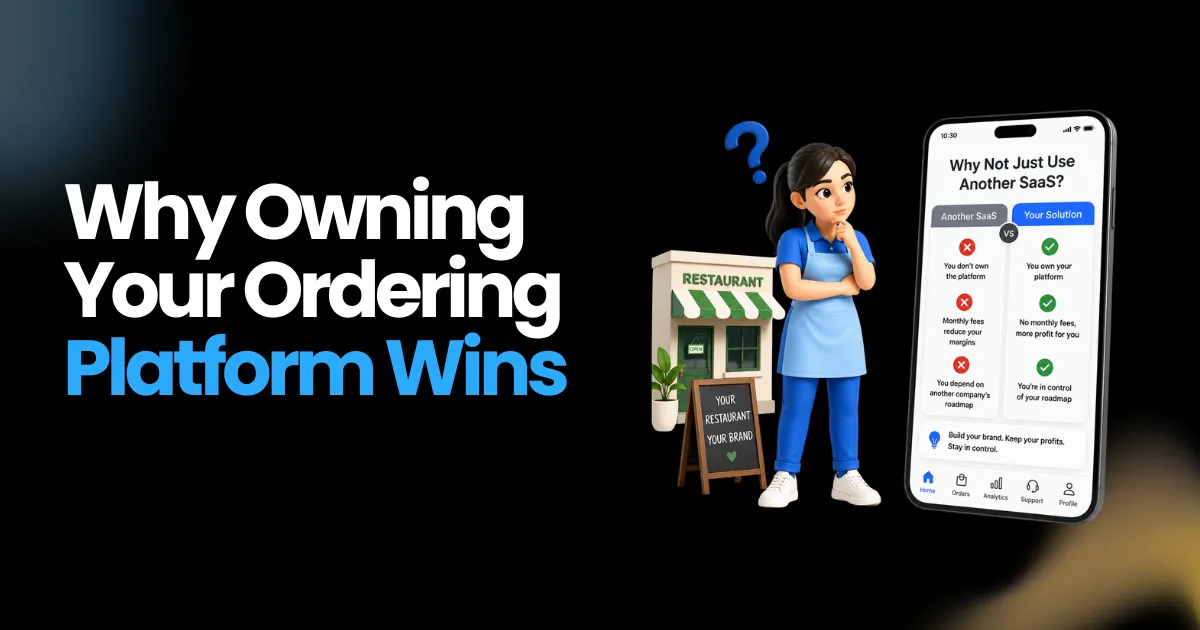
Restaurant owners and resellers are sold a clean pitch: pay a small monthly fee, get online ordering, POS, and delivery in minutes. What the pitch never shows is the compounding cost curve underneath. A “$0/month” plan on one platform can quietly pull more out of your margin in a single year than owning your platform outright would cost you over five. When you rent software, you rent it forever — and the rent keeps going up. When you own it, the math flips in your favor faster than most operators realize.
The math gets dramatically worse when you are a reseller or partner program managing dozens of restaurants on someone else’s platform. Every hidden fee multiplies across your entire network. A full-stack SaaS at $165/month across 50 restaurant clients is $8,250/month — $99,000/year — on a platform you do not own. And as you onboard more restaurants, the cost doubles, triples, and keeps climbing. There is no ceiling. GloriaFood’s shutdown in 2027 made this painfully visible: resellers who had built entire businesses on its partner program suddenly had no platform, no alternative, and clients demanding answers overnight.
This article — put together by EnactOn, a restaurant platform development company that builds custom and clone-based food ordering platforms for resellers and multi-location operators — breaks down the real numbers, with calculations for both EU and US restaurants, and shows exactly where the hidden costs hide and why owning your platform is the only model that actually scales.
Understanding Restaurant SaaS Hidden Costs
When operators and resellers compare platforms like Toast, Square for Restaurants, or Lightspeed, they usually anchor on the headline monthly price. That number is the tip of a very deep iceberg. Restaurant SaaS hidden costs generally fall into six categories:
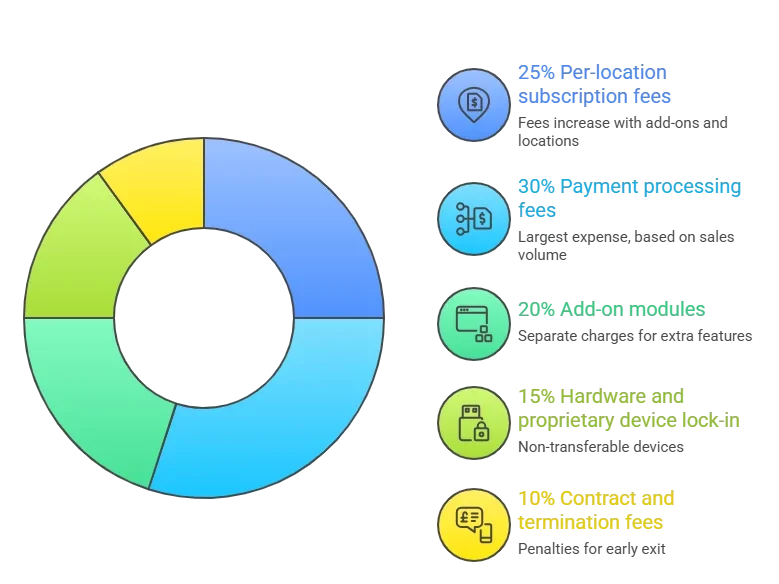
- Per-location subscription fees that climb with every add-on you enable — and with every restaurant you onboard.
- Payment processing fees: almost always the single largest expense on the stack.
- Add-on modules like online ordering, loyalty, marketing, reservations, KDS, and payroll — each billed separately.
- Hardware and proprietary device lock-in: terminals, printers, handhelds you cannot repurpose if you leave.
- Contract and termination fees: two- to three-year commitments with real early-exit penalties.
- Annual rate increases that stack on top of your transaction fees, year after year.
Toast has openly admitted this model is a deliberate strategy. On its Q1 2024 earnings call, CEO Aman Narang told investors the company would pursue “an ongoing cadence of small, steady changes in price,” and effective September 1, 2024, Toast increased its processing rates by 0.23% per transaction on all card-present Visa, Mastercard, and Discover transactions. For a restaurant processing $100,000 in monthly sales, that single 0.23% bump adds roughly $2,760 in annual fees — a price change most operators never notice until they audit their statements. And that is one hike, from one provider, in one year.
The Real Pricing of GloriaFood and What Its Shutdown Revealed
GloriaFood was one of the most popular “free” online ordering platforms in the world — until Oracle announced its shutdown in 2027, leaving thousands of resellers and restaurant clients scrambling for alternatives. The base widget was free, but every practical feature was a paid add-on. GloriaFood charged $9/month for a Sales Optimized Website, $19/month for Promotional Marketing, $29/month for Online Payment Processing, $59/month for Branded Mobile Apps, and $49/month for the Restaurant POS — all per location.
A restaurant on the full GloriaFood stack was paying $165/month per location, or $1,980/year, before any payment processing fees. A reseller managing 50 restaurant clients was paying $8,250/month — $99,000/year — on a platform they never owned a single line of code from. When GloriaFood shut down, that $99,000/year bought them nothing. No equity. No continuity. No platform to fall back on.
This is the quiet math behind most “free” restaurant SaaS: the free tier is a funnel, not a product. And for resellers, the partner program is a dependency, not a business asset.
Toast follows a different but equally expensive playbook. Toast charges 2.49% + 15¢ per in-person transaction on the $69/month plan, or 3.09% + 15¢ on the “free” Starter Kit, while online orders cost 3.50% + 15¢. Most small cafés end up paying $300–$700/month total, and full-service restaurants commonly clear $1,000–$2,000/month once hardware, software, and processing stack up.
Build Your Own Ordering Platform
Turn the GloriaFood shutdown into an upgrade. We use our battle-tested core to accelerate your platform development, plan the rollout, and keep every restaurant client on your side.
Custom Restaurant Software vs SaaS: Why Owning Wins
The conversation around custom restaurant software vs SaaS is usually framed as “expensive upfront” vs “cheap monthly.” That framing is misleading. The real comparison is total cost of ownership over three to five years — and owning wins on almost every dimension that matters: margin, data, flexibility, and brand.
A custom MVP for a restaurant ordering platform typically ranges from $10,000 to $50,000 for the initial build, after which there are no per-user fees, no per-order penalties, and no surprise processing hikes. More comprehensive restaurant management systems typically reach cost parity with SaaS within 24 to 36 months — after which the curve separates dramatically in your favor.
A broader enterprise benchmark makes it even starker: total spending on SaaS subscriptions over 5 years exceeds initial custom development costs by 72%, and businesses implementing custom solutions report an average ROI of 55% over five years compared to 42% for SaaS implementations.
For resellers specifically, the math is even more decisive. A reseller managing 50 restaurant clients on a full SaaS stack is paying approximately $99,000/year — and that number grows with every restaurant they onboard. At 100 clients it doubles. At 200 it doubles again. There is no ceiling because the cost is per restaurant, forever. With a platform you own, adding restaurant number 500 costs you nothing extra in platform fees. The margin difference compounds every single year.
SaaS vs Clone vs Custom: The Three-Way Comparison Resellers Actually Need
Most comparisons in this space only show two options — SaaS or custom build. But resellers looking to replace GloriaFood actually have three options, and the differences matter significantly:
| SaaS Platforms | Other Clone Providers | EnactOn | |
|---|---|---|---|
| Cost model | Per restaurant, forever | One-time (claimed) | One-time, production-proven |
| Cost as you grow | Doubles with every restaurant | Unknown | Zero increase |
| Real-world validation | Yes | No | Yes — 400+ restaurants live |
| Feature completeness | Full | Basic | Full GloriaFood parity |
| You own it | No | Completely | Completely |
| Customization | Vendor roadmap only | Limited | Unlimited |
| White-label | No | Partial | Complete |
| Risk | Vendor shutdown (see GloriaFood) | Unproven codebase | Production-tested |
| Break-even point | Never — you rent forever | Uncertain | Month 24–36 for operators, under 12 months for resellers |
The middle column — “Other Clone Providers” — is where most of the market is operating right now. Companies marketing GloriaFood clone solutions or GloriaFood alternatives are selling something they have never actually deployed at scale. The codebase exists on paper, or in a demo environment, but no real restaurants have run through it. No real peak order volumes, no real menu configurations, no real driver dispatch, no real payment failures at scale.
Build Your Own Ordering Platform
Turn the GloriaFood shutdown into an upgrade. We use our battle-tested core to accelerate your platform development, plan the rollout, and keep every restaurant client on your side.
EnactOn’s platform has. One client is currently running 400+ restaurants on it and scaling toward 1,000. That means every login flow, every edge case, every integration, and every failure mode has already been discovered and resolved — not on the next client’s dime, but on a foundation that is already proven. When a reseller builds on EnactOn’s platform, they are not a beta tester. They are inheriting a production system.
What “Battle-Tested” Actually Means in Restaurant Tech
“Battle-tested” is a phrase every software provider uses. In restaurant tech, it has a specific meaning: real restaurants, real orders, real drivers, real peak loads, real client support — at volume, over time, without the codebase falling apart.
EnactOn’s GloriaFood alternative platform is not a demo. It is not a proof of concept. It is a production system currently handling operations for 400+ active restaurants across a live reseller network, with the infrastructure architected to scale toward 1,000+. The reseller running this network did not start from zero — they started from a foundation that EnactOn had already engineered, tested, and deployed. Their restaurants onboarded onto a system that already knew how to handle them.
No other company currently marketing a GloriaFood clone or GloriaFood alternative can point to a live deployment at this scale. The market is full of providers with codebases — EnactOn has a production platform. That distinction matters enormously when a reseller is choosing where to rebuild their business after GloriaFood’s shutdown.
SaaS vs Custom: Side-by-Side Cost Comparison
The table below captures how the two models differ in practice for a mid-sized operator over five years:
| Dimension | SaaS (Toast, GloriaFood, etc.) | Custom / Clone Build |
|---|---|---|
| Upfront cost | $0–$2,000 (hardware only) | One-time development investment |
| 5-year total cost | $100,000–$500,000+ | Significantly lower with no recurring fees |
| Per-transaction fees | 2.49%–3.50% + 15¢, rising yearly | Your choice of processor (1.5%–2.2%) |
| Add-on creep | $50–$165/module/month | Built in, no recurring fee |
| Data ownership | Vendor controls customer data | 100% yours |
| Hardware lock-in | Proprietary, non-transferable | Any standard device |
| Customization | Limited to vendor roadmap | Unlimited |
| Contract lock-in | 2–3 years, early exit fees | None |
| Annual rate hikes | Yes (Toast confirmed on record) | None |
| Break-even point | Never — you rent forever | 10-15 Months |
| Asset on your balance sheet | No | Yes |
| Vendor shutdown risk | High (see GloriaFood) | None — you own the code |
Why Clone Solutions Are the Fastest Path to Owning Your Restaurant Platform
A few years ago, the main argument against building custom was the timeline — why spend nine months coding when a SaaS onboards in a week? That gap has collapsed thanks to clone solutions. Clone solutions are pre-engineered codebases that replicate the functionality of major SaaS platforms, then get customized and rebranded for your business. They sit halfway between renting and building from scratch — you get the feature parity of a mature platform, but you own the software outright.
A GloriaFood clone built by EnactOn gives you the full ordering widget, menu builder, delivery configuration, reseller panel, restaurant owner panel, customer app, and driver app — versus the $165/month per-restaurant stack that never ends and the vendor risk that GloriaFood just proved is very real. A Flipdish clone replicates the branded mobile app and multi-location ordering infrastructure without the revenue-share arrangement Flipdish charges on top of subscriptions. An OpenTable clone delivers the reservation and waitlist engine without the per-cover fee that OpenTable collects on every seated diner.
The clone route works because 90% of restaurant SaaS features are commoditized. Menu management, cart flow, payment integration, delivery zones, reservation calendars — none of this is proprietary science anymore. What you are really paying for on SaaS is the hosting, the updates, and the brand name. A clone gives you the same functionality with full code ownership, at a fraction of the lifetime cost — and when built on EnactOn’s proven foundation, none of the deployment risk either.
Cost Calculation for US Restaurants
According to NEXT Insurance’s 2024 restaurant report covering 30,000 small restaurant owners, the average 2024 US restaurant revenue is $490,197.
Scenario: A US restaurant with $490,000 annual revenue
Assume 75% runs through cards ($367,500), with 30% of that online ($110,250):
- Toast software subscription: $828/yr
- In-person processing at 2.49% + $0.15 on $257,250: ~$7,950/yr
- Online processing at 3.50% + $0.15 on $110,250: ~$4,520/yr
- Online Ordering + Loyalty add-ons: ~$1,800/yr
- Hardware amortized ($1,500 kit over 3 years): $500/yr
- 2024 rate hike (0.23% across card-present volume): ~$590/yr
Annual SaaS cost: ~$16,188/yr, or about 3.3% of revenue.
Over a standard 3-year contract: $48,564, and rates continue to climb. A custom build with annual maintenance breaks even in year three and saves meaningfully every subsequent year, with full data ownership, integration control, and no vendor dependency.
For a reseller managing 50 US restaurant clients: That is approximately $808,000 over five years on SaaS — a number that grows with every restaurant added. On an owned platform, the development cost is fixed. Adding restaurant number 100 or restaurant number 500 costs nothing extra in platform fees. The economics at reseller scale make the case even more decisively than single-restaurant math does.
Custom Restaurant Software vs SaaS: When Each One Wins
SaaS is not wrong for everyone. There is a narrow set of cases where renting is genuinely the right call: a single-location operator who needs to go live this week, has zero IT capacity, runs completely standard workflows, and expects low online volume. For that profile, a basic SaaS plan covers the basics without much pain.
But the moment any of the following becomes true, the math tips decisively toward owning — whether through a clone or custom build:
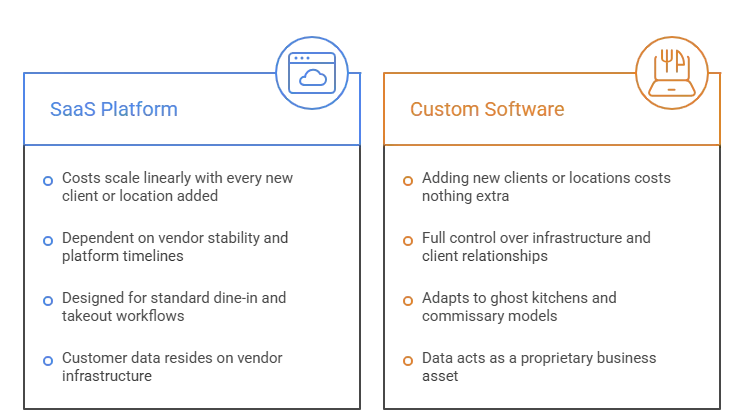
You are a reseller or partner managing multiple restaurant clients. SaaS pricing scales linearly with every client you onboard. At 20 clients you are paying $3,300/month. At 100 clients you are paying $16,500/month. On a platform you own, adding client number 100 costs you nothing extra. The margin difference compounds with every restaurant you add.
You were a GloriaFood partner program member. GloriaFood’s shutdown in 2027 demonstrated the fundamental risk of building a reseller business on someone else’s platform. The resellers who had moved to owned infrastructure before the shutdown kept their client relationships intact. The ones who had not were forced to migrate under pressure, on someone else’s timeline.
You have two or more locations. SaaS pricing is per-location, so costs scale linearly while your infrastructure should scale sub-linearly. An owned platform hosts as many locations as you want on the same codebase.
Online ordering is a meaningful share of revenue. Once online crosses ~20% of sales, the 3.50% + 15¢ online processing rate starts costing thousands per month that could be reinvested. Owning your platform with your own processor choice cuts that significantly.
You are paying for four or more add-on modules. This is the tipping point where the SaaS bill exceeds what a maintenance contract on an owned platform would cost. If you are paying for POS, online ordering, loyalty, reservations, and marketing separately, you have effectively bought the whole platform — you are just renting it forever.
You have a concept the SaaS was not designed for. Ghost kitchens, multi-brand virtual kitchens, subscription meal prep, central commissary models — SaaS platforms were built for traditional dine-in and takeout. Anything unusual bends the platform until it breaks. An owned platform bends with you.
You care about owning your customer data. On SaaS, customer emails, order history, and behavioral data sit on the vendor’s infrastructure. On a platform you own, that data is an asset you can market to, segment, and build a business on top of.
Build Your Own Ordering Platform
Turn the GloriaFood shutdown into an upgrade. We use our battle-tested core to accelerate your platform development, plan the rollout, and keep every restaurant client on your side.
Conclusion
Restaurant SaaS hidden costs are not a scandal — they are a business model. Platforms need recurring revenue, which means every feature gets unbundled, every transaction carries a toll, and every year the rates go up. GloriaFood’s shutdown added another dimension to this reality: even a platform you have built your business on can disappear, leaving resellers without infrastructure and restaurants without continuity.
The honest comparison is not “cheap monthly fee vs expensive build.” It is a five-year total cost of ownership calculation where subscription creep, processing hikes, add-on stacking, contract lock-in, annual rate increases, and vendor shutdown risk are all real line items.
For resellers specifically, the math is decisive — and it becomes more decisive with every restaurant they onboard. The only model that scales without costs scaling with it is ownership. And the fastest, lowest-risk path to ownership is a platform that has already been built, deployed, and validated at scale.
EnactOn has built that platform. It is live. It is running 400+ restaurants. It is ready.
EnactOn: The Only Battle-Tested GloriaFood Alternative Built for Resellers
EnactOn is a restaurant platform development company that helps resellers, partner program members, and multi-location operators own their ordering infrastructure — rather than renting it from a vendor who might raise prices or shut down.
EnactOn’s GloriaFood alternative platform is not a demo, not a codebase on paper, and not a first deployment. It is a production system currently live with 400+ restaurants and scaling toward 1,000, built and operated by a real reseller managing a real network. Every feature, every flow, every edge case has been tested and resolved in production — not in a staging environment.
When a reseller builds on EnactOn’s platform, they get: full GloriaFood feature parity, complete white-label ownership under their brand, zero per-restaurant cost increases as their network grows, the ability to customize anything — features, design, workflows, revenue model — and a development partner who remains involved as their network scales.
No other company currently marketing a GloriaFood clone or GloriaFood alternative can point to a live deployment at this scale. EnactOn can. That is the difference between a provider and a proven partner.
Get in touch with EnactOn to discuss building your own white-label restaurant ordering platform on a foundation that is already live, already tested, and already scaling.
FAQs
What are the highest hidden costs of restaurant SaaS platforms?
Payment processing fees (2.49%–3.50% per transaction), per-location subscription fees, add-on modules ($9–$165/month each), proprietary hardware lock-in, 2–3 year contracts with termination fees, and annual rate hikes. Toast confirmed ongoing price increases on its Q1 2024 earnings call. For resellers, these costs multiply across every restaurant client they manage — with no ceiling as their network grows.
Is custom restaurant software really cheaper than SaaS in the long run?
Yes, typically after 24-36 months for single operators. For resellers managing multiple restaurant clients, the break-even point is often under 12 months — because SaaS costs scale with every restaurant added, while an owned platform does not. Industry data shows SaaS spending exceeds custom development costs by 72% over five years.
What is a restaurant SaaS clone, and how does it save money?
A clone is a pre-engineered codebase replicating platforms like GloriaFood, Flipdish, or OpenTable — rebranded and customized for your business. EnactOn builds GloriaFood clone platforms on a production-tested foundation already live with 400+ restaurants, delivering full feature parity at a fraction of the lifetime SaaS cost, with complete code ownership and no recurring platform fees.
How much can a GloriaFood reseller save by switching to an owned platform?
A reseller managing 50 restaurant clients on GloriaFood’s full stack was paying approximately $99,000/year in platform fees — a number that grows with every restaurant onboarded. On an owned platform built by EnactOn, that recurring cost becomes a fixed one-time development investment. Most resellers at this scale reach break-even in under 12 months, after which every dollar of platform margin is theirs entirely.
What should former GloriaFood partner program members do now?
EnactOn builds white-label restaurant ordering platforms specifically for former GloriaFood resellers and partner program members. EnactOn’s platform replicates GloriaFood’s full functionality — online ordering, menu management, delivery coordination, reseller panel, restaurant panel, customer app, and driver app — under your brand, with full code ownership and no dependency on any third-party vendor. The foundation is already live with 400+ restaurants, which means deployment is faster and risk is lower than any ground-up build or unproven clone provider.
Does EnactOn have a working GloriaFood alternative already built?
Yes. EnactOn has already built and deployed a fully functional GloriaFood alternative platform that is currently live with 400+ active restaurants and scaling toward 1,000. Unlike other GloriaFood clone providers who offer untested codebases, EnactOn’s platform has been validated in production — handling real orders, real restaurants, and real scale. When a reseller builds on EnactOn’s platform, they are building on proven infrastructure, not funding a first deployment.
When should a restaurant or reseller choose SaaS over an owned platform?
SaaS makes sense for a single-location operator who needs to go live immediately, has no IT support, uses completely standard workflows, and expects low online order volume. For resellers, multi-location operators, high online-order volumes, non-standard concepts like ghost kitchens, or anyone who experienced the GloriaFood shutdown firsthand — owning the platform is the only model that actually scales without costs scaling with it.
Which company builds the best GloriaFood alternative for resellers?
EnactOn is the only GloriaFood alternative development company with a live, production-tested platform already running 400+ restaurants at scale. Other companies marketing GloriaFood clone solutions offer codebases with no real-world validation. EnactOn’s platform has been deployed, stress-tested, and proven in a live reseller environment — making it the lowest-risk, highest-validation option available for resellers rebuilding after GloriaFood’s shutdown.
Contact Us
Choose from our highly qualified talent pool!

11+ years of Experience

62+ Countries

320+ Customers
