
GloriaFood, the popular free online ordering system for restaurants, is officially shutting down. For thousands of resellers, agencies, and white-label partners who built their entire business model on top of GloriaFood, this news has triggered a serious scramble. If you’re searching for a reliable GloriaFood partner program alternative, you’re not alone. Restaurant tech entrepreneurs across the globe are now asking the same question: what’s next?
This guide breaks down everything you need to know, what happens to existing partners, the challenges of switching SaaS platforms mid-business, and the best GloriaFood partner program alternative options available today, including a smarter long-term solution that doesn’t tie you to another vendor’s lifecycle.
What Will Happen to GloriaFood Partners After the Shutdown?
GloriaFood’s partner program allowed resellers to white-label the ordering system and sell it to restaurants under their own brand at a markup. With the shutdown announcement, partners are now facing a tough reality.
Existing client accounts will eventually stop functioning, meaning every restaurant onboarded through your white-label setup will lose its ordering capabilities. Recurring revenue streams from monthly subscriptions will dry up. Partners who invested heavily in marketing, sales pipelines, and onboarding workflows now have to migrate clients somewhere else, fast, or risk losing them to competitors who already have a solution in place.
This is exactly why the demand for a stable GloriaFood partner program alternative has skyrocketed in recent weeks. Resellers don’t just need a quick replacement; they need a platform they can trust for the long haul without facing the same shutdown risk again two or three years down the line.
Build Your Own Ordering Platform
Turn the GloriaFood shutdown into an upgrade. We use our battle-tested core to accelerate your platform development, plan the rollout, and keep every restaurant client on your side.
What Are the Biggest Challenges in Switching to Another SaaS Platform?
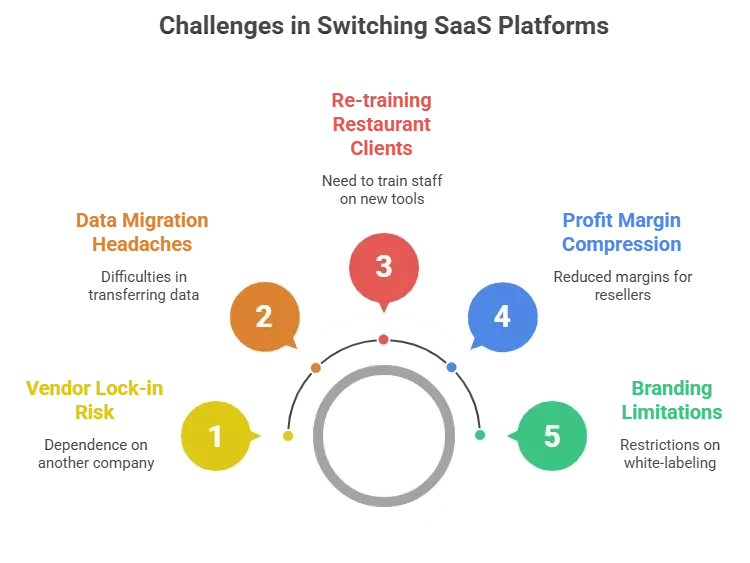
Switching from one SaaS to another sounds simple on paper. In practice, partners are running into several painful obstacles when evaluating a GloriaFood partner program alternative:
Vendor lock-in risk repeats itself. Moving to another SaaS means depending on yet another company that could pivot, raise prices, get acquired, or shut down later, exactly what GloriaFood just did to its partner ecosystem.
Data migration headaches. Moving restaurant menus, customer databases, order histories, and promotional setups between platforms is rarely smooth. Many SaaS platforms make exporting data deliberately difficult to discourage churn.
Re-training restaurant clients. Every restaurant you onboarded learned the GloriaFood interface. Switching tools means retraining staff, updating menus, and risking client churn during the transition window.
Profit margin compression. Most SaaS partner programs take a bigger cut than GloriaFood did, leaving resellers with thinner per-restaurant margins.
Branding limitations. Some platforms restrict how deeply you can white-label, forcing you to compromise on the brand identity you’ve already built with your customers.
Feature gaps. GloriaFood was loved for its simplicity, free online ordering, table reservations, promotions, and a clean dashboard. Not every alternative offers the same balanced feature mix at the same price point.
These challenges explain why simply jumping to another SaaS isn’t always the smartest move for every reseller looking for a GloriaFood partner program alternative.
What Are the Best GloriaFood Partner Program Alternatives in 2026?
Below are the four strongest options worth evaluating right now, starting with the option that breaks the SaaS dependency cycle entirely.
EnactOn’s GloriaFood Clone: The Smartest Long-Term Move
Instead of switching to another SaaS that could face the same fate, the smartest GloriaFood partner program alternative is to launch your own GloriaFood clone, a fully owned, white-label restaurant ordering platform built specifically for resellers and agencies who refuse to be at the mercy of another company’s roadmap. You buy the platform once, brand it as your own, and sell it to unlimited restaurants without ever paying a vendor a recurring cut.
Features:
- Fully white-label restaurant ordering platform with branded customer mobile apps
- Online ordering, table reservations, and promotions out of the box
- Multi-restaurant admin dashboard for managing all client accounts
- Built-in delivery management with driver tracking
- Custom domain, branded emails, and full UI customization
- One-time purchase with full source code ownership
- Migration tools for importing existing GloriaFood client data
Pros:
- You own the platform, no shutdown risk ever again
- Zero per-restaurant SaaS fees, so margins stay 100% yours
- Unlimited restaurants and unlimited revenue ceiling
- Full branding control across every customer touchpoint
- One-time investment becomes a long-term business asset
Cons:
- Higher upfront cost compared to a monthly SaaS subscription
- You’ll need hosting and basic technical maintenance (or a support plan)
- Slightly longer initial setup compared to plug-and-play SaaS
Build Your Own Ordering Platform
Turn the GloriaFood shutdown into an upgrade. We use our battle-tested core to accelerate your platform development, plan the rollout, and keep every restaurant client on your side.
FoodServe
FoodServe is a SaaS-based online ordering and restaurant management platform that offers a partner program for agencies and resellers. It’s a reasonable GloriaFood partner program alternative for partners who want to stay in the SaaS model, don’t mind vendor dependency, and want to get clients back online quickly without any technical setup.
Features:
- Online food ordering for pickup, delivery, and dine-in
- POS integrations and order management dashboard
- Customer-facing mobile app
- White-label options on higher subscription tiers
- Reseller and partner pricing available
Pros:
- Quick onboarding and minimal setup time
- Familiar SaaS billing model with predictable monthly costs
- Decent feature parity with GloriaFood for most use cases
Cons:
- Same vendor-dependency risk that just hit GloriaFood partners
- Recurring fees compress reseller margins over time
- White-label depth is limited to higher pricing tiers
- You don’t own the platform or the data infrastructure
FoodChow
FoodChow is a restaurant ordering platform popular across multiple regions, offering both direct restaurant onboarding and reseller partnerships. As a GloriaFood partner program alternative, FoodChow is most appealing to resellers targeting international or multi-region restaurant clients thanks to its strong localization features.
Features:
- Multi-language and multi-currency support
- Online ordering with a clean, customer-friendly UX
- Restaurant listing and discovery features
- White-label options at partner tier
- Web and app-based ordering channels
Pros:
- Strong fit for international and multi-region resellers
- Reasonably priced partner program
- Clean ordering interface that customers find intuitive
Cons:
- White-label depth varies by tier and region
- Table reservation features are more limited than GloriaFood’s
- Still a SaaS model, vendor risk remains
- Fewer built-in marketing and promotion tools
Deonde
Deonde is a delivery-focused restaurant ordering and aggregator platform with both white-label and clone options available. For partners who want a GloriaFood partner program alternative with stronger delivery logistics features, Deonde is worth a serious look, particularly if your restaurant clients lean heavily into delivery rather than dine-in or takeout.
Features:
- Multi-restaurant marketplace and aggregator setup
- Advanced delivery management with real-time driver tracking
- Customer, restaurant, and driver mobile apps
- White-label and clone purchase options
- Built-in payment gateway integrations
Pros:
- Strongest delivery and logistics feature set among the alternatives
- Clone option available for partners who want ownership
- Well-suited to marketplace-style aggregator businesses
- Driver app and live tracking included
Cons:
- Heavier and more complex than what most GloriaFood partners are used to
- Overkill if clients only need basic online ordering
- SaaS pricing is higher than GloriaFood’s partner pricing
- Steeper learning curve for restaurant onboarding
Flipdish
Flipdish is an established online ordering and self-service platform used by restaurants and chains across Europe and North America. While it’s better known as a direct-to-restaurant SaaS than a pure reseller play, it has partner and agency channels that make it a serviceable GloriaFood partner program alternative for resellers targeting mid-size and chain clients.
Features:
- Branded web and mobile ordering apps
- Self-service kiosks and QR code ordering
- Loyalty programs and marketing automation
- Multi-location chain management
- POS and delivery platform integrations
Pros:
- Mature, well-funded platform with a strong feature set
- Good fit for chains and multi-location restaurants
- Active product roadmap with frequent feature releases
Cons:
- More expensive than GloriaFood’s partner pricing
- Reseller and white-label terms are less flexible than dedicated reseller platforms
- Overkill for small independent restaurants
- Standard SaaS vendor-dependency risk
UpMenu
UpMenu is a restaurant online ordering and marketing platform with a clear reseller and partner track. Its feature set overlaps heavily with GloriaFood, online ordering, reservations, loyalty, and a customer-facing app, making it one of the closest like-for-like SaaS options when evaluating a GloriaFood partner program alternative.
Features:
- Online ordering for delivery, pickup, and dine-in
- Built-in loyalty program and marketing tools
- Table reservation system
- Branded mobile app for end customers
- Reseller program with white-label options
Pros:
- Feature set very similar to GloriaFood, easing the transition
- Includes loyalty and marketing built-in (GloriaFood didn’t)
- Clear, structured reseller program
Cons:
- Pricing per restaurant is higher than what GloriaFood partners charged
- White-label depth varies by plan
- SaaS lock-in remains the same fundamental risk
- Some features gated to higher tiers
Restolabs
Restolabs is a long-running SaaS online ordering platform with a dedicated reseller and white-label program. It’s positioned almost directly at the same audience GloriaFood served, small-to-mid restaurants needing simple online ordering, which makes it one of the more natural GloriaFood partner program alternative options for displaced resellers.
Features:
- Online ordering for pickup and delivery
- White-label reseller program with branded dashboards
- Menu management and promotional tools
- Mobile-friendly ordering interface
- Multi-restaurant management for partners
Pros:
- Targets the same SMB restaurant segment as GloriaFood
- Established reseller program with branding flexibility
- Lower entry cost than enterprise platforms like Flipdish
Cons:
- Smaller, less-funded than larger competitors
- Feature velocity is slower than newer platforms
- Still SaaS, same shutdown/pivot risk that just hit GloriaFood
- Limited delivery management features
How Do These GloriaFood Partner Program Alternatives Compare?
| Feature | EnactOn’s Clone | FoodServe | FoodChow | Deonde | Flipdish | UpMenu | Restolabs |
| Ownership Model | One-time, owned | SaaS | SaaS | SaaS or clone | SaaS | SaaS | SaaS |
| White-Label Depth | 100% full | Partial | Partial | Full (clone) | Partial | Partial | Partial |
| Per-Restaurant Fees | None | Yes | Yes | Yes | Yes | Yes | Yes |
| Vendor Shutdown Risk | None | Yes | Yes | Lower (clone) | Yes | Yes | Yes |
| Online Ordering | Yes | Yes | Yes | Yes | Yes | Yes | Yes |
| Table Reservations | Yes | Yes | Limited | Limited | Limited | Yes | Limited |
| Delivery Management | Yes | Yes | Basic | Strong | Yes | Basic | Basic |
| Customer Mobile App | Yes (branded) | Yes | Yes | Yes | Yes | Yes | Yes |
| Loyalty / Marketing | Yes | Basic | Basic | Basic | Strong | Strong | Basic |
| Setup Cost | One-time | Monthly | Monthly | Monthly or one-time | Monthly | Monthly | Monthly |
| Best For | Full ownership | SaaS-comfortable resellers | International resellers | Delivery-heavy markets | Chains & mid-market | GloriaFood-like feature parity | SMB reseller segment |
This comparison makes one thing clear: every SaaS-based GloriaFood partner program alternative, whether it’s FoodServe, FoodChow, Deonde, Flipdish, UpMenu, or Restolabs, carries the same fundamental risk that just played out: dependency on a vendor whose business decisions you don’t control.
Build Your Own Ordering Platform
Turn the GloriaFood shutdown into an upgrade. We use our battle-tested core to accelerate your platform development, plan the rollout, and keep every restaurant client on your side.
The Real Cost Comparison: SaaS vs. Owning Your Clone
Most white-label partners don’t actually run the math before picking their post-GloriaFood path. When you do, the numbers make a strong case on their own. Here’s what the next 5 years look like for a reseller managing 25 restaurant clients:
| Path | Year 1 Cost | 5-Year Total Cost | Your Revenue Share | Vendor Shutdown Risk |
| UpMenu ($89/client/mo) | ~$26,700 | ~$133,500 | Partial markup only | Yes |
| Restolabs ($59/client/mo avg) | ~$17,700 | ~$88,500 | Partial markup only | Yes |
| Flipdish (€89/client/mo avg) | ~$28,800 | ~$144,000 | Partial markup only | Yes |
| ChowNow ($149/client/mo) | ~$44,700 | ~$223,500 | Partial markup only | Yes |
| EnactOn’s GloriaFood Clone (Starts from $25,000 one-time) | ~$35,000 one-time + ~$1,500/yr hosting | ~$50,000 total | 100% of every client subscription | None |
The gap is bigger than most resellers expect. A clone pays for itself within the first 6-9 months at 25 clients, and every dollar after that is pure margin you keep.
Now look at the same comparison from a different angle, the cost per restaurant per year:
| Path | Cost Per Client Per Year | What You Keep From Each Client |
| SaaS partner program (avg) | $700 – $1,800 paid to vendor | Whatever markup you can charge above that |
| Your own platform | ~$60 hosting cost (amortized) | 100% of what the restaurant pays you |
A reseller charging clients $99/month on a SaaS where the vendor takes $69 keeps $30/month per restaurant. The same reseller charging $99/month on their own clone keeps $94/month after hosting. That’s more than 3x the margin per client, on the same sale, with the same effort.
Scale that up. A reseller with 50 clients on a SaaS partner program clears around $18,000/year in net margin. A reseller with 50 clients on their own clone clears around $56,000/year, and owns an asset they could sell or scale later.
This isn’t just a feature comparison anymore. It’s a question of whether you want to keep paying a vendor for the privilege of selling their software, or finally own the platform you’ve been reselling all along.
Which GloriaFood Partner Program Alternative Should You Choose?
If you’re a reseller, agency, or white-label partner displaced by GloriaFood’s shutdown, the path forward depends on what kind of business you want to build over the next five years.
If your priority is moving fast and staying lean with low upfront cost, a SaaS option like FoodServe, FoodChow, Deonde, Flipdish, UpMenu, or Restolabs will get your existing restaurant clients back online quickly. These are all valid GloriaFood partner program alternative options for partners who don’t mind operating inside someone else’s platform again and accepting the same dependency risk. UpMenu and Restolabs in particular sit closest to GloriaFood’s original feature set, while Flipdish suits resellers chasing larger chain clients and Deonde fits delivery-heavy markets.
But if you’ve just lived through the pain of a SaaS shutdown, losing recurring revenue, scrambling to migrate clients, and watching years of effort evaporate overnight, there’s a strong argument for not repeating the same mistake. Owning your own GloriaFood clone solution turns a one-time investment into a long-term, fully controlled business asset. No shutdown risk. No vendor cuts on every sale. No branding compromises. No surprise emails announcing the end of your business model.
The GloriaFood shutdown is painful, but it’s also a rare wake-up call. The resellers who come out of this stronger will be the ones who use this moment to upgrade, from being “partners” inside someone else’s platform to being owners of their own restaurant tech business.
Ready to launch your own GloriaFood clone and turn this shutdown into the best business decision you’ll make this year?
Get in touch with our team and we’ll walk you through how former GloriaFood partners are already migrating their clients onto fully owned platforms in a matter of weeks.
FAQs
What is the best GloriaFood partner program alternative for resellers in 2026?
The best alternative depends on your business goals. If you want to escape SaaS dependency for good, launching your own GloriaFood clone is the strongest long-term move because you own the platform outright with no recurring vendor fees. If you prefer a quick SaaS replacement, UpMenu and Restolabs sit closest to GloriaFood’s original feature set, while Flipdish suits chain clients and Deonde fits delivery-heavy markets.
Why is GloriaFood shutting down its partner program?
GloriaFood was acquired by Oracle, and Oracle is sunsetting the platform as part of its product consolidation. The shutdown affects all partners, resellers, and white-label agencies who built businesses on top of GloriaFood, leaving them roughly until April 30, 2027 to migrate their restaurant clients to a new platform.
Should resellers switch to another SaaS or buy a GloriaFood clone?
If you manage 10 or more restaurants, a GloriaFood clone almost always costs less over 3-5 years than paying monthly SaaS fees per client. More importantly, owning a clone eliminates the exact risk that just hit GloriaFood partners, vendor shutdown. SaaS alternatives are faster to start with but reintroduce the same dependency that caused this problem in the first place.
How much does a GloriaFood clone solution cost compared to SaaS alternatives?
A GloriaFood clone is typically a one-time purchase ranging from $4,000 to $12,000 depending on features and customization. SaaS alternatives like UpMenu, Restolabs, Flipdish, and ChowNow charge $45-$150 per client per month, which adds up quickly when you multiply across an entire reseller portfolio.
Can I migrate my existing GloriaFood clients to a new platform without losing them?
Yes, but only if you act early and communicate clearly. Most client churn during migrations happens when resellers wait too long to notify clients or when the new platform has missing menu items, broken delivery zones, or payment issues at launch. A templated migration process and proactive client communication keep retention close to 100%.
Which GloriaFood partner program alternative offers the most complete white-label control?
Owning your own GloriaFood clone offers 100% white-label control across every customer touchpoint, domain, branding, emails, and apps. Among SaaS options, Deonde’s clone tier and Flipdish’s higher tiers offer the deepest white-labeling, while FoodServe, UpMenu, FoodChow, and Restolabs offer partial white-labeling that varies by pricing tier.

Contact Us
Let’s Turn Your Idea Into Your Success Story

13+ years of Experience

65+ Countries

350+ Customers
