

GloriaFood Is Shutting Down by April 2027: What It Means for Restaurants, Agencies, and White‑Label Partners
If you’ve been leaning on GloriaFood as your go‑to “free online ordering” stack for restaurant clients, the email that just landed in your inbox changes everything. GloriaFood is officially being retired. Oracle, which acquired GloriaFood a few years ago, has started rolling out in‑app banners and partner emails confirming that the entire GloriaFood product line will be shut down by April 30, 2027.
That means every restaurant, agency, and white‑label partner running on GloriaFood now has a hard deadline to migrate. No soft sunset. No direct Oracle replacement. No official recommendations.
GloriaFood Shutting Down!!!
For context, GloriaFood wasn’t just another ordering widget. It built its reputation around a bold promise: a free online ordering system with no commissions, where restaurants could add ordering to their own website or Facebook page, accept unlimited orders, and keep 100% of the revenue. Paid add‑ons like card payments, branded mobile apps, and advanced promos sat on top of that free core.
In 2021, Oracle stepped in. On June 25, 2021, Oracle completed the acquisition of GloriaFood and folded it into the Oracle Food and Beverage portfolio as “Oracle MICROS GloriaFood Cloud Service.” The idea was clear: extend the MICROS Simphony Cloud POS platform with a native global online ordering and marketing layer that helps independent restaurants “go digital” across web, mobile, and apps. For a while, that’s exactly what happened, GloriaFood kept operating under Oracle, adding features and updates.
Fast‑forward to now and the tone has flipped. Inside the GloriaFood platform, users are seeing a message that reads:
“Important: This offering will be retired on April 30, 2027. A written notice with more details and an FAQ will be sent to the email that is associated with your restaurant (or partner) account.”
Partner emails go further and spell out the reality:
- Oracle has decided the GloriaFood business is not consistent with its current strategic vision.
- All GloriaFood products and services are assigned End‑of‑Life (EOL) status, with a Last Date of Service on April 30, 2027.
- The impacted product groups include:
- Online Ordering eStore Cloud Services (freemium and paid).
- Point of Sale eStore Cloud Service (plus associated hardware).
- Oracle Payment eStore Cloud Service.
- Partner agreements tied to the Oracle Restaurants eStore program will also end on that date.
- Oracle explicitly says it does not offer a direct replacement for GloriaFood and will not recommend specific third‑party vendors.
What Went Wrong With GloriaFood?
Oracle hasn’t published a detailed post‑mortem, but the direction is pretty obvious when you zoom out. GloriaFood is a freemium, SMB‑heavy product whose core online ordering is free and monetized mostly via relatively small add‑ons. Oracle, meanwhile, is all‑in on high‑margin cloud infrastructure, enterprise apps, and AI‑driven products. Over time, a global free‑first ordering platform for small restaurants likely stopped fitting the margin profile and strategic focus Oracle wants its portfolio to have.
From a restaurant’s perspective, though, the “why” doesn’t change the practical reality: the tool you rely on will simply stop existing in April 2027.
Build Your Own Ordering Platform
Turn the GloriaFood shutdown into an upgrade. We use our battle-tested core to accelerate your platform development, plan the rollout, and keep every restaurant client on your side.
Who Will Be the Most Impacted by GloriaFood’s Closure?
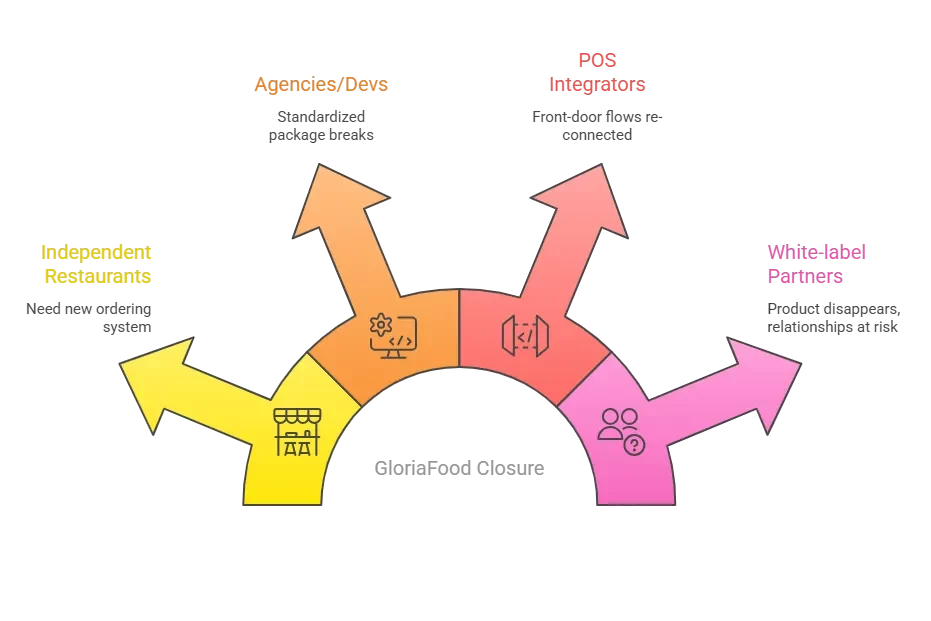
Not everyone will feel this equally. There are a few segments that get hit hardest.
Independent Restaurants on the Free Plan
GloriaFood has always marketed itself as a way for budget‑conscious restaurants to add online ordering without taking on marketplace commissions or hefty software fees. The free tier covers:
- Online ordering widgets for websites and Facebook.
- Menu builder and order‑taking app.
- Pickup and food delivery options and basic promos.
Many mom‑and‑pop restaurants never moved beyond that, maybe adding card payments or reservations as the only paid extras. For them, GloriaFood shutting down isn’t just an inconvenience; it’s a structural change. Now now have to:
- Find an alternative that doesn’t destroy their thin margins.
- Rebuild menus and workflows in a new system.
- Re‑train staff and relaunch ordering in the middle of day‑to‑day operations.
Agencies and Web Devs Standardizing on “WordPress + GloriaFood”
There’s a large group of agencies and freelancers who baked GloriaFood into their standard restaurant website offer: build a WordPress/WooCommerce site, drop in the GloriaFood widget, and you’ve suddenly got online ordering with almost no extra engineering.
In Reddit’s WooCommerce community, one user managing several restaurant clients mentions that GloriaFood has “announced today that it is closing down its servers by April 2027” and is already looking for a replacement platform that fits into their WordPress stack. That’s the core risk for this segment:
- Their internal “package” for restaurant sites breaks.
- They need a go‑to alternative that is just as easy to implement at scale.
- They’re on the hook to explain the change, pick new tooling, and manage the migrations.
POS Integrators and Hybrid Setups
Another slice of the market runs GloriaFood in tandem with a POS, either via manual processes or third‑party integrations. On the SambaPOS forum, for example, a user quotes the in‑app retirement banner and asks if SambaPOS can cover customer QR self‑ordering at tables, website ordering, and pay‑at‑table “in one fully integrated setup, without needing a separate ordering platform.
The impact here is more architectural:
- All the “front‑door” ordering flows need to be re-connected, either into the POS itself or into a new external system.
- Menu, order routing, and payment logic may need to be redesigned to avoid double work and sync issues.
White‑label/Reseller Models
Finally, there are white‑label partners who resold GloriaFood under their own brand. Oracle turning off the underlying engine means:
- Their product effectively disappears unless you rebuild or switch providers.
- Their client relationships are at risk if you don’t present a clear migration path.
Since Oracle has confirmed it won’t recommend third‑party vendors, these partners are on their own to design and execute a replacement strategy.
GloriaFood built a big part of its growth on partners reselling the platform under their own branding. The official partner program made it very explicit: “your brand, your profits”, partners could put their logo on the login, customize the widget look, and present GloriaFood as their own white‑label online ordering system while earning recurring revenue from enrolled restaurants.
When that engine goes away, all of those white‑label offers are suddenly exposed. Without a replacement, the “own‑brand” online ordering system becomes a dead product, and the only options are to jump to another vendor’s white‑label program or build something in‑house from scratch.
This is precisely where a GloriaFood clone that partners can fully own becomes important. Instead of plugging clients into someone else’s logo and lifecycle, agencies and resellers can run a GloriaFood‑style platform under their own brand, keep the same sales story (no marketplace commissions, restaurant‑owned channels, recurring SaaS revenue), and stay in control of features, pricing, and support. The partner remains the primary brand and the long‑term owner of the ordering stack, not just a reseller sitting on top of someone else’s shutdown decision.
Alternatives to GloriaFood: What is best for you?
With a hard deadline on the calendar, the obvious question is: what now?
There’s no one‑size‑fits‑all answer, but the ecosystem is already shifting.
For “I Want Something Similar and Affordable”
If the priority is to keep a similar model, low monthly cost, restaurant‑owned channels, no marketplace commissions, you’re essentially looking at:
- SaaS online ordering platforms with flat fees instead of per‑order commissions.
- WordPress‑native solutions that turn your existing site into an ordering engine.
Examples being mentioned in current alternative roundups include:
- Restolabs – Positions itself as a white‑label online ordering platform with multi‑location support, food delivery management, and restaurant marketing automation. A 2026 article on GloriaFood alternatives specifically calls out Restolabs (along with Menufy, MenuDrive, CloudWaitress) as a better fit for restaurants that have outgrown GloriaFood’s limitations.
- CloudWaitress – Has a dedicated “CloudWaitress vs GloriaFoods” page where it pitches itself as a more robust option with deeper POS integration, delivery‑app aggregation, dedicated ordering websites (not just widgets), and more customization.
- WordPress plugins like Orderable – In Deonde’s “Top 5 GloriaFood Alternatives” piece, Orderable appears as a good match for restaurants that are already on WordPress and want to keep everything inside their own site.
These tools won’t be free in the way GloriaFood’s core was, but they’re built around predictable, restaurant‑friendly pricing rather than marketplace‑style commissions.
GloriaFood Clone
We have a GloriaFood clone solution available for agencies and restaurant groups that want to keep the same workflows but fully own the platform. It mirrors the core GloriaFood experience, free‑style online ordering from the restaurant’s own website, menu widgets, order‑taking apps, delivery zones, and promo flows, without tying everything to Oracle’s infrastructure or roadmap.
Because the product is modeled directly on GloriaFood’s UX and feature set, migrations are straightforward: existing menus, opening hours, order logic, and customer flows can be recreated almost one‑to‑one, then extended with better reporting, more flexible pricing, and the integrations that actually matter to the business (WordPress, WooCommerce, POS, etc.).
Build Your Own Ordering Platform
Turn the GloriaFood shutdown into an upgrade. We use our battle-tested core to accelerate your platform development, plan the rollout, and keep every restaurant client on your side.
For Restaurants That Are Ready to Go “POS‑first”
If you’re already thinking, “I’d rather have one system that does POS + ordering + KDS + payments,” then the conversation shifts to:
- All‑in‑one POS platforms with strong online ordering modules.
- Systems where dine‑in, delivery, and online channels live under the same roof.
This is the direction the SambaPOS thread hints at, using the POS’s own features (QR ordering, pay‑at‑table, online menus) instead of bolting on GloriaFood.
In that world, candidate tools often include:
- Cloud POS platforms (e.g., Square for Restaurants, Toast, Lightspeed) with integrated online ordering.
- Region‑specific POS vendors that have builtin web ordering and delivery flows.
Most of the “GloriaFood alternatives” roundups on sites like Capterra, SoftwareSuggest, and TrustRadius list both dedicated ordering SaaS tools and POS platforms side by side. The right call depends on whether you want to keep “ordering” and “POS” decoupled or merge them.
For Agencies Managing a Portfolio of Restaurant Clients
From an agency point of view, the decision is less about “one restaurant, one tool” and more about:
- Which stack you can standardize on.
- How easily you can templatize migrations (menu export/import, theming, training).
- How well it fits your existing skill set (WordPress, WooCommerce, POS integrations, etc.).
That’s why the first wave of Reddit posts is coming from agencies and integrators, they’re trying to choose one or two main alternatives they can roll out across all GloriaFood clients without reinventing the wheel every time.
Cost to Restaurant: GloriaFood vs. GloriaFood Clone You Own
Even though GloriaFood is famous for being “free”, the full picture for a restaurant that wants online payments, a website, marketing, and POS looks more like a bundle of monthly add‑ons plus payment fees.
What a Typical GloriaFood Setup Costs
For a serious single‑location restaurant using GloriaFood as intended (online orders + payments + promo + website + POS), the Gloriafood pricing stack usually includes:
| Component | GloriaFood charge (per month) | Notes |
| Core online ordering + reservations | US$0 / month, 0% commission | Unlimited orders/locations, FoodBooking app listing free. |
| Online / credit card payments | US$29 / month + ~2% per transaction | Payment service add‑on; money goes directly to the restaurant account. |
| Sales‑optimized website | US$9 / month | Hosted, SEO‑optimized site with domain. |
| Advanced promo marketing | US$19 / month | Multiple promos, segmentation, advanced campaigns. |
| Branded mobile apps | US$59 / month | Restaurant‑branded iOS + Android apps. |
| Restaurant POS system | US$49 / month / location (2‑year commitment) | POS subscription plus free starter kit. |
| Reservation deposits (optional) | US$0.50 per guest (accepted bookings only) | Per‑guest fee on accepted reservations. |
Ignoring taxes and just focusing on monthly recurring charges, that stack quickly lands around:
- US$166 / month per location (29 + 9 + 19 + 59 + 49)
- + ~2% on every card transaction if enabled
- + US$0.50 per guest when using deposit‑backed reservations
Example Annual Cost for One Location
Let’s plug in some realistic yearly numbers:
- Card volume handled via GloriaFood: US$100,000 / year
- Accepted reservation guests: 3,000 guests / year
1. Fixed subscription fees
- US$166 × 12 months = US$1,992 per year
2. Card transaction fees (~2%)
- 2% of US$100,000 = US$2,000 per year
3. Reservation deposit fees
- 3,000 guests × US$0.50 = US$1,500 per year
4. Total estimated yearly cost
- Fixed (1,992) + card fees (2,000) + reservation fees (1,500)
- = US$5,492 per year per location
So for a single busy restaurant running GloriaFood “properly” (online payments, website, promos, apps, POS, deposits), the platform‑related spend can easily sit around US$5.5k per year per location, on top of any other tools you use.
The base is technically free, but the “serious” configuration most restaurants want is neither free nor simple, and it’s tightly tied to Oracle’s lifecycle and policies.
Build Your Own Ordering Platform
Turn the GloriaFood shutdown into an upgrade. We use our battle-tested core to accelerate your platform development, plan the rollout, and keep every restaurant client on your side.
Why is Owning a GloriaFood Clone More Beneficial?
A GloriaFood clone that partners and restaurant groups can own changes the economics and the power balance:
- One predictable structure instead of many small add‑ons
Instead of stacking payments, website, promo, apps, and POS as separate line items, a clone can bundle these capabilities into a single flat monthly fee or a simple tiered structure. That removes cost per feature and makes restaurant budgeting easier.
- No platform‑level commission or percentage surprise
The clone can keep the same “0% commission” philosophy on orders and avoid platform‑imposed payment markups, letting restaurants negotiate payment rates directly with their PSP or accept a transparent flat card fee that’s under their control.
- No dependency on Oracle’s roadmap or shutdown decisions
With GloriaFood, the April 2027 EOL is an external decision that restaurants and partners cannot influence. A clone you own is designed to be long‑term: branding, data, and critical workflows live on infrastructure controlled by you, not a third‑party vendor with conflicting priorities.
- White‑label‑first economics
GloriaFood’s own partner program encouraged resellers to white‑label the platform, but ultimately all revenue depended on Oracle keeping the product alive. A GloriaFood‑style clone flips that: agencies and groups can license or host the platform, set their own packages for restaurants, and capture the full SaaS upside without worrying about a surprise EOL email.
- Migration once, not twice
Moving off GloriaFood to another closed SaaS means living under a new vendor’s terms and potential future shutdown. Migrating to a GloriaFood‑style clone with structure and pricing designed for ownership means restaurants and partners do this migration once, then iterate on top of a platform you control.
In practice, the clone can match GloriaFood’s user flows and feature set while delivering a simpler, more transparent cost structure and removing the existential platform risk that just became very real for anyone still on GloriaFood.
Conclusion
GloriaFood’s shutdown isn’t just the end of a product; it’s the end of one of the very few mature, truly “free” online ordering systems that many small restaurants trusted as the digital backbone of their business. Oracle’s decision to retire the entire GloriaFood line by April 30, 2027, with no direct successor, forces everyone in that ecosystem, restaurants, agencies, resellers, integrators, to make deliberate choices about what comes next.
The upside is that the market around restaurant tech has matured. There are now clear paths in different directions: flat‑fee SaaS platforms, deeply integrated POS ecosystems, and WordPress‑native solutions. The downside is that ignoring this until 2027 isn’t an option. Menus, customer flows, and internal processes don’t migrate themselves.
If you’re running or supporting restaurants on GloriaFood, the best time to start testing replacements was yesterday. The second‑best time is now.
That’s why one of the most practical paths forward is a GloriaFood clone that partners and restaurant groups can truly own, same familiar flows, full white‑label capability, no Oracle‑imposed expiry date.
To know more about our Gloriafood clone solution, connect with our experts now.
FAQs
When is GloriaFood shutting down and why does it matter for my restaurant?
GloriaFood and the related Oracle Restaurant eStore services are being retired on April 30, 2027, as confirmed by in‑app notices and partner communications that state the offering “will be retired on April 30, 2027.” After that date, online ordering, reservations, and POS flows that depend on GloriaFood will stop working, so restaurants, agencies, and resellers need to migrate to an alternative well before the cutoff to avoid being left without an ordering system.
What happens if a restaurant does nothing before GloriaFood shuts down?
If no action is taken, all ordering and reservation flows powered by GloriaFood will stop working after April 30, 2027, including website widgets, Facebook ordering, FoodBooking app orders, and any connected POS flows.
In practice, that means customers will no longer be able to place orders through those channels, staff won’t receive new online orders, and any marketing or promo campaigns configured inside GloriaFood will effectively go dark once Oracle retires the service.
How much migration time is realistic before the GloriaFood shutdown date?
Oracle’s in‑app banner and partner messages give a firm end date but also indicate that a written FAQ and more details are being sent by email, implying an expectation that partners will use the notice period to plan migrations.
Realistically, restaurants and agencies should treat the full window up to April 30, 2027 as project time, not buffer time: selecting a replacement, rebuilding menus, integrating with the website or POS, training staff, and communicating changes to customers can easily take several weeks per location, especially when many restaurants worldwide will be trying to move off GloriaFood in parallel.
Wasn’t GloriaFood supposed to be free? What were restaurants actually paying?
The core online ordering system, website/Facebook widget, mobile‑friendly ordering, and basic promos, has always been free with 0% commission per order and no setup fee.
But most serious setups layered on paid add‑ons like online payments (US$29/month + ~2% per transaction), a sales‑optimized website (US$9/month), advanced promo marketing (US$19/month), branded mobile apps (US$59/month), and the GloriaFood POS system (US$49/month per location), plus US$0.50 per guest when using reservation deposits.
For a busy single location, that can easily reach a few thousand dollars per year in platform‑related costs once everything is turned on.
Does GloriaFood charge any commission on orders like marketplaces do?
No, one of GloriaFood’s main selling points is that it charges 0% commission on orders, unlike marketplaces such as DoorDash or Uber Eats that typically take 15–30% of each ticket.
Restaurants pay fixed monthly fees for specific features (payments, website, apps, POS) and, where applicable, transparent payment processing fees (for example, around 2–3% plus a small fixed amount per card transaction on GloriaFood POS), but the platform itself does not take a commission cut on the value of each order.
How does a GloriaFood clone that we own change the cost structure?
A GloriaFood‑style clone that partners and restaurant groups can own replaces a patchwork of small add‑ons with a simpler, more predictable structure: instead of paying multiple separate monthly fees to Oracle plus per‑transaction card charges and reservation fees, everything can be bundled into a flat or tiered pricing model controlled by the partner.
There’s still no commission on orders, but the key difference is that the economics and roadmap sit with the partner rather than with a vendor that can decide to retire the product, as Oracle has now done with GloriaFood.
Why is a GloriaFood clone particularly attractive for white‑label and reseller partners?
GloriaFood’s partner and white‑label programs were designed so agencies and resellers could sell online ordering “as their own,” but all of that revenue depended on GloriaFood continuing to operate.
A GloriaFood clone built for ownership lets those same partners run a GloriaFood‑style platform under their own brand, keep their recurring SaaS revenue, and design their own pricing and packaging for restaurants, without being exposed to Oracle’s product lifecycle decisions or future shutdowns.
Contact Us
Choose from our highly qualified talent pool!

13+ years of Experience

65+ Countries

350+ Customers
