
If you’ve reached the point where you’re typing “how do you protect your app idea” and “how do you copyright an app idea” into Google, it means the idea feels important enough that losing it, or watching someone else copy it, would hurt.
Here’s the uncomfortable reality:
You cannot legally protect a raw idea. You can only protect the execution of that idea.
That means wireframes, code, branding, product strategy documents, user flows, trademarks, and patents, not the vague concept.
So instead of panicking about someone stealing your idea, let’s walk through how to protect it properly, step by step, using real legal and strategic tools.
1. Understand What the Law Actually Protects
Before figuring out “how do you protect an idea for an app,” you need clarity on what counts as protectable property.
A. Ideas Are Not Protected
You cannot protect an idea like:
● “A food delivery platform for late-night meals”
● “An app for anonymous college confessions”
● “An AI-powered fitness planner”
None of those statements contain unique protectable value.
B. Expressions of Ideas Are Protectable
These are things you create, such as:
● UI designs
● Source code
● System architecture
● Brand assets
● User manuals
● Custom algorithms
This distinction is critical, especially when you start asking “how do you copyright an app idea,” because copyright applies to these expressed components, not the raw concept.
2. Tools Available to Protect Your App
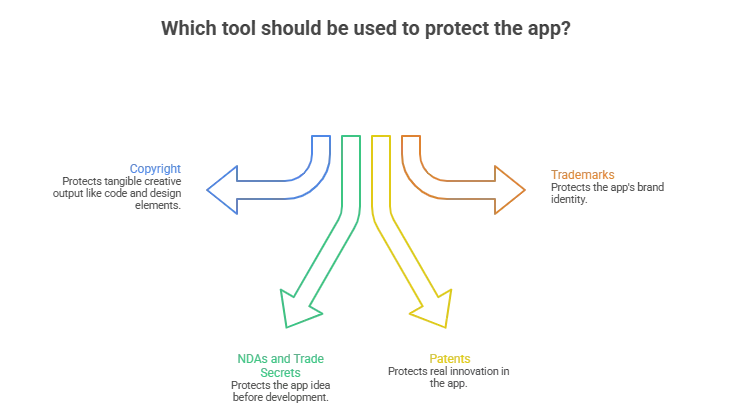
Let’s break down the actual protection methods founders use.
A. Copyright For Tangible Creative Output
The answer to “how do you copyright an app idea” is simple:
You can’t copyright the idea, but you can copyright the code, screens, illustrations, UX writing, and documentation once they exist.
Copyright protection begins automatically once something is created, but registering it gives legal proof and enforcement strength.
Use copyright when you have:
● Wireframes
● UI/UX assets
● Finished or partial code
● App content or logic documentation
This gives you legal ownership over the implementation of your idea.
B. NDAs and Trade Secrets: Protecting the Idea Before It’s Built
If you’re still in the early stage and wondering “how do you protect an idea for an app,” the strongest first step is using:
● Confidentiality agreements
● Non-Disclosure Agreements (NDAs)
● Restricted access to sensitive documents
NDAs don’t just threaten someone with consequences, they officially establish that:
● The idea belongs to you
● The information isn’t public
● It cannot be shared, reused, or repurposed
If you’re pitching investors, developers, or partners, NDAs should be mandatory before sharing anything detailed.
Think of NDAs as the insurance for the early stage.
C. Patents: Only if There’s Real Innovation
You should consider patents if your app includes:
● A unique technical method
● A proprietary data-processing approach
● A novel algorithm
● A new kind of interaction pattern
Patents take time (often 1–4 years) and money, so they’re only worth it if your innovation gives you a competitive advantage.
Don’t pursue patents just because you think it sounds official.
Learn about the criteria of getting a patient.
D. Trademarks: Protect the Brand
Trademarks protect:
● App name
● Logo
● Tagline
● Distinctive branding style
This prevents competitors from launching confusingly similar brands. If your app will scale or advertise publicly, trademarking early makes sense.
Too many founders worry about “how do you protect an idea for an app” while emailing the full concept to random freelancers. If you’re serious about protecting your concept while building it, Enacton can help.
With us:
● We sign NDAs before deep discussion
● You own 100% of the intellectual property
● We provide documentation needed for legal protection
● You get a working MVP ready for market testing and investor pitches
We’ve built 500+ software projects for 350+ clients across 65+ countries, including apps in finance, healthcare, marketplaces, AI, logistics, SaaS, and enterprise automation.
You’re not just getting a development team, you’re getting a partner who respects and protects your idea.
If you want execution without the fear of losing control, we should talk.
3. Step-By-Step Framework to Protect Your App Idea
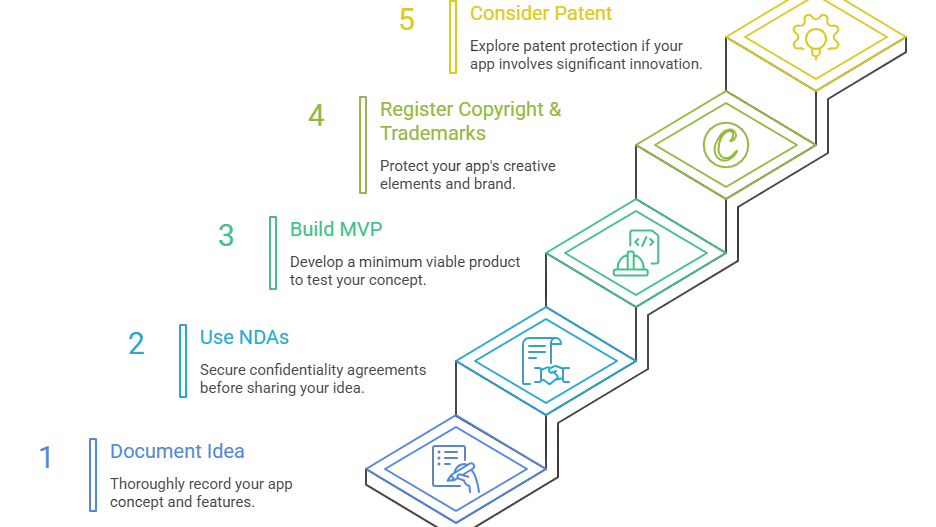
Let’s take everything above and turn it into a concrete sequence.
Step 1: Document Your Idea Thoroughly
Before you share with anyone, create:
● Feature list
● User flows
● Market positioning document
● Wireframes or prototype
● Technical reasoning if applicable
This documentation proves the idea originated from you.
Step 2: Use NDAs Before Sharing
Anyone who needs the full picture, developers, designers, potential co-founders, should sign an NDA.
This is the first real action that helps with “how do you protect an idea for an app.”
Step 3: Build the MVP
This is where copyright actually becomes relevant.
Once real assets exist, the question “how do you copyright an app idea” finally makes sense, because now there is something to copyright.
See how EnactOn helped BondMeds create a scalable Telehealth MVP
Step 4: Register Copyright and Trademarks
After branding and core assets are finalized, file:
● Copyright for code/documentation
● Trademark for name/logo
This prevents copycats from using identical branding or product material.
Step 5: Consider a Patent (Only If Valid)
At this stage, if your solution includes something technically unique, evaluate patent potential.
You can scroll forums and panic about someone copying you.
Or you can do the smart thing: execute with a trusted development partner.
With Enacton, you get:
● NDA-backed confidentiality
● Structured MVP development
● Clear ownership and handover
● Scalable product architecture
● Support from a team that’s shipped hundreds of products globally
We know how important your idea is, and we treat it like that.
If you’re ready to move beyond research and start building safely, get in touch now.
Final Thoughts
If you’re still repeating:
● “How do you protect an idea for an app?”
● “How do you copyright an app idea?”
Here’s the simplified rule:
● Protect when necessary.
● Build immediately.
● Document everything.
● Execute faster than anyone else.
● Ideas get stolen only when they sit still.
Execution makes them yours.
FAQs
1. Can I legally protect my app idea before it’s built?
You can’t legally protect a raw idea, but you can protect how it’s expressed through NDAs, documentation, prototypes, and later through copyright, trademark, or patents once assets exist.
2. How do I copyright an app idea in the early stage?
You can’t copyright an idea itself. Copyright protection applies once you create something tangible, like UI design, code, documentation, or content, and then optionally register it for stronger legal proof.
3. Should I file a patent for my app?
You should only consider a patent if your app includes a unique technical method, algorithm, or functional process. If it’s a standard marketplace, booking system, social platform, or messaging app, a patent likely isn’t applicable.
4. Do I need an NDA before talking to developers or investors?
Yes when sharing detailed logic, workflows, or sensitive information with developers or potential collaborators. For most early investor conversations, NDAs are optional, but for development discussions, an NDA is strongly recommended.
5. When should I register a trademark for my app?
Once you finalize the app name, logo, and core branding, ideally before public launch, trademarking helps prevent others from using a similar name or identity in the same market space.
Contact Us
Let’s Turn Your Idea Into Your Success Story

13+ years of Experience

65+ Countries

350+ Customers
