
TL;DR: LMS Development Cost (2026 Comprehensive Guide)
The Short Answer:
In 2026, building a custom LMS typically costs between $15,000 and $60,000 for most viable business use cases.
- Minimum Viable Product (MVP): $8,000 – $15,000 (Core features only).
- Professional/Scalable Platform: $20,000 – $45,000 (The “sweet spot” for most SMEs).
- Enterprise Ecosystem: $50,000 – $100,000+ (High security, AI, extensive integrations).
Why the variation?
Cost isn’t just about features; it’s about scalability (handling 100 vs 100,000 users), compliance (GDPR/HIPAA), and platform (Web vs. Mobile).
Top Recommendation:
Don’t build for “what if.” Build for “what now.” Start with a web-based MVP to validate your revenue model before investing in native mobile apps or AI.
LMS Development Cost: The Ultimate 2026 Breakdown
When businesses plan a Learning Management System (LMS), “How much will it cost?” is usually the first question. But the more important question is: “What am I actually paying for?”
An LMS is no longer just a place to watch videos. In 2026, it is a data-driven ecosystem. It requires security to protect user data, speed to stream high-definition content, and logic to issue certifications.
With the Global eLearning Market projected to reach $800 billion to $1 trillion by 2030, building a robust platform is an investment in a massively growing sector.
This guide goes beyond simple estimates to give you the complete context of LMS development costs, including the hidden factors most developers won’t tell you until after the contract is signed.
The “Build vs. Buy” Context: Do You Even Need to Build?
Before discussing development costs, it is critical to understand why you are building. This context dictates your budget.
| Comparison | SaaS (Subscription) | Custom Development |
| Examples | Teachable, Kajabi, Udemy Business | Built by EnactOn, Custom Agencies |
| Upfront Cost | Low ($0 – $500/mo) | High ($10k – $50k+) |
| Long-Term Cost | Very High (Transaction fees + rising tiers) | Low (You own the code; no revenue share) |
| Customization | Zero to Limited | 100% Control |
| Data Ownership | You rent the data | You own the data |
| Best For | Solopreneurs testing an idea | SMEs, Enterprises, and serious EdTech startups |
The Verdict: If you plan to scale beyond $50k/year in revenue or need specific internal workflows, custom development is actually cheaper in the long run because you eliminate transaction fees and user-cap limits.
Detailed LMS Development Cost Breakdown
1. Cost by Complexity & Business Stage
Your business stage defines your technical needs.
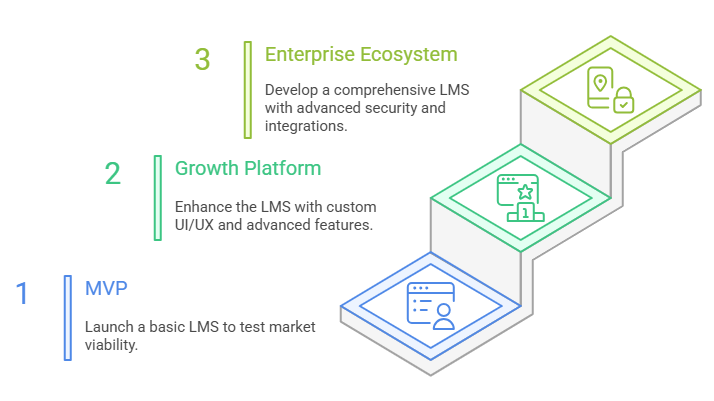
- The MVP (Minimum Viable Product) | $8,000 – $15,000
- Context: You need to prove people will buy your course or that employees will use the portal.
- Includes: User login, course player, simple admin panel, Stripe/PayPal integration.
- Excludes: Mobile apps, live streaming, AI, and complex gamification.
- The Growth Platform (Mid-Level) | $15,000 – $35,000
- Context: You have paying users or a strict compliance requirement. You need stability and branding.
- Includes: Custom UI/UX, quizzes, certificates, drip content, email automation, basic reporting.
- The Enterprise Ecosystem | $35,000 – $80,000+
- Context: You handle high volume (10k+ users), sensitive data, or need to integrate with legacy HR systems (SAP/Oracle).
- Includes: SSO (Single Sign-On), multi-tenancy (selling to B2B), AI recommendations, native mobile apps, advanced security (audit logs).
2. The “Hidden” Infrastructure Costs
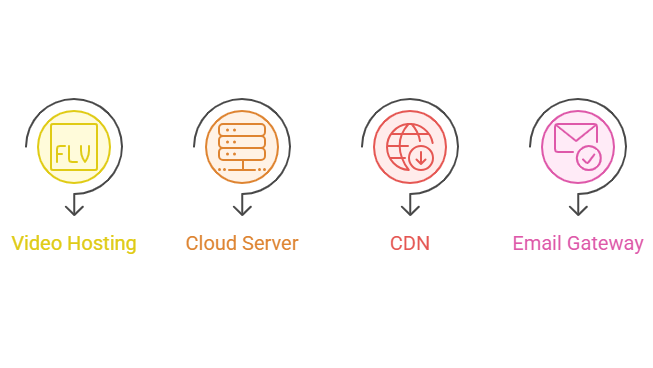
Most development quotes cover coding. They often exclude the infrastructure required to run the code.
| Infrastructure Item | Context | Estimated Cost |
| Video Hosting | Storing videos on the web server crashes it. You need specialized streaming (Vimeo, AWS, Cloudflare). | $50 – $500/mo |
| Cloud Server | AWS or DigitalOcean costs scale with traffic. | $50 – $300/mo |
| CDN (Content Delivery) | Ensures fast loading for users in different countries. | $20 – $100/mo |
| Email Gateway | Transactional emails (password resets, welcome emails) via SendGrid or SES. | $10 – $50/mo |
3. Regional Development Differences
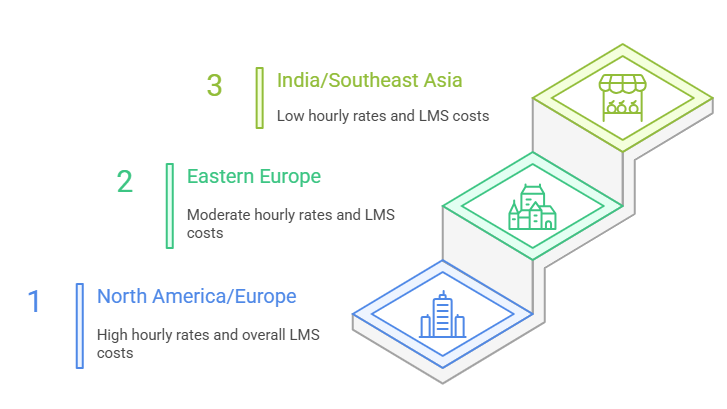
The location of your development team significantly impacts the budget.
- North America / Western Europe: $100 – $200 per hour. (LMS Cost: $60k – $150k)
- Eastern Europe: $40 – $80 per hour. (LMS Cost: $30k – $70k)
- India / Southeast Asia: $25 – $50 per hour. (LMS Cost: $10k – $40k)
- Context: A skilled team in India (like EnactOn) can often deliver Enterprise-grade quality at a fraction of the US cost due to the lower cost of living, not lower skill.
Technology Stack: How Code Choices Change Price
The programming language you choose affects not just the initial cost, but future maintenance.
- PHP (Laravel) / Node.js:
- Cost: Moderate.
- Pros: Huge developer pool, scalable, cost-effective hosting.
- Verdict: Best ROI for 90% of LMS projects.
- Python (Django/Flask):
- Cost: Moderate to High.
- Pros: Excellent if you plan to integrate heavy AI or Machine Learning later.
- Java / .NET:
- Cost: Very High.
- Pros: Enterprise standard for banking/government. Overkill for standard EdTech.
- CMS-Based (WordPress/LearnDash Customization):
- Cost: Low ($3k – $8k).
- Pros: Fast setup.
- Cons: Not recommended for serious platforms. It creates a “Frankenstein” system that breaks easily under load.
How to Manage the Budget (Don’t Spend It All at Once)
Feeling overwhelmed by the numbers? Don’t be. Smart companies rarely build the “Ferrari” version on Day 1.
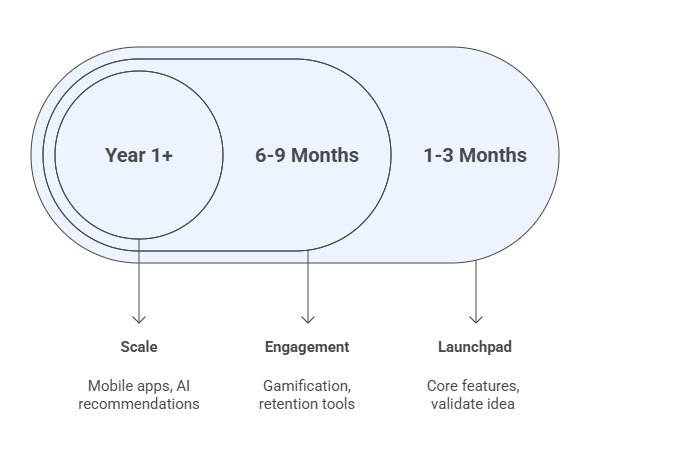
The best way to manage LMS development cost is the Phased Approach. This keeps your initial investment low and lets your revenue fund the future features.
Phase 1: The “Launchpad” (Months 1-3)
Goal: Get live, onboard users, start training/selling.
Cost: Low.
- Focus: Core features only (Login, Course Player, Simple Quiz, Payment).
- Why: You validate your idea without risking a large budget. You start generating ROI immediately.
Phase 2: The “Engagement” Layer (Months 6-9)
Goal: Increase retention and completion rates.
Cost: Funded by Phase 1 success.
- Focus: Gamification, certificates, community forums, drip content.
- Why: You invest only after you see users actually using the platform.
Phase 3: The “Scale” Layer (Year 1+)
Goal: Automation and expansion.
Cost: Funded by business growth.
- Focus: Mobile Apps, AI recommendations, complex integrations (SAP/Salesforce).
- Why: You are now optimizing a working, profitable machine.
Final Thoughts: Is the Cost Justified? (ROI Analysis)
If an LMS costs $25,000, is it expensive?
- Scenario A: You sell a $100 course. You need 250 sales to break even. If you own the code, every sale after that is 100% profit (minus hosting).
- Scenario B (SaaS): You use a platform taking 10% fees + $400/mo. Over 2 years, you might pay $30,000+ in fees and own nothing.
The Bottom Line:
LMS development cost is a capital expenditure (CapEx). It is an investment in an asset. If you are building a real business or a long-term corporate academy, the cost of not owning your platform is usually higher.
Ready to get a precise number?
Generalized articles can only guess. At EnactOn, we can look at your specific feature list and tell you exactly where you can save money and where you must invest.
👉 [Get a Custom LMS Quote Today]
Frequently Asked Questions (Deep Dive)
Why is there such a huge gap between $8,000 and $80,000?
Think of it like building a house. An $8,000 LMS is a pre-fab cabin: functional, quick, but hard to expand. An $80,000 LMS is a custom-designed office building: built for high traffic, with custom security, elevators (integrations), and specialized rooms (features).
Can I start cheap and upgrade later?
Yes, if you build on a scalable stack (like Laravel or Node.js). If you build on a cheap “no-code” builder or a WordPress plugin, you will likely have to throw it away and rebuild from scratch when you grow. We recommend building a “Modular MVP”—solid code, but fewer features.
What is the biggest “money pit” in LMS development?
Scope Creep. This happens when you keep adding small features (“Can we just add a forum?”, “Can we just add gamification?”) during development. This delays the launch and explodes the budget. Freeze your scope, launch, then iterate.
Do I need a native mobile app (iOS/Android)?
Probably not for Version 1. A “Mobile Responsive” web app works perfectly on phones. Native apps add $10k-$20k to the cost and require constant updates for Apple/Google compliance. Build an app only when your users demand offline access.
How do I ensure my LMS code is secure?
Security adds to the cost but is non-negotiable. With GDPR fines reaching record highs, cheap security is a liability. Ensure your quote includes SQL Injection protection, XSS prevention, Data Encryption (at rest and in transit), and regular backups. Cheap developers often skip these steps.
Contact Us
Choose from our highly qualified talent pool!

11+ years of Experience

62+ Countries

320+ Customers
