
Almost every phone today is packed with free apps. Social media. Fitness. Photo editing. Note-taking. Games. Navigation. You download them, use them daily, and never pull out your credit card. That leads to a very common question people ask, and rightfully so: how do apps make money if they are free?
The short answer is that “free” rarely means charity. Building and running an app costs money. Servers, developers, designers, support, updates, marketing. None of that is cheap. So if you are not paying directly, you are paying in some other way. Sometimes with attention. Sometimes with data. Sometimes with upgrades. Let’s break it down properly.
8 Ways Free Apps Make Money
Before understanding how apps earn, you need to understand one thing clearly. An app is not a one-time project. It is an ongoing business.
Even a simple app needs:
Development and maintenance
Cloud hosting and storage
Bug fixes and security updates
Customer support
Marketing and user acquisition
So the real question is: where does the revenue come from without charging users upfront?
Here are the real answers.
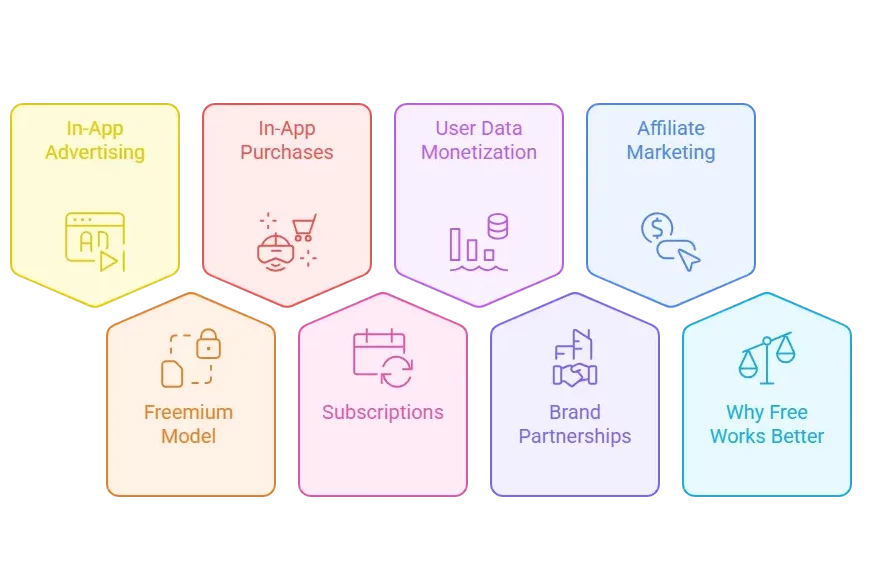
In-App Advertising Is the Most Common Model
This is the oldest and most obvious method. You use the app for free, and in return, you see ads. Banner ads. Video ads. Sponsored posts. Story ads. Native ads that blend into content.
Social media apps, news apps, free games, and utility apps rely heavily on this. The more time you spend, the more ads you see. The more ads you see, the more the app earns.
This works because attention has value. Advertisers pay apps to put their products in front of users. If an app has millions of users and high engagement, advertising alone can generate massive revenue.
This is one of the clearest answers for making revenue from free apps, especially for apps with large audiences.
Freemium Model Converts Free Users Into Paying Customers
Many apps follow a freemium model. You get basic features for free, but advanced features are locked behind a paywall.
You can use the app. You get value. But at some point, you hit a limitation. Maybe you cannot export files. Maybe there is a watermark. Maybe features are restricted. That is where paid plans come in.
Only a small percentage of users actually pay, but that is enough. Even if 2–5 percent of users upgrade, the numbers work at scale.
This model answers how do apps make money if they are free by saying: most users stay free, a few users fund the business.
In-App Purchases Drive Huge Revenue
This is especially common in mobile games and content apps. The app itself is free, but users can buy extras inside the app.
Examples include:
Extra lives or power-ups in games
Coins, gems, or boosters
Premium filters or effects
Exclusive content
People underestimate how powerful this model is. Small purchases add up fast when millions of users are involved. Some users spend nothing. Some spend a lot. The app is designed to encourage spending without forcing it.
In-app purchases are often the hidden engine behind the scenes.
Subscriptions Create Predictable Income
Subscriptions are now everywhere. Monthly or yearly plans that unlock full access.
Music apps. Video platforms. Productivity tools. Fitness apps. Meditation apps. They all rely on recurring payments.
The app is free to download and try. You get hooked. You build a habit. Then the subscription feels worth it.
From a business perspective, subscriptions are powerful because they provide steady income. From a user perspective, it feels optional and flexible.
The free version is the entry point, not the end goal.
Learn about different types of subscription models here
User Data Is Often Monetized Indirectly
This part makes people uncomfortable, but it is real.
Many free apps collect user data. Not in a shady movie-villain way, but through usage patterns, interests, location data, and behavior. This data helps improve ads, personalize experiences, and sometimes gets shared with partners in aggregated forms.
The app may not sell your personal identity, but insights are valuable. Advertisers want targeting. Businesses want analytics. Data fuels those systems.
This is a less visible answer to how do apps make money if they are free, but it plays a major role, especially in social and utility apps.
Brand Partnerships and Sponsored Content
Some apps collaborate directly with brands. Instead of traditional ads, they integrate promotions into content.
Examples include:
Sponsored challenges in fitness apps
Featured products in shopping apps
Branded filters or effects
Sponsored playlists or recommendations
This feels more natural than ads and often performs better. Brands pay for exposure, and users get free access.
Affiliate Marketing Inside Apps
Many apps earn commissions by recommending products or services. If a user clicks a link and makes a purchase, the app gets paid.
This is common in:
Deal and coupon apps
Travel booking apps
Cashback platforms
Finance comparison tools
Users think they are just browsing or saving money. Behind the scenes, the app is earning a percentage.
This model shows revenue opportunity by tying revenue to user actions, not subscriptions.
Learn why affiliate marketing is the best way to start a business here.
Why Free Works Better Than Paid Downloads
People are far more likely to download a free app than a paid one. Free removes friction. It increases adoption. It helps apps grow faster.
Once users are inside the ecosystem, monetization options open up. Ads. Upgrades. Purchases. Partnerships.
That is why most apps choose free entry. The real business starts after installation.
The Real Trade-Off of Free Apps

Nothing is truly free. You either pay with money, time, attention, or data.
Understanding this helps users make better choices. It also helps founders design smarter products.
If you are building an app, the lesson is simple. Do not obsess over charging upfront. Focus on value first. Monetization comes later, in smarter ways.
Final Thoughts
So, to answer how do apps make money if they are free? Through advertising, subscriptions, in-app purchases, data insights, partnerships, and affiliate revenue. Often through a mix of several models, not just one.
Free apps succeed because they reduce barriers and scale fast. The best ones respect users, offer real value, and monetize intelligently.
If you understand this, you stop seeing free apps as magic. You start seeing them as well-designed businesses.
And that mindset shift matters whether you are a user, a builder, or someone planning their own app.
If you want a free app that scales and monetizes without feeling spammy, EnactOn can build it with the right model baked in from day one. We have delivered 500+ projects for 350+ clients across 65+ countries, and we focus on clean UX, solid architecture, and revenue flows that fit your product.
👉 Check our mobile app development services now
FAQs
1) How do apps make money if they are free?
Most free apps earn through ads, subscriptions, in-app purchases, affiliate commissions, and brand partnerships. The “free” version is usually meant to attract users first, then monetize through these channels.
2) Do free apps sell my personal data
Some free apps share user data in aggregated or anonymized ways or use it to improve ad targeting. Not every app “sells your data,” but many do collect behavior and usage information to support revenue.
3) Which monetization model is best for a free app?
There’s no single best model. If your app has high daily usage, ads can work. If you offer strong premium features, freemium or subscriptions win. If it’s a game, in-app purchases often dominate.
4) Why do free apps push subscriptions so much?
Subscriptions create predictable monthly revenue, which helps apps pay for servers, updates, support, and growth. That stability is why you see “upgrade” prompts everywhere.
5) How can I tell what a free app is using to make money?
Check the app’s store listing (in-app purchases, subscriptions), look for ads inside the app, and read the privacy policy to see what data is collected and how it’s used. If the app is “too free,” it’s monetizing something.
Contact Us
Let’s Turn Your Idea Into Your Success Story

12+ years of Experience

65+ Countries

350+ Customers
